
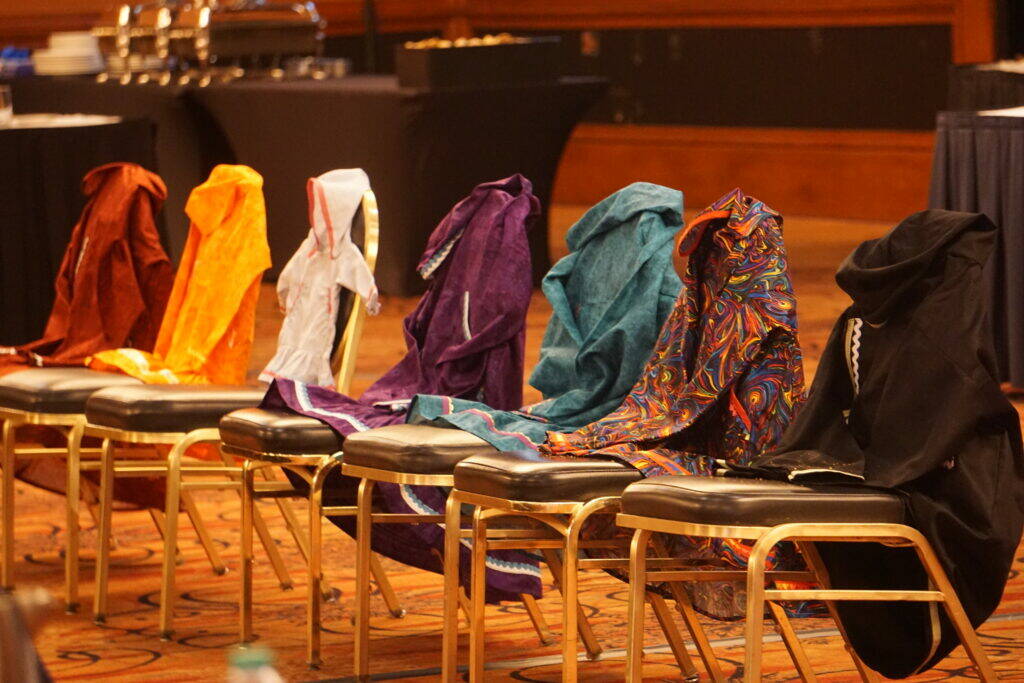
At a legislative hearing that reviewed grim statistics about the dangers facing Alaska Native women and girls, Indigenous activists presented recommendations for better state responses.
Those dangers can be addressed through the state budget and through other practical actions, activists said Wednesday in testimony to the House Tribal Affairs Special Committee.
Before detailing their policy recommendations, members of the Missing and Murdered Indigenous Women and Girls and Two-Spirit Alaska Working Group presented the statistics about deaths and violence.
“We do this work for the thousands of Alaska Native women and girls and their family members who have gone missing or have been murdered,” said Emily Edenshaw, president of the Alaska Native Heritage Center, one of the organizations that helped create the working group in 2018.
She is among the affected family members.
“One of our Yup’ik values is to show up as our true selves, to be our whole selves in every space alongside our community, to live in truth. And my truth is that my mother was murdered in 2020 and her killer is still out there today, walking free. Unfortunately, her story and mine are not unique,” she said.
The working group, which was formed in 2018, is trying to fill in some incomplete statistics, but those gathered up to now are distressing, said Debra Dzijúksuk O’Gara, an attorney, professor and tribal judge.
Among the statistics O’Gara presented: 80% of Alaska Native women will experience violence at some point in their lives, nearly 56% of Alaska’s sexual assault victims are Native and Alaska Native people are victims of homicide at twice the rate of the state average.
Members of the working group presented several recommendations, some concerning state budgeting for enhanced safety and some concerning new policies or approaches that might not cost much money but could help communities and agencies better respond to problems.
Recommended budget items included funding for more people in state law-enforcement agencies devoted to working on the missing and murdered Indigenous cases. The two investigators assigned to the Missing and Murdered Indigenous People cases are “doing some really great work, but we need to have a partner with them in the Department of Law specific to MMIP,” said Kendra Kloster, co-director for law and policy at the Alaska Native Women’s Resource Center, another organization that is part of the working group. Cases being resolved by the investigators face a risk of being “stuck in a backlog of cases,” she said. Additionally, the investigative team could use more members. She lauded the work of the two investigators. “But there are so many cases that they could use additional support,” she said.
Also on the list of recommended budget items was funding for some practical tools to be used at the local level – including grants for tribal governments, more support for the Village Public Safety Officer program and funding to update an outdated 911 emergency calling system.
The 911 system deficiency is widespread, she said. “This is really important, as there’s many communities across Alaska that if you call 911, you’re going to get rerouted into a different community,” she said.
In some places, callers have to use an 800 number to access the 911 system, she said. And in much of Alaska outside of Anchorage and the bigger cities, the system cannot track the location of calls, she said.
As for policy changes, recommendations include required training from Indigenous-led organizations for public safety officials; better reviews of deaths, law enforcement investigations and ensuing prosecutions; better interagency cooperation; and establishment of an annual grant program to tribes that is noncompetitive.
The changes would make improvements that are desperately needed, O’Gara said.
“Every single Alaskan, and I’ll just add, every single Indigenous person in this state has the right to be safe in their home and free from violence. And that is not the case,” she said.
• Yereth Rosen came to Alaska in 1987 to work for the Anchorage Times. She has been reporting on Alaska news ever since, covering stories ranging from oil spills to sled-dog races. She has reported for Reuters, for the Alaska Dispatch News, for Arctic Today and for other organizations. This article originally appeared online at alaskabeacon.com. Alaska Beacon, an affiliate of States Newsroom, is an independent, nonpartisan news organization focused on connecting Alaskans to their state government.
