
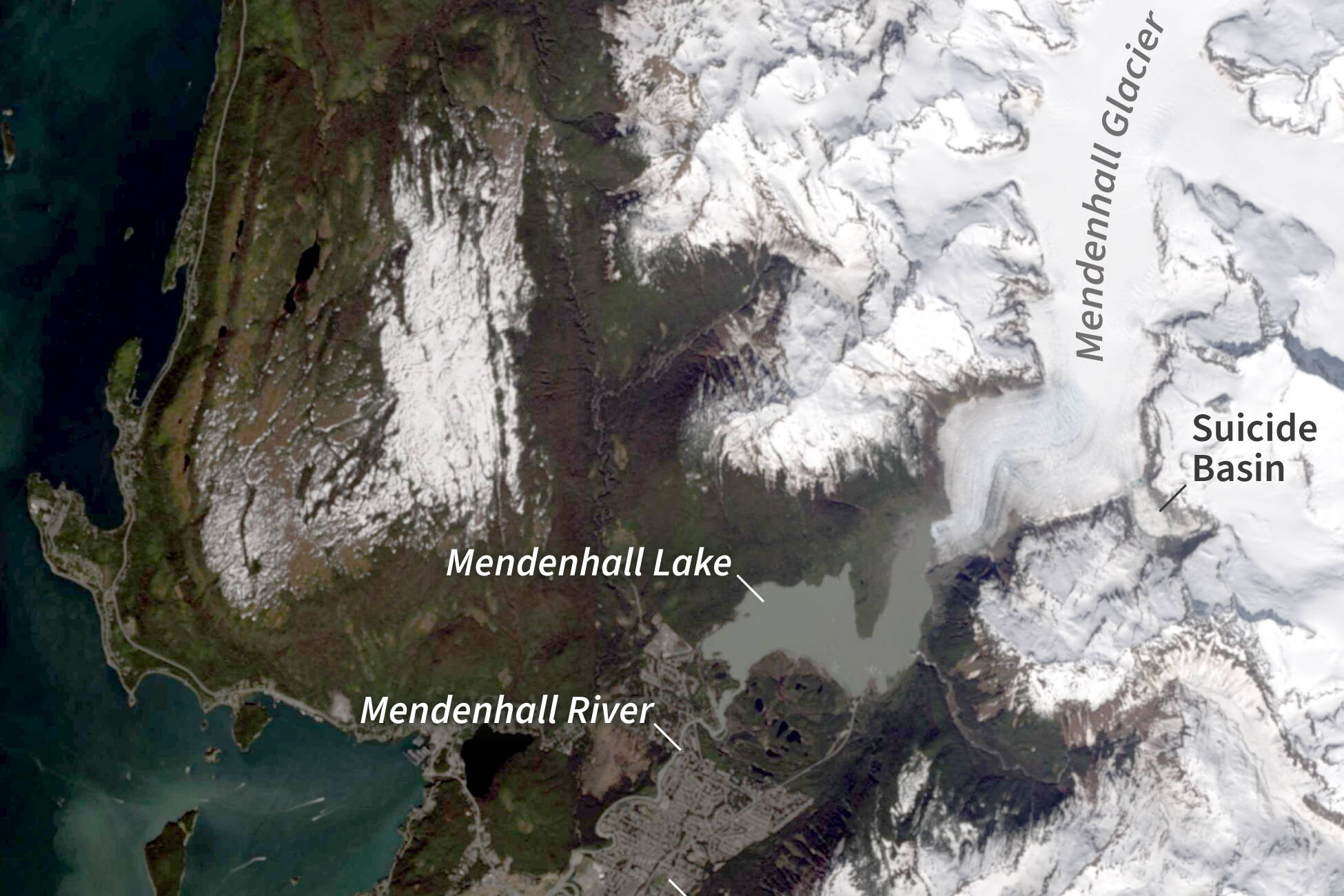
When it comes to trying to prevent a reoccurrence of this month’s record flooding from Suicide Basin, Juneau’s leaders are willing to evaluate every possible option that comes their way.
“Try not to laugh because people legitimately have asked this question…could you bomb the glacier?” City Manager Rorie Watt told the City and Borough of Juneau Assembly Committee of the Whole during a Monday night meeting that invited a panel of guests to explain the science of a jökulhlaup. “You could. I don’t know if you could ever get permitted to do it. I don’t know that you could ever predict what would happen. I don’t know that you would even know where to get a bomb or how to detonate it.”
The flooding in early August from the glacier dam high above the face of the Mendenhall Glacier — which since 2011 has occurred in an annual cycle — destroyed or damaged dozens of homes, plus other property and infrastructure. The incident was declared a state disaster and officials with the Federal Emergency Management Agency arrived in Juneau last week to assess if the area qualifies for federal disaster relief.
So while the question about bombing a portion of the glacier to prevent such flooding might be amusing to many people, Watt said some people victimized by the flood are seeking reassurance that officials are considering every preventative action possible.
“People lost incredible value and sense of peace,” he said. “And what they want us to do is ask these questions.”
Another possibility raised by someone was siphoning the water out of the basin so it doesn’t accumulate to dangerous levels, Watt said. He said such an action can be as scientifically simple as sucking water through a hose, except the amount of water involved in the Aug. 5 flood — 14 billion gallons — would make it “extremely dangerous and extremely complicated.”
Similarly, trying to drill a tunnel under the lake would be complex, plus there could be numerous other areas of the glacier where such flooding might become a possibility.
“So I don’t think on a practical level we can do anything about this other than try to map it, try to understand it, try to communicate,” Watt said.
Part of the complexity is due to the regulatory process since the glacier is on federal land, Watt said, noting U.S. Forest Service officials have taken several years to evaluate and have yet to approve a “modest” renovation of the Mendenhall Glacier Recreation Area.
“It’s taken them seven years to decide it would be OK for the natural environment to expand a parking lot by 20% or 50%,” he said.
Watt’s assessment followed an overview by a trio of experts about the history and possible future of Suicide Basin and other glacier areas that may pose a flood risk. One of them, Eran Hood, a professor of environmental science at the University of Alaska Southeast, said he agreed the options discussed by Watt were impractical and the more feasible option is preventing damage from such flooding downstream.
“There’s no way you’re going to build a siphon system that’s going to outpace that, and bombs definitely won’t work and would be really hard to get permitted,” Hood said. “So there’s no real obvious mitigation strategy, and there’s nowhere I’ve ever seen where they’ve dealt with something on this scale and were able to mitigate it beyond when you talk about downstream stopping water from coming into neighborhoods and armoring banks, which is a totally different discussion.”
Getting more specific expert advice about riverbank options — noting those at Monday’s meeting were primarily experts about glaciers — was raised by Assembly member Wade Bryson, who noted glacier outburst flooding has been a problem for many decades, including one in the late 1950s or early 1960s that resulted in about a dozen cars being placed along Riverside Drive next to the river as a block — known as “junk car bend” against future flooding.
“Juneau has been doing things to the river for at least 70 years to deal with these glacial outbursts,” Byrson said. “So can we get one of those guys or one of those scientists to come in and say ‘Here’s how your river is going to perform the best for the situation that you have’ as we’re trying to come up with real solutions, because out of all the things that I’ve heard the river action is going to be the one thing that could maybe be realistic.”
Watt said a large-scale solution such as “armoring” the entire riverbank with rocks or other protective fill — compared to smaller-scale protective efforts currently being done by individual property owners trying to save their homes — would be expensive (offering a ballpark estimate of $100 million), possibly difficult to obtain permitting for and raise tricky questions about ownership.
“The upshot of that is CBJ would own and maintain those improvements, not the homeowners,” he said. “So the only entity who could step in with that level of funding — not to say that they would — would be the federal government and then that would become a piece of municipal infrastructure.”
But Assembly member Michelle Bonnet Hale, noting she lives a block away from the river that flooded, said she’s seeing promising results from the individual restoration efforts the past few weeks.
“From my point of view an astonishing amount of work has gone in on both sides of the river, and some incredible work by the contractors and by the homeowners in actually armoring those banks,” she said.
Hale said getting a visual overview of riverbanks that have been armored may help the Assembly when considering future options. Among the other options discussed during the meeting she said seem most practical are maps showing areas at risk of being inundated by future flooding.
“I am looking around my house right now and trying to figure out how fast I could move stuff three feet up off the floor,” she said. “So I think it’s going to be really important for the peace of mind of many, many, many homeowners in the Mendenhall Valley that we have some better idea of whether we are going to be at risk and how much lead time will we need, or do I just need to start moving stuff up off the floor now in preparation for next summer?”
• Contact Mark Sabbatini at mark.sabbatini@juneauempire.com or (907) 957-2306.
