
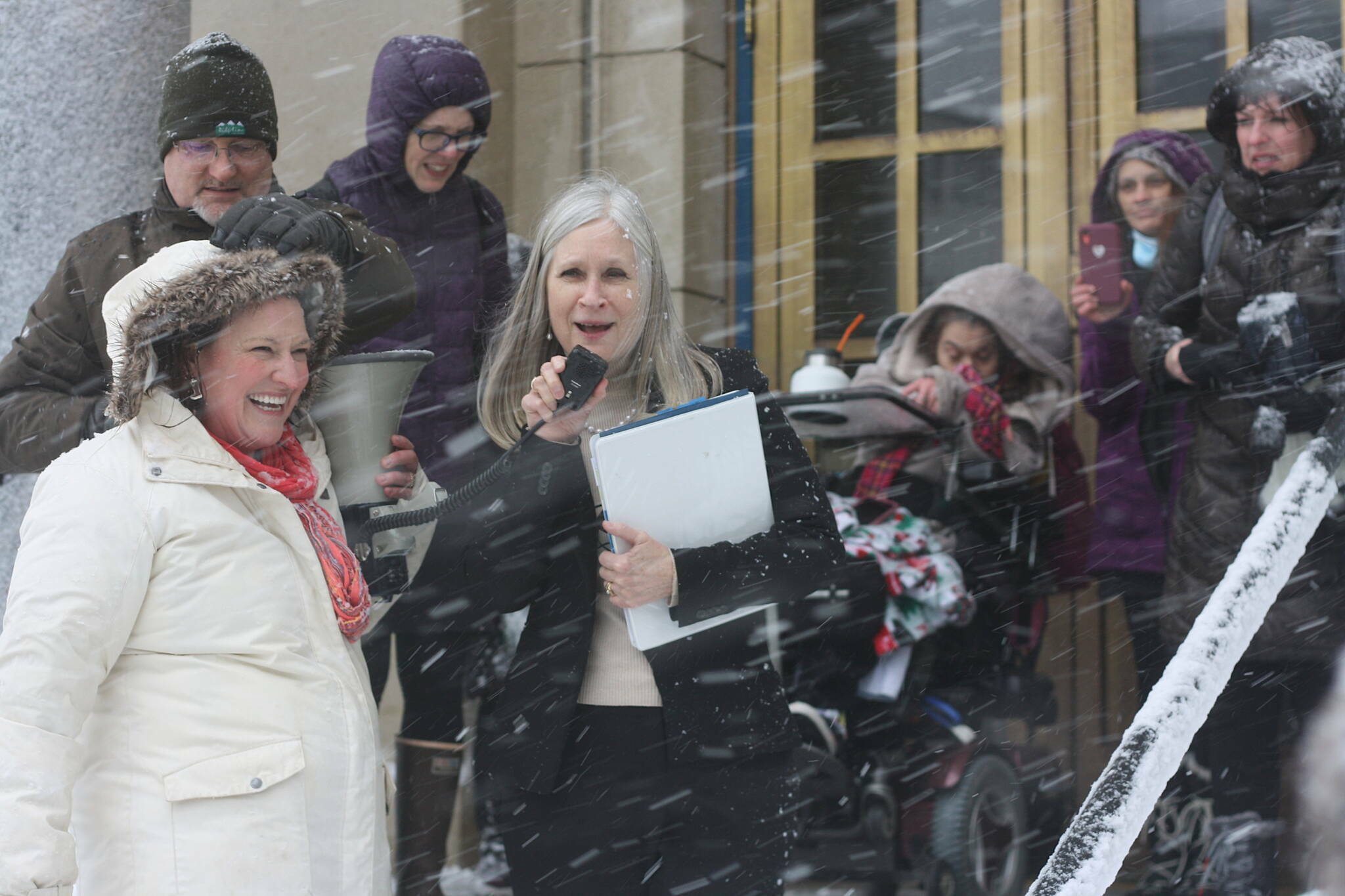
This story has been updated to correct a reference to a dock associated with the death of Anna Foltz.
Two bills by Juneau state Rep. Andi Story — one adding more Indigenous languages to the state’s official list, the other implementing new safety requirements at municipal floating docks and expanding eligibility for state disaster assistance — have become law during the past week.
Both bills became law without Gov. Mike Dunleavy’s signature during a span when he acted on a range of high-profile legislation including signing a bill requiring schools to be stocked with anti-overdose kits, and vetoing bills easing access to contraception and establishing guidelines related to productivity quotas for warehouse workers.
The most immediately relevant bill of Story’s for Juneau residents is House Bill 345, which originated as an effort to prevent drowning accidents by mandating safety ladders at municipal floating docks that receive harbor facility grants. The bill passed on the final day of the session after adding part of a disaster-recovery measure by state Sen. Jesse Kiehl, a Juneau Democrat, allowing condominium owners to use state disaster aid for collectively owned property such as the foundation of a shared building.
Story, a Democrat, said in a press release Thursday her bill was initiated when local business owner Scott Jensen approached her following the death of an employee, Anna Foltz, during an incident where she was unable to return to a dock.
“I view this legislation as ‘Anna’s Safety Ladders bill,’ dedicated to her memory,” Story said. “This new law is about saving lives. By making deeper water safer with the installation of safety ladders, we are taking a proactive approach to protecting our communities. We all know the water safety saying, ‘Kids Don’t Float,’ but now we can add, ‘and look for the safety ladders.’”
The release states Alaska has the highest rate of drowning deaths in the nation.
“Without proper ladders, retrieving oneself from the water can be nearly impossible due to wave action, heavy clothing, and the risk of hypothermia,” the release adds. “The addition of safety ladders, which are both inexpensive and straightforward to install, will provide a crucial means of escape and significantly reduce the likelihood of drowning.”
Kiehl introduced a disaster assistance bill during the past legislative session that, in addition to expanded eligibility, sought to raise the cap on state assistance to $50,000 (rather than the current $22,000) or half of the maximum the Federal Emergency Management Agency pays in a federal disaster, whichever is greater. The bill, spurred by last year’s record flooding from Suicide Basin (where an even more severe release of water occurred a month ago), failed to get past the House after passing the Senate unanimously.
The senator, after Story’s bill passed at the end of the session, said the eligibility provision added to her legislation was the most important aspect due to condo and other property owners being denied assistance for common buildings after last year’s flood.
Expanding the state’s official language list
Added to Alaska’s official languages with Story’s bill becoming law are Cup’ig and Wetał (Ts’etsa’ut), while the existing Tanana language is divided into the Benhti Kokhwt’ana Kenaga’ (Lower Tanana) and Sahcheeg xut’een xneege’ (Middle Tanana) languages. The state now has 23 official languages.
House Bill 26 passed the House by a 37-1 vote in the House near the end of last year’s session, with the Senate unanimously passing it in May of this year. The bill also changes the Alaska Native Language Preservation and Advisory Council (ANLPAC) to the “Council for Alaska Native Languages” and expands the five-member council by two members.
While there are few current fluent speakers of languages added in the bill, support for the legislation as a way of preserving and restoring such “overlooked” languages was expressed in a letter by the Alaska Regional Coalition, a consortium representing five Alaska Native regional tribal entities in 100 communities.
“By (passing the bill), the State of Alaska is demonstrating its commitment to preserving the cultural heritage of its Indigenous peoples and ensuring that future generations have the opportunity to learn and use these languages,” the letter states.
• Contact Mark Sabbatini at mark.sabbatini@juneauempire.com or (907) 957-2306.
