
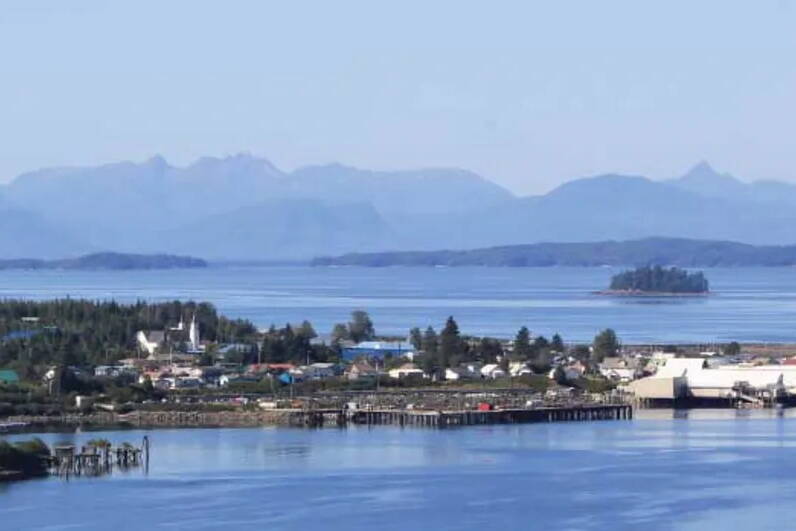
The Biden administration could jump into a high-profile lawsuit involving a Southeast Alaska Native community that’s fighting with GOP Gov. Mike Dunleavy’s administration about its fishing rights.
The U.S. Department of Justice said in a filing late Tuesday that it’s considering submitting a friend-of-the-court brief in the dispute between the state and the Metlakatla Indian Community, a tribal government.
The three-year-old Metlakatla lawsuit, filed by the tribal government against Dunleavy’s administration, centers on the extent of fishing rights granted to the community’s members.
The Justice Department didn’t say which side it would take in the suit.
But the Biden administration has already filed a lawsuit against the state that it says is aimed at protecting the rights of rural subsistence fishermen in Southwest Alaska. And its filing Tuesday describes the federal government as having a stake in the Metlakatla lawsuit because it is the “trustee of the community’s federally reserved tribal fishing rights, with a general trust responsibility to preserve and protect those rights.”
A Justice Department spokesman, Matthew Nies, declined to comment, as did a spokeswoman for the U.S. Department of the Interior, whose attorneys also are named on the Biden administration’s filing.
Metlakatla, at the southern end of Alaska’s panhandle, is the only Indian reservation in the state. It was established by a congressional bill in 1891, after Indigenous Tsimshian people from British Columbia resettled there at the invitation of President Grover Cleveland.
In 1916, an executive proclamation by President Woodrow Wilson declared that the reservation extends 3,000 feet from the shoreline and gave Metlakatlans exclusive rights to the fish there.
The question in the lawsuit is whether Metlakatlans can also fish outside the 3,000-foot limit without being subject to the state of Alaska’s “limited entry” program, which requires commercial fishermen to have state-issued permits. In 2020, “in response to Alaska’s attempt to subject the Metlakatlans to its limited entry program,” the community sued the state in federal court, according to findings by a federal appeals panel.
After Alaska-based U.S. District Court Judge John Sedwick ruled for the state, the Metlakatla Indian Community appealed.
A panel from the Ninth Circuit Court of Appeals sided with the community last year and reaffirmed its decision in February. It said the 1891 congressional bill gave the community’s fishermen non-exclusive rights to fish outside the limit without state permits, in “waters where they have traditionally fished.”
The case has now been returned to the lower court to decide precisely which areas those traditional fishing grounds include.
The Biden administration’s five-page filing this week asks U.S. District Court Judge Sharon Gleason, who’s taken over the case from Sedwick, to give the federal government until Jan. 12 to decide whether to participate as an “amicus curiae,” or friend of the court. The process for that decision, the filing said, was “recently initiated” and “involves multiple levels of review.”
Metlakatla’s mayor, Albert Smith, said he welcomes the federal government’s involvement, adding that the case is about preserving Metlakatla’s identity as a fishing community.
Other rural, Indigenous communities that lack their own fishing rights have seen sharp declines in permit ownership and participation under the limited entry system.
But Metlakatla’s fishing traditions, buoyed by the congressionally authorized tribal fishing rights, have thrived.
“It’s been a long time coming with the feds coming in,” Smith said. “I wish it could have been a little sooner, but they’re stepping in now, and we’re grateful and optimistic.”
A spokeswoman for the Alaska Department of Law declined to immediately comment on the case.
If the Biden administration submits a brief on Metlakatla’s behalf, it would be the second time in just over a year that the federal government has challenged the state on behalf of rural fishermen.
The Biden administration last year sued the state over who has the authority to manage salmon harvests on Southwest Alaska’s Kuskokwim River. Dozens of villages along that river depend on salmon fish to feed their families, in a remote region where groceries are expensive.
Amid record low salmon runs, the federal government said only local rural residents could harvest salmon along a 180-mile stretch of the river inside a federal wildlife refuge. At the same time, the state issued its own orders that allowed subsistence harvests in the same area by all Alaskans, not just rural residents.
The dispute centers on competing interpretations of the landmark Alaska National Interest Lands Conservation Act, which Congress passed in 1980.
The Biden administration and the Alaska Federation of Natives, or AFN, argue that under that act, the federal government maintains the authority to manage fisheries in the contested stretch of the Kuskokwim.
The case has become a major source of tension between the Dunleavy administration and tribal groups, and AFN has intervened in the lawsuit on the federal government’s behalf.
AFN is closely watching the Metlakatla case and the potential for the Biden administration’s participation, according to Nicole Borromeo, its in-house attorney.
“We’re reviewing the filings, and taking a very keen interest in how DOJ proceeds,” she said.
Fishermen from outside of the reservation, who are subject to the state’s commercial permitting program, are also closely following the case, said Justin Peeler, a board member of the Southeast Alaska Seiners Association, a major trade group.
“It could drastically affect the fishing industry,” Peeler said. Everyone with a Southeast Alaska fishing permit, he added, “should be watching this very carefully.”
• Nathaniel Herz is a freelance reporter who’s spent a decade as a journalist in Alaska, including stints at the Anchorage Daily News and Alaska Public Media. This article first published in his newsletter, Northern Journal, at natherz.substack.com, is republished through an agreement with the Alaska Beacon.
