
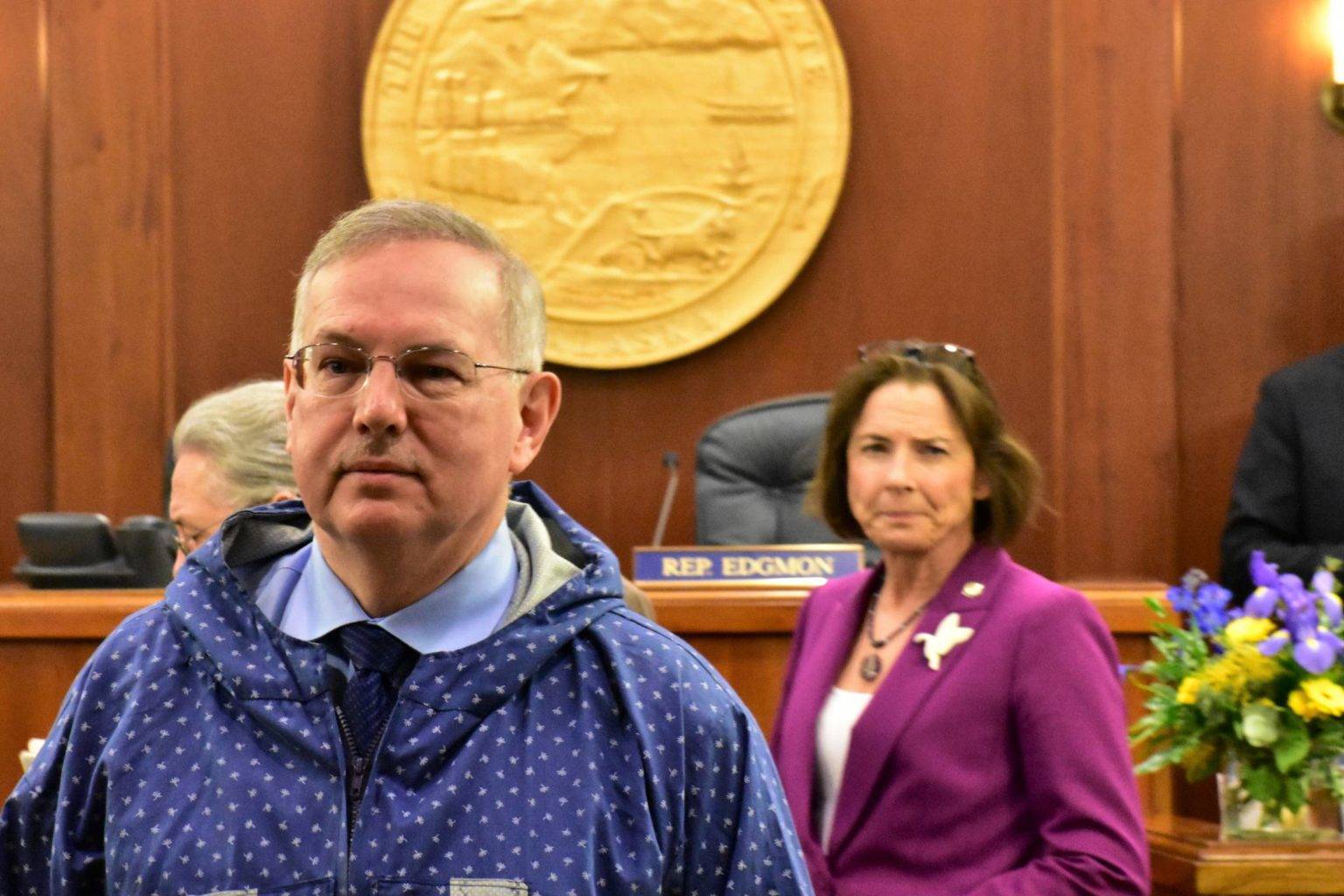
In his speech to the Alaska Federation of Natives Annual Convention Thursday, state House Speaker Bryce Edgmon, I-Dillingham, highlighted gains Alaska Natives had made in state government and urged continued participation in the political process.
Speaking to the convention virtually, Edgmon, the first Alaska Native House Speaker, began by stressing the importance of individuals working together to contain the spread of COVID-19.
“I think of the spring whale hunt,” he said, “where everybody collectively puts a hand on the rope to pull the whale ashore.”
The pandemic is personal to many Alaska Natives, Edgmon said during his keynote speech. He said many remember the painful history of the 1918 Spanish Flu. According to a report from the Alaska Division of Public Health, Alaska Natives accounted for roughly 82% of influenza deaths at a time when they made up 48% of the state’s population.
He thanked Gov. Mike Dunleavy and Chief Medical Officer Dr. Anne Zink for stepping up in a time of need, and Dunleavy Chief of Staff Ben Stevens for working to ensure a fishing season still occurred this year.
Acknowledging the difficult economic situation in the state, Edgmon said recovery here had been decent and not as bad as first predicted.
“This is not 1986 all over again,” he said. “We’re getting our way through the storm, preparing for the winter and what 2021 will bring.”
With both the pandemic and the state’s budget, Edgmon stressed the importance of working together. He spoke about his youth in rural Alaska, being deeply affected by the physical environment and his many years in state politics learning from Alaska Native politicians who came before him.
“I have to say, through it all, our great state remains an enigma to me,” he said. “As we all know we are the biggest state, but at the same time we’re the smallest state where everyone seems to know each other.”
[Elected officials urge census response ahead of deadline]
Edgmon said that as Speaker of the House he wanted to increase the presence of Alaska Natives in the Legislature. He cited the creation of the House Tribal Affairs Committee, the first in state history, as a significant achievement of his tenure.
“A committee that’s been very busy the last couple of years, unraveling the mystery of what Alaska tribes are,” he said.
Edgmon cited a bill which would have the state formally recognize tribal sovereignty, a bill which passed the state House and would have been signed by the governor, he said, if the COVID-19 pandemic had not forced an early end to the legislative session.
Looking ahead to next year’s session and the projected budget, the state is now at a point where it needs to settle the question of how much goes to services, and how much to the Permanent Fund Dividend.
“We have arrived at the proverbial crossroads,” he said.
But he was concerned about how some in the state government might approach that.
Edgmon didn’t mention any names, but he said that in his years at the Alaska State Capitol as both staff member and lawmaker he had met people in and around state politics whom he feels don’t understand Alaska.
“There are those who still don’t grasp the characteristics or the nuances of our state,” he said. “Who don’t understand that Alaska’s first people are the backbone of the state, and have been for many years. A lot of people come and go, but we’re here for the long run.”
Edgmon cited his leadership of a bipartisan coalition in the House and work with Senate President Cathy Giessel, R-Anchorage, as evidence of Alaskans being able to work together for the benefit of the state. Giessel and several other prominent Republicans lost their primary elections to challengers frustrated with the bipartisan, majority caucus.
“You might see a leadership that’s going to take a one-dimensional approach” to balancing services and the amount of state funding that goes to the PFD.
Edgmon said lawmakers who cut too deeply may regret those decisions and have to reverse those decisions later.
“We’re going to have to make measured choices about how to right-size government,” he said. “And speaking of the PFD dilemma, I invite Governor Dunleavy and his administration into this conversation.”
There were several times, he said, when he and Giessel together recalled the words of the late U.S. Sen. Ted Stevens, “to hell with politics, it’s time to do what’s best for Alaska.”
• Contact reporter Peter Segall at psegall@juneauempire.com. Follow him on Twitter at @SegallJnuEmpire.
