
A Ketchikan man agreed to plead guilty this month to federal charges in conjunction with a long-running scheme to sell fake Alaska Native souvenirs manufactured in the Philippines.
Travis Lee Macaset’s plea deal follows several other guilty pleas this summer that stem from a scheme to sell mislabeled products from two businesses in Ketchikan.
“It occurs more often than we would like,” said Jack Schmidt, the assistant U.S. Attorney who prosecuted the cases.
With tourism rebounding from the COVID-19 pandemic, so is the market for souvenirs. In the shops along the Southeast Alaska waterfront, authentic Alaska-made items sell for many times the cost of mass-manufactured ones created overseas, and the threat of fake products appears to be growing.
“The temptation is always there,” Schmidt said.
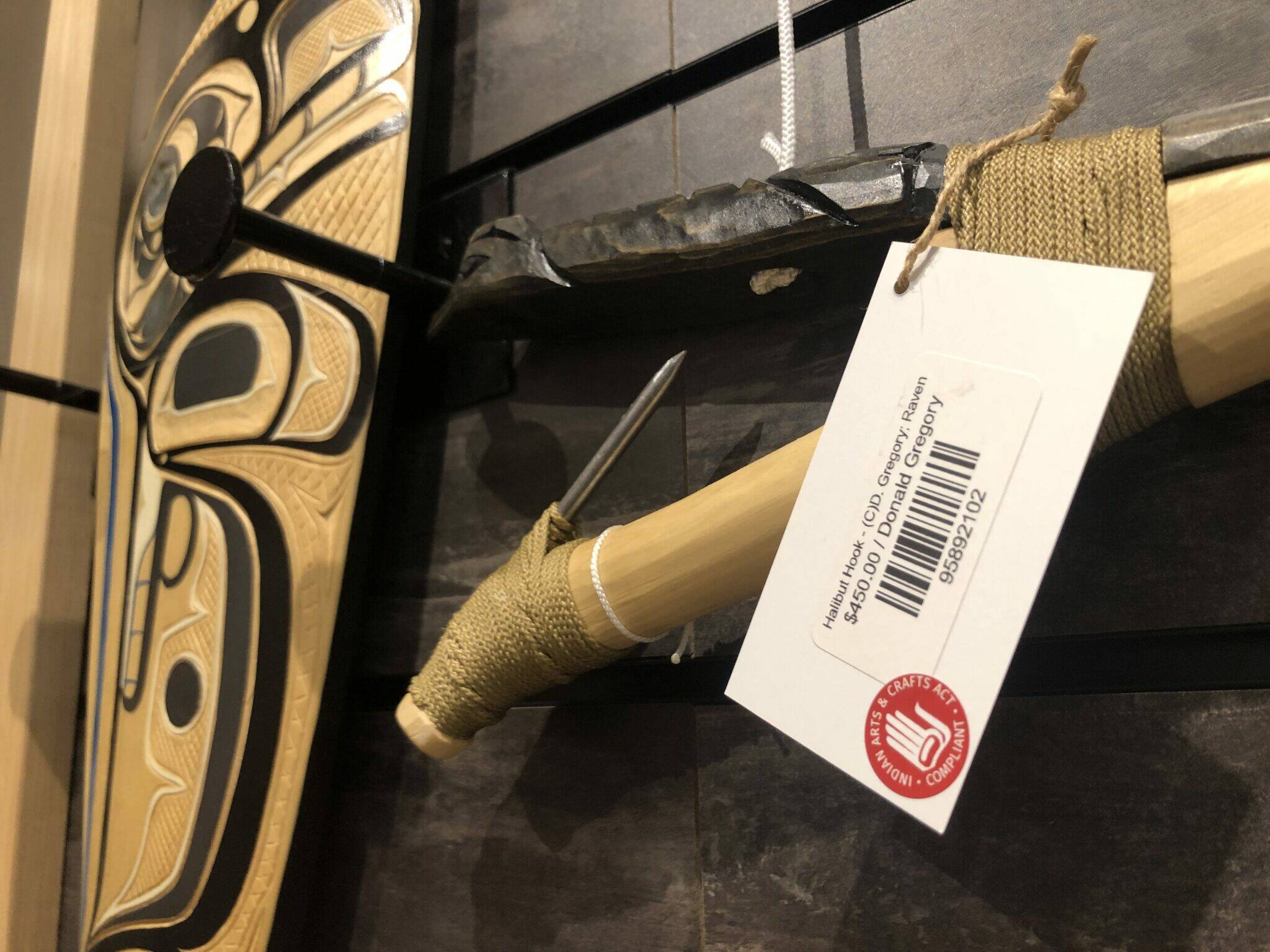
In the United States, souvenirs sold as authentic products of tribes or tribal members and identified as coming from American Indians and Alaska Natives are specifically protected under the federal Indian Arts and Crafts Act.
That law makes it illegal to market and sell artwork falsely labeled as created by an Alaska Native or a Native tribe. The act is enforced by the federal Indian Arts and Crafts Board, which collects complaints and investigates violations.
Breaking that law might seem like a minor crime, said attorney Jacob Adams, but the long-term consequences are large.
“Allowing non-genuine products like that to be out there in the market, and essentially take over a lot of areas, it makes the environment that much more difficult for Indigenous craftspeople to live off of their culture, and that causes many follow-on effects,” Adams said.
“If people are unable to make use of their culture, to live off their culture … then it disincentivizes upcoming generations to pick up those crafts,” he said.
Three years ago, Adams represented Sealaska Heritage Institute, a Southeast Alaska Native cultural group, and several other plaintiffs in a lawsuit against Neiman Marcus, the luxury retailer. At the time, Neiman Marcus was selling a “Ravenstail” coat that the plaintiffs said was the copyrighted work of a Native weaver.
The parties later settled the suit with an undisclosed agreement.
Statistics for the scale of the problem are hard to come by, Adams and others said.
In 2011, the federal Government Accountability Office concluded that it was impossible to gauge the size of the illegal market with available data but noted that of 649 complaints filed with the Indian Arts and Crafts Board between 2006 and 2010, almost a quarter involved apparent violations of federal law.
Anecdotally, officials and artists pointed to the number of prosecutions and actions against the sellers of fake products as a demonstration of both the problem and actions being taken to combat it via the Indian Arts and Crafts Act.
“To a great extent, for the most part, we’re seeing more of its use both in the private and the criminal side in recent years, in the past decade or so,” Adams said, referring to the law.
This spring, the U.S. Attorney’s office in Seattle prosecuted a man who sold fake American Indian and Alaska Native artwork at Pike’s Place Market.
Two years ago, the attorney’s office in Alaska prosecuted the former owner of the Arctic Treasures gift shop in Anchorage. Seven years ago, four shops were charged by federal prosecutors.
Fines for violations of the Indian Arts and Crafts Act are common, but jail time remains rare, Tribal Business News reported in 2021.
The arts board operates a special investigations unit, Schmidt said, with one investigator based out of Juneau and another out of Anchorage.
“There’s a lot of potential for fraud out there,” Schmidt said.
The state of Alaska also investigates complaints via its consumer protection unit and in 2022 filed a civil lawsuit against the owners of an Anchorage business, accusing them of shipping Alaska-bought bones and antlers to the Philippines before turning them into knives and other products there.
At the start of this year’s tourist season, the Department of Law sent a warning letter to 44 tourism businesses, warning them not to remove foreign country markings from souvenirs.
“In the past, CPU has received information indicating that some businesses serving the tourist market may be removing foreign country of origin markings from products, which confuses or misleads consumers into believing that the products were made in Alaska,” the letter said in part.
Patty Sullivan, an attorney and spokesperson for the department, said that the letters weren’t intended to target particular businesses and aren’t a sign that the state believes those businesses are doing something wrong.
“These are stores that we believe serve the tourist market. There have been allegations that this conduct is happening in stores that serve the tourist market. We may send a second round of letters to additional shops in the future,” she said.
Adams said the issue is worth continued attention.
“Many people would think this discussion is trivial, but it’s actually essential to the identity of Indigenous groups,” Adams said.
“If we are going to support not only the Indigenous people but also celebrate the idea of diversity, we have to protect and secure these types of valuable pieces of identity,” he said.
How to buy smart
Here are some tips recommended by the state of Alaska and the Indian Arts and Crafts Board if you’re looking to make sure that you’re buying something authentic:
• Shop at stores with good reputations, those linked to tribes or tribal groups, and ask for a written guarantee or written verification that what you’re buying has been made by an Alaska Native.
• If possible, get a receipt that includes all the information about the maker, the maker’s village or tribe, and where they’re from.
• Look for a certification tag. The board and the Alaska State Council on the Arts’ “Silver Hand” program each offer a certification process that includes a label.
• Go beyond “Made in Alaska.” Something can carry a “Made in Alaska” logo but be made by a non-Native. Instead, look for labels and explanations that something was made by a member of a particular tribe.
• Price, materials and appearance are all clues. Authentic items will cost much more than mass-produced ones. If something is advertised as hand-carved but is right next to identical pieces, be skeptical. Something advertised as soapstone might actually be made of resin — real stone is cool to the touch, plastic is warm, and stone is heavier.
• If you need to file a complaint, visit the Indian Arts and Crafts Board online or call 888-278-3253.
• James Brooks is a longtime Alaska reporter, having previously worked at the Anchorage Daily News, Juneau Empire, Kodiak Mirror and Fairbanks Daily News-Miner. This article originally appeared online at alaskabeacon.com. Alaska Beacon, an affiliate of States Newsroom, is an independent, nonpartisan news organization focused on connecting Alaskans to their state government.
