
Angoon students led a procession of regalia-clad residents down the village’s Front Street on Monday. Elders and family members looked on as they sang and drummed Tlingit songs in the afternoon sun, then joined in dances — the killer whale song, the dog salmon song and the Haida “tired paddler” song. Children spun on playground equipment above the sparkling water of Chatham Strait, and visitors recorded videos on their phones.
It was a celebration of enduring culture — the students were preparing to name and launch a dugout canoe they’d created with master carver Wayne Price. When a canoe, called a yaakw in Tlingit, first enters the water and takes its name, it becomes at.óow, a sacred object. The students’ canoe is the first of its kind to be built and launched in Angoon since the U.S. Navy shelled the village and destroyed its war canoes and winter stores in 1882. The U.S. Navy has never formally apologized.
Kyle Johnson Jr., an Angoon High School student, led the songs and dancing with Cheyenne Kookesh and Gabbi George-Frank, who drummed. Johnson Jr. addressed the crowd: “In the words of my grandfather: Your presence here means everything,” he said, invoking the words of Albert Kookesh, an Alaska Federation of Natives leader and former state senator who died in 2021.

Cedar to at.óow
The canoe started as a red cedar log in the Angoon High School parking lot. It got there because Jonathan Wunrow, then the interim president of Kootznoowoo Inc., Angoon’s village corporation, heard from shareholders that a canoe would be good for the community.
Peter and Mary Jane Duncan, as well as Donald Frank, told Wunrow that they’d like to work with Wayne Price. Wunrow and Kootznoowoo Inc. raised roughly $165,000 for the project, from Sealaska Corporation, the Crossett Fund, Central Council of Tlingit and Haida Indian Association, Sealaska Heritage Institute, the Rasmuson Foundation, Hecla Greens Creek Mine, and the Juneau Community Foundation.
Students helped Price every day, Wunrow said. It took a little over a year to complete the project. After the ceremonial steaming — where participants fast and place hot rocks in the canoe to open the wood — Kootznoowoo, Inc. dedicated and gave the canoe to the school and Angoon students.
“This is about the kids, it’s about the community, it’s about healing. It’s about resilience,” he said. He then quoted Daniel Johnson Jr., the acting leader of the Basket Bay House: “As Dan Johnson said, ‘We’re still here.’ You know, the community, the people of Angoon are still here.”
The effect on the community was palpable on Monday. Mayor Albert Kookesh III – son of the late AFN leader and state senator – and teacher Chenara Johnson rallied the students and the crowd for the event.

“We’re still here.”
Residents and guests filled Front Street, including the crew of the Polynesian voyaging canoe Hōkūle‘a, who were in Angoon before a four-year trans-Pacific voyage.
Community members Frances and Jesse Daniels waited with Floyd Jim and their children and grandchildren at a table on Front Street to watch the procession and dances.
“I’m proud of the kids, of what they accomplished and carrying our songs and traditions,” said Jim. As he watched the kids dance by the 40-foot canoe, the memory of the bombardment was on his mind.
“We do things like this because in the ’80s my dad and mom went to D.C. to ask for an apology,” he said. “But it never came.”
The bombardment isn’t part of the school’s curriculum — “yet,” said Emma Demmert, the principal. She just finished her first year in the role and back in her hometown.
“But it is: I mean, everybody knows about it,” she said. “The kids know about it. They have that history.”
It’s a violent chapter in the history of American colonialism and repression of the Tlingit language and culture, and it’s one that Angoon residents are still reckoning with.
Peter Frank was in the crowd at the naming ceremony. He grew up in Angoon and said when he was a child, the Tlingit culture wasn’t something that could be proudly expressed on Front Street.
“They told us to go hide away,” he said. Culture was something that happened “when no white eyes were watching.” He said that began to shift as he became an adult, after boarding school at Mt. Edgumbe High School in Sitka. Now language and culture are openly celebrated.
Launch
The students called three adults to come help with the naming ceremony.
Frank Jack III, a board member of Kootznoowoo Inc., wore a wolf hat, and his voice was thick with emotion when he addressed the students and the crowd.
“This is something we have never seen in our lifetimes. It’s a great honor to be here,” he said. “When the songs were being sung, I had a moment where I was tearing up because I’m so proud. Proud of them for what they’re doing.”
A few spontaneous calls of “Gunalchéesh” came from the crowd — “thank you,” in Tlingit.
He and Daniel Johnson Jr. explained the naming ceremony and invoked the history of violence and survival that deepened the canoe’s significance.
“Your grandfathers stand here today to say that with the name that you chose, we stand confident in knowing that you’re ready to move forward,” Johnson said.
He wore a Chilkat robe with a beaver design that was woven in the 1920s. Johnson’s uncles named him in Tlingit after the prow piece of the sole remaining canoe after the Angoon bombardment, carved in the form of a beaver.
“Our way of life, our culture, will continue to live if you continue to hang on to what’s in your heart that called you to be a part of the carving of this canoe,” he told the students. “And we hope that you continue with that long into your life, so that our way of life, our culture, continues to thrive.”
Then he repeated the name the students chose for the canoe three times: Ch’a Tléix Tí, Ch’a Tléix Tí, Ch’a Tléix Tí.

Unity
Chenara Johnson is the students’ Tlingit language teacher, but she’s been a mentor to many of them since she ran their early childhood education program, Head Start. She oversaw the canoe project and helped the students pick a name for it.
“The students chose unity because they’ve seen how split our community can be,” she explained to the crowd on Monday. “The hope is that we named the canoe unity, Ch’a Tléix Tí, and our community will eventually come together and be one and work together and be where we want to be.”
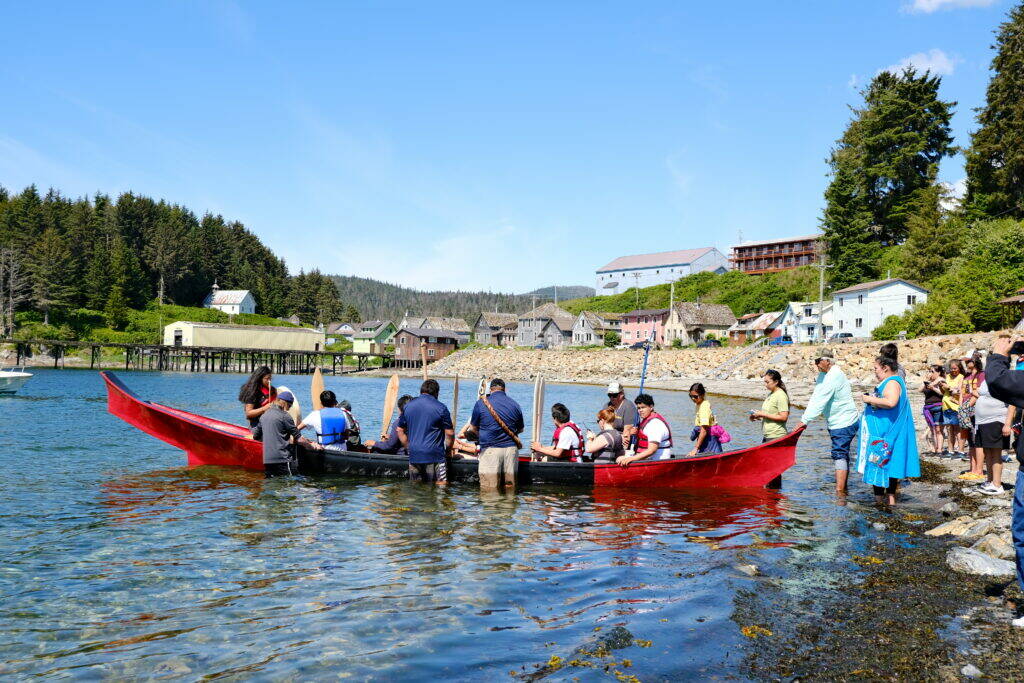
It took about a dozen people to carry the canoe into Chatham Strait, including some of the Hōkūle‘a crew. But most of them were students, who wore American-flag-printed life vests and carried hand-carved wooden paddles.
As parents, guests and community members looked on from the beach, they pushed off. The canoe wobbled slightly, then steadied, and the students began to paddle towards the white-capped mountains of Baranof Island. Gabbi George-Frank, of the Aangoon Yatx’i dance group, stood at the prow of the boat with her drum.
Johnson’s voice was thick with emotion when she remembered the launch later.
“As soon as I saw the canoe tilt back and forth really quickly and then just stop, I knew that they were there,” she said. “And I knew that they were OK. And I knew that they were going to take off.”
She was talking about their transition into adults, she said, but also into something more — a foundation for the Tlingit community and culture in Angoon.
“They’re ready to help teach what they know to the next generation,” she said.
“That was always important, is to make sure these kids knew who they were, where they were from. And just know, and feel accepted. And now they are. And now they do. And now they’re ready to make sure the next generation is going to be OK.”
GET THE MORNING HEADLINES DELIVERED TO YOUR INBOX
• Claire Stremple is a reporter based in Juneau who got her start in public radio at KHNS in Haines, and then on the health and environment beat at KTOO in Juneau. This article originally appeared online at alaskabeacon.com. Alaska Beacon, an affiliate of States Newsroom, is an independent, nonpartisan news organization focused on connecting Alaskans to their state government.
