
Chances are, you have at least one credit card in your wallet.
Any time you pull it out and use it — whether at Foodland, Fred Meyer or Shoefly — you know you’re not just paying the cost of what you’re buying. Your credit card company is going to charge you a fee or interest on that purchase.
To you, it’s worth it: Payday isn’t for another week, and you need — right now — that extra loaf of bread, that tank of gas or that set of killer shoes.
That’s the situation the state of Alaska is in with TransCanada, one of its partners in the AKLNG project.
That project is the one that intends to bring natural gas from the North Slope down to Cook Inlet, where it can be sold on world markets.
According to the experts, it would be the biggest natural gas project on the planet. “The governor said it’s a pipe. It’s a very big pipe,” explained Phillip Fletcher of Millbank, one of the consulting firms the state has hired to help with AKLNG.
That very big pipe (and the industrial plants at either end of it) are estimated to cost $45 billion to $65 billion.
The state isn’t planning to pay that whole sum. It has partners: oil giants BP, ConocoPhillips and ExxonMobil. Together, they’re planning to pay for 75 percent of AKLNG.
The remaining one-quarter is the state’s responsibility, and that’s the reason for the Alaska Legislature’s special session.
TransCanada’s partnership
Under Gov. Sean Parnell, the state found a fourth partner — Canadian pipeline construction firm TransCanada — to pay for its part of AKLNG.
Under the terms of the deal, TransCanada pays the state’s costs up front as AKLNG is planned and designed. When the time comes to build the project, TransCanada also pays half the state’s share of construction costs.
That amounts to about $144 million by the end of 2016, another $875 million by 2019, and another $6 billion to $7 billion by the time AKLNG is expected to open in 2026.
In exchange for paying those amounts and offering its pipeline expertise, TransCanada is guaranteed to be repaid by the state once the gas starts flowing and the state starts collecting taxes.
Even if the pipeline project fails and never ships a molecule of gas, the state must pay TransCanada.
“If the project does not move forward and TransCanada is still the state’s agent … under all circumstances, the state of Alaska will repay TransCanada’s costs,” said Marty Rutherford, deputy commissioner of the Alaska Department of Natural Resources.
In success or failure, not only will the state have to pay TransCanada back in full, it also must pay 7.1 percent interest on top, even if it’s in the billions.
Just like your credit card, there are no free rides. The bill eventually comes due.
Other options
In the world of finance, 7.1 percent interest is fairly high. In 2013, the state borrowed more than $162 million from the open market. That amount was divided into many smaller loans due in different years. For an $18.1 million loan expiring in 2025, the state will pay 5 percent interest.
Just as you wouldn’t buy a car with a credit card — you’d go to a bank and get a lower interest rate — the state is considering borrowing money from the open market instead of from TransCanada, which is acting like a bank.
That carries its own risks. If you use your credit card too much (or have too many loans outstanding), banks will give you a worse credit rating. They think it’s less likely you’ll be able to pay up. That makes the interest rate higher on your credit card and you’ll find it harder (or more expensive) to get a car loan or house loan.
The same is true for the state. If the state borrows from the open market, it will be asking for money at a time when it has a multibillion-dollar gap between revenue and expenses.
“We expect that, absent revenue, that’s going to put pressure on the state’s credit rating,” said Steven Kantor, managing director of First Southwest, which the state hired to analyze the financial aspects of the project. “The state’s credit rating may decline as we issue so much debt without corresponding revenue.”
In addition, there’s no way to know whether the price of gas in 20 years — when AKLNG is operating — will be high enough to make the project pay off.
Banks may decide that they’re willing to loan the state money, but the state’s credit rating might suffer just as yours would if you have too many loans. If that happens, the state will pay more to finance things like schools and port projects as well as AKLNG.
The state could also look at different ways to pay for the project, such as the Permanent Fund, but the fund’s new director, Angela Rodell, has said that such an arrangement must be as worthwhile for the fund as it is for the state.
The state argues that in the long run, regardless of how it pays for its share of AKLNG, it makes more sense to stop working with TransCanada. If TransCanada foots the bill up front, the extra interest means the state will lose almost $400 million per year in revenue once the pipeline starts running.
If the pipeline operates for 20, 30 — even 40 years as the trans-Alaska oil pipeline has done — it will end up paying TransCanada far more than if it had just paid for its share of the project on its own.
Why now?
The state has to decide TransCanada’s role now because it has a Dec. 31 deadline to do so. That date is the boundary between the project’s first stage and its second.
If the state buys out TransCanada now, it will pay about $154 million — what TransCanada has spent to date, plus the 7.1 percent interest it is owed. If the state doesn’t buy out TransCanada now, its next opportunity to buy out TransCanada won’t come until 2018, at the end of the second stage of the project. By then, TransCanada is expected to have spent almost $1 billion, and the state will have to pay interest on that larger expense.
“If we make that decision today, the state has a smaller check to write,” said Deepa Poduval, director of Black & Veatch, one of the state’s consultants.
On the other side of the argument, TransCanada could be an important partner if oil prices remain low and the state continues to struggle to make ends meet. In that case, the state might be willing to forego long-term profits in order to keep the project moving when it might otherwise not be able to.
The choice is in the hands of the Alaska Legislature: Pay now, or pay later?
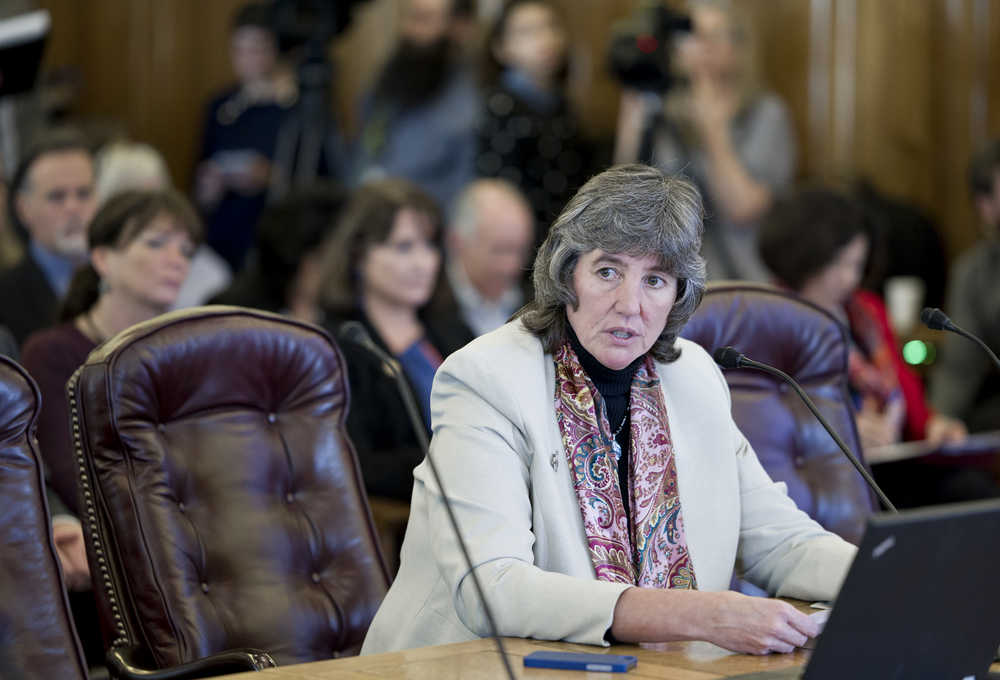
Pat Pitney, director of the Office of Management and Budget, gives an overview of Gov. Bill Walker’s TranCanada buy-out proposal in front of the House Finance Committee at the Capitol on Saturday.
