
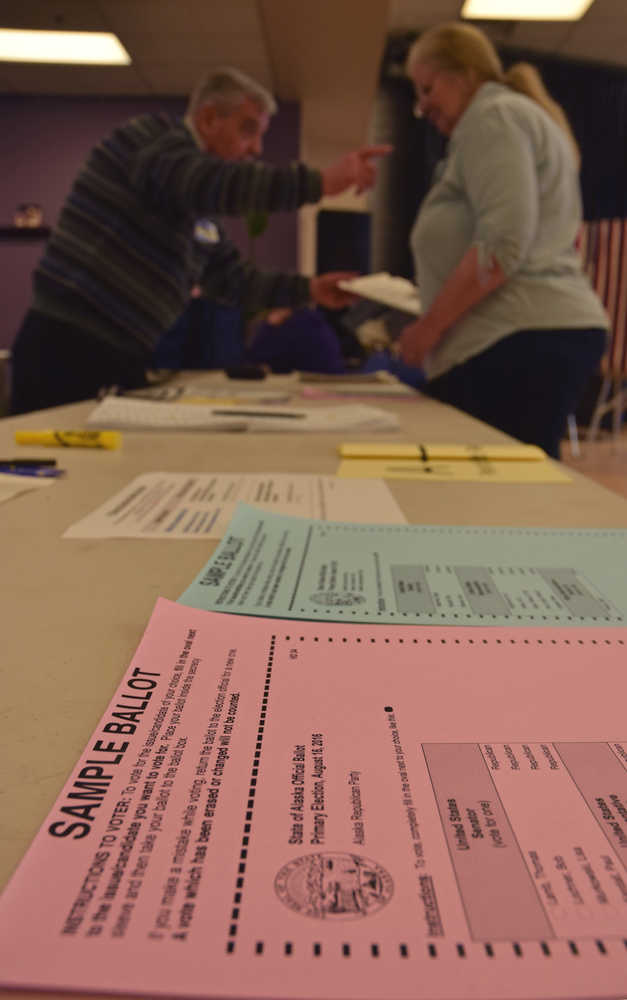
On Tuesday night, Alaska political reporter Casey Reynolds gathered a handful of the state’s political experts for a live blog on the results of the statewide primary.
As the results began to come in, former U.S. Senator Mark Begich asked a rhetorical question: “The outcome of tonight’s election will tell us where we are going as state. So the question is, what direction will we go?”
The answer to that question may not come until November.
Tuesday’s vote offered voters a referendum on the Alaska Legislature’s failure to balance the state’s multibillion-dollar budget.
While the purpose of a primary election is to pick candidates for a general election, the winners of 16 primary races will face no opposition in November — the other party hasn’t bothered to field a candidate.
Many of the others face only independent opposition or are in districts that tilt toward one party or another, making them largely uncompetitive in a general election.
“Forty percent of the elections this year will be determined by the primary race,” said Rep. Sam Kito III, D-Juneau, who faces no opposition in either the primary or general elections.
For that reason, Kito and his Juneau co-worker, Rep. Cathy Muñoz, R-Juneau, said they planned to keep a close eye on a handful of House and Senate races.
On the North Slope, initial indications were that Democratic challenger Dean Westlake was leading incumbent Democratic Rep. Benny Nageak.
Nageak is a member of the Republican-led House Majority and has consistently opposed higher taxes and lower subsidies on oil companies.
Precincts on the North Slope are small and isolated, with results not typically published until the following day.
In Southwest Alaska, incumbent Democratic Rep. Bob Herron faced a big challenge challenger Zach Fansler for a seat representing Bethel. As on the North Slope, Herron was a member of the Republican-led House Majority, and as on the North Slope, results were not expected until later Wednesday.
Muñoz and Kito said they’re also watching a handful of Republican races in Southcentral. Those races concern members of the “Musk Ox Caucus,” a group of moderate Republicans who have been willing to defect from the House Majority on some budget issues.
Most members of that caucus are facing stiff primary election challenges. If they stay in office and Democrats win seats in November, there could be a joint Republican-Democratic majority in the House.
With nine of 11 precincts reporting results by 10 p.m., Rep. Jim Colver of Palmer (a member of the caucus) was losing 45-55 to George Rauscher, a more traditional Republican.
Conversely, incumbent Rep. Paul Season (another Musk Ox) was leading his three-way race in Homer, 55-22-23, with four of nine districts reporting results.
Any attempt to create a theme from Tuesday’s election will run into a significant problem: turnout.
In 2000, just 17.2 percent of Alaska’s registered voters participated in the state primary. In 1982, the high-water mark, that figure was 57.6 percent. Initial indications are that this year’s turnout will approach the 2000 figure as the lowest ever.
With fewer than 1 in 5 Alaska voters participating Tuesday, it will be difficult for anyone to say they have a referendum based on the results.
—
Read more election news:
Tuesday’s election results promise at least seven new faces in Legislature
