
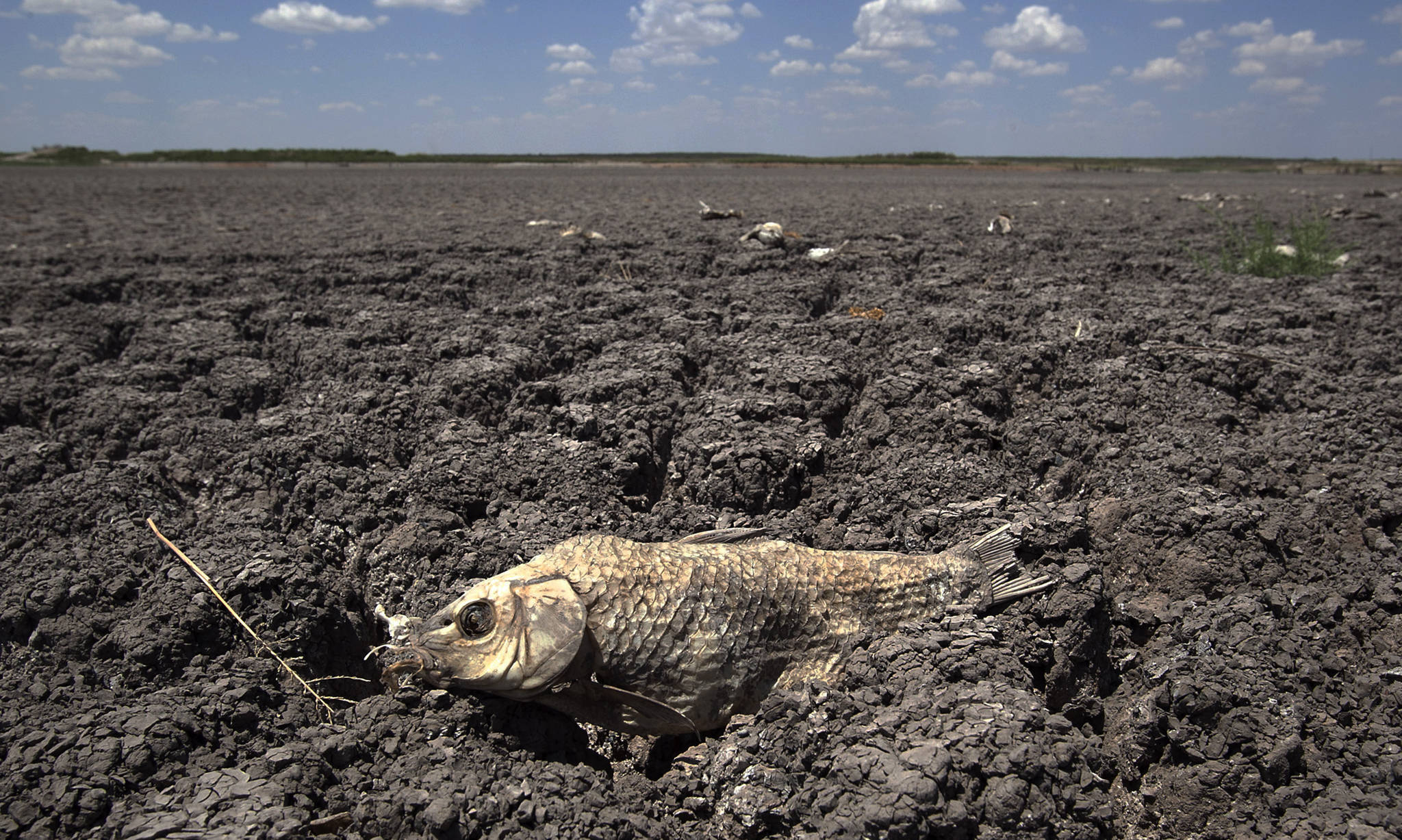
FILE - In this Wednesday, Aug. 3, 2011 file photo, the remains of a carp are seen on the dry lake bed of O.C. Fisher Lake in San Angelo, Texas. According to data released by the National Oceanic and Atmospheric Administration on Tuesday, May 4, 2021, the new United States normal is not just hotter, but wetter in the eastern and central parts of the nation and considerably drier in the West than just a decade earlier. (AP Photo / Tony Gutierrez)

FILE - In this Wednesday, Aug. 3, 2011 file photo, the remains of a carp are seen on the dry lake bed of O.C. Fisher Lake in San Angelo, Texas. According to data released by the National Oceanic and Atmospheric Administration on Tuesday, May 4, 2021, the new United States normal is not just hotter, but wetter in the eastern and central parts of the nation and considerably drier in the West than just a decade earlier. (AP Photo / Tony Gutierrez)

America’s new normal: A degree hotter than two decades ago

America’s new normal temperature is a degree hotter than it was just two decades ago.

By Seth Borenstein

AP Science Writer

America’s new normal temperature is a degree hotter than it was just two decades ago.

Scientists have long talked about climate change — hotter temperatures, changes in rain and snowfall and more extreme weather — being the “new normal.” Data released Tuesday by the National Oceanic and Atmospheric Administration put hard figures on the cliche.

The new United States normal is not just hotter, but wetter in the eastern and central parts of the nation and considerably drier in the West than just a decade earlier.

Meteorologists calculate climate normals based on 30 years of data to limit the random swings of daily weather. It’s a standard set by the World Meteorological Organization. Every 10 years, NOAA updates normal for the country as a whole, states and cities — by year, month and season.

For the entire nation, the yearly normal temperature is now 53.3 degrees based on weather station data from 1991 to 2020, nearly half a degree warmer than a decade ago. Twenty years ago, normal was 52.3 degrees based on data from 1971 to 2000. The average U.S. temperature for the 20th century was 52 degrees.
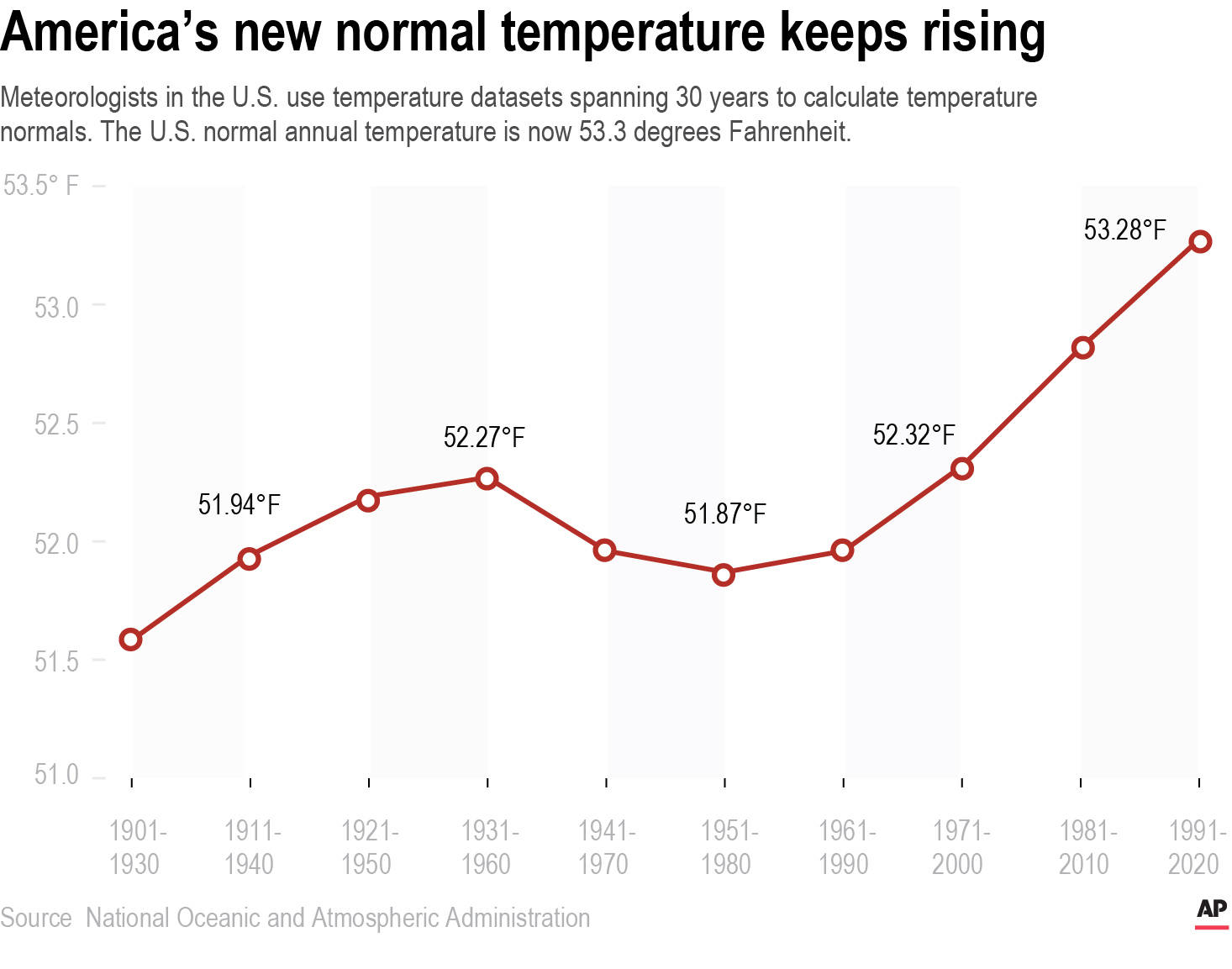
Meteorologists in the U.S. use temperature datasets spanning 30 years to calculate temperature normals. The U.S. normal annual temperature is now 53.3 degrees Fahrenheit.

Meteorologists in the U.S. use temperature datasets spanning 30 years to calculate temperature normals. The U.S. normal annual temperature is now 53.3 degrees Fahrenheit.

The new normal annual U.S. temperature is 1.7 degrees hotter than the first normal calculated for 1901 to 1930.

“Almost every place in the U.S. has warmed from the 1981 to 2010 normal to the 1991 to 2020 normal,” said Michael Palecki, NOAA’s normals project manager.

Fargo, North Dakota, where the new normal is a tenth of a degree cooler than the old one, is an exception, but more than 90% of the U.S. has warmer normal temperatures now than 10 years ago, Palecki said.

In Chicago and Asheville, North Carolina, the new yearly normal temperature jumped 1.5 degrees in a decade. Seattle, Atlanta, Boston and Phoenix had their normal annual temperature rise by at least half a degree in the last decade.

Charlottesville, Virginia, saw the biggest jump in normal temperatures among 739 major weather stations. Other large changes were in California, Texas, Virginia, Indiana, Arizona, Oregon, Arkansas, Maryland, Florida, North Carolina and Alaska.

New normals are warmer because the burning of fossil fuels is making the last decade “a much hotter time period for much of the globe than the decades” before, said Cornell University climate scientist Natalie Mahowald.

For Phoenix, the biggest change in normal came in precipitation. The normal annual rainfall for Phoenix dropped 10% down to 7.2 inches. Rainfall in Los Angeles dropped 4.6%.

At the same time, Asheville saw a nearly 9% increase in rainfall, while New York City’s rainfall rose 6%. Seattle’s normal is 5% wetter than it used to be.

Climate scientists are split about how useful or misleading newly calculated normals are.

Mahowald and University of Oklahoma meteorology professor Jason Furtado said updating normal calculations helps city and regional planners to prepare for flooding and drought, farmers to decide what and when to plant, energy companies to meet changing demands and doctors to tackle public health issues arising from climate change.

But Pennsylvania State University climate scientist Michael Mann said he prefers a constant baseline such as 1951 to 1980, which is what NASA uses. Adjusting normal every 10 years “perverts the meaning of ‘normal’ and ‘normalizes’ away climate change,” he said in an email.

North Carolina’s state climatologist Kathie Dello said, “It seems odd to still call them normals because 1991-2020 was anything but normal climate-wise.”

More in News

The northern lights are seen from the North Douglas launch ramp late Monday, Jan. 19. A magnetic storm caused unusually bright northern lights Monday evening and into Tuesday morning. (Chloe Anderson/Juneau Empire)
Rare geomagnetic storm causes powerful aurora display in Juneau

The northern lights were on full display Monday evening.

teaser
Juneau activists ask Murkowski to take action against ICE

A small group of protesters attended a rally and discussion on Wednesday.

A female brown bear and her cub are pictured near Pack Creek on Admiralty Island on July 19, 2024. (Chloe Anderson for the Juneau Empire)
Pack Creek permits for bear viewing area available now

Visitors are welcome from April 1 to Sept. 30.

Cars pass down Egan Drive near the Fred Meyer intersection Thursday morning. (Clarise Larson / Juneau Empire file photo)
Safety changes planned for Fred Meyer intersection

DOTPF meeting set for Feb. 18 changes to Egan Drive and Yandukin intersection.

Herbert River and Herbert Glacier are pictured on Nov. 16, 2025. (Mari Kanagy / Juneau Empire)
Forest Service drops Herbert Glacier cabin plans, proposes trail reroute and scenic overlook instead

The Tongass National Forest has proposed shelving long-discussed plans to build a… Continue reading

A tsunami is not expected after a 4.4-magnitude earthquake northwest of Anchorage Wednesday, Feb. 4, 2026. (U.S. Geological Survey)
No tsunami expected after 4.4-magnitude earthquake in Alaska

U.S. Geological Survey says 179 people reported feeling the earthquake.

ORCA Adaptive Snowsports Program staff member Izzy Barnwell shows a man how to use the bi-ski. (SAIL courtesy photo)
Adaptive snow sports demo slides to Eaglecrest

Southeast Alaska Independent Living will be hosting Learn to Adapt Day on Feb. 21.

Cars drive aboard the Alaska Marine Highway System ferry Hubbard on June 25, 2023, in Haines. (Photo by James Brooks)
Alaska’s ferry system could run out of funding this summer due to ‘federal chaos problem’

A shift in state funding could help, but a big gap likely remains unless a key federal grant is issued.

Photo by James Brooks/Alaska Beacon
U.S. Sen. Dan Sullivan stands with acting Coast Guard Commandant Adm. Kevin Lunday during the after the commissioning ceremony for the Coast Guard icebreaker Storis on Sunday, Aug. 10, 2025, in Juneau, Alaska.
Coast Guard’s new Juneau base may not be complete until 2029, commandant says

Top Coast Guard officer says he is considering whether to base four new icebreakers in Alaska.

Most Read