
By Ned Rozell
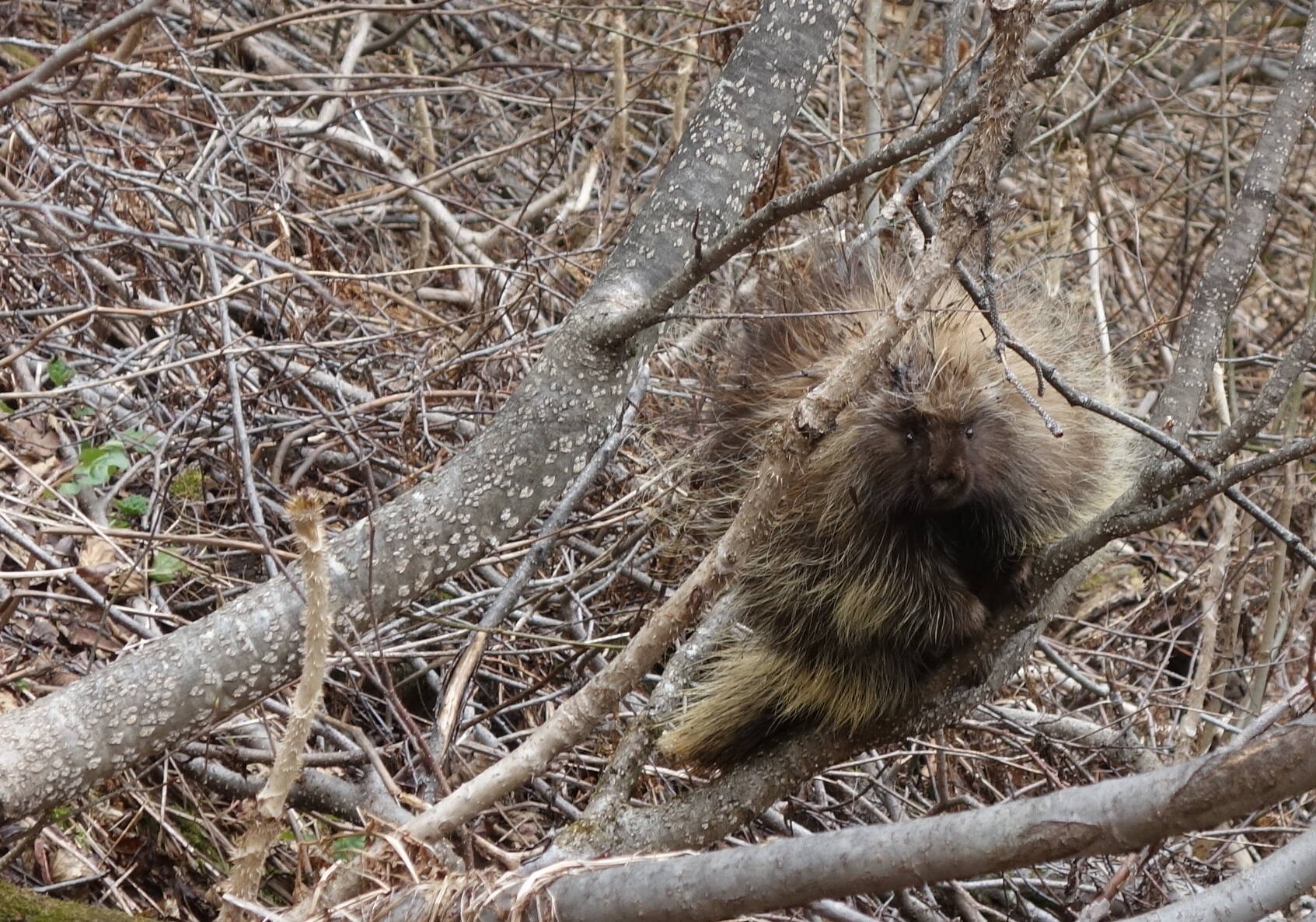
While running through Bicentennial Park in Anchorage, biologist Jessy Coltrane spotted a porcupine in a birch tree. On her runs on days following, she saw it again and again, in good weather and bad. Over time, she knew which Alaska creature she wanted to study.
“I thought, ‘Oh my god, how does he do it? How does this animal make it through winter?’” Coltrane said years ago during the December defense of her doctoral thesis in Fairbanks. “It would be 20 below out and he’s there eating (bark).”
Coltrane’s study cast some midwinter light on the Alaska porcupine, perhaps the least-studied mammal in the state. She at first wanted to learn about what porcupines did in winter, but switched to studying the physiology of the quilled creature after the porcupines she watched hardly moved on their tree-limb perches.
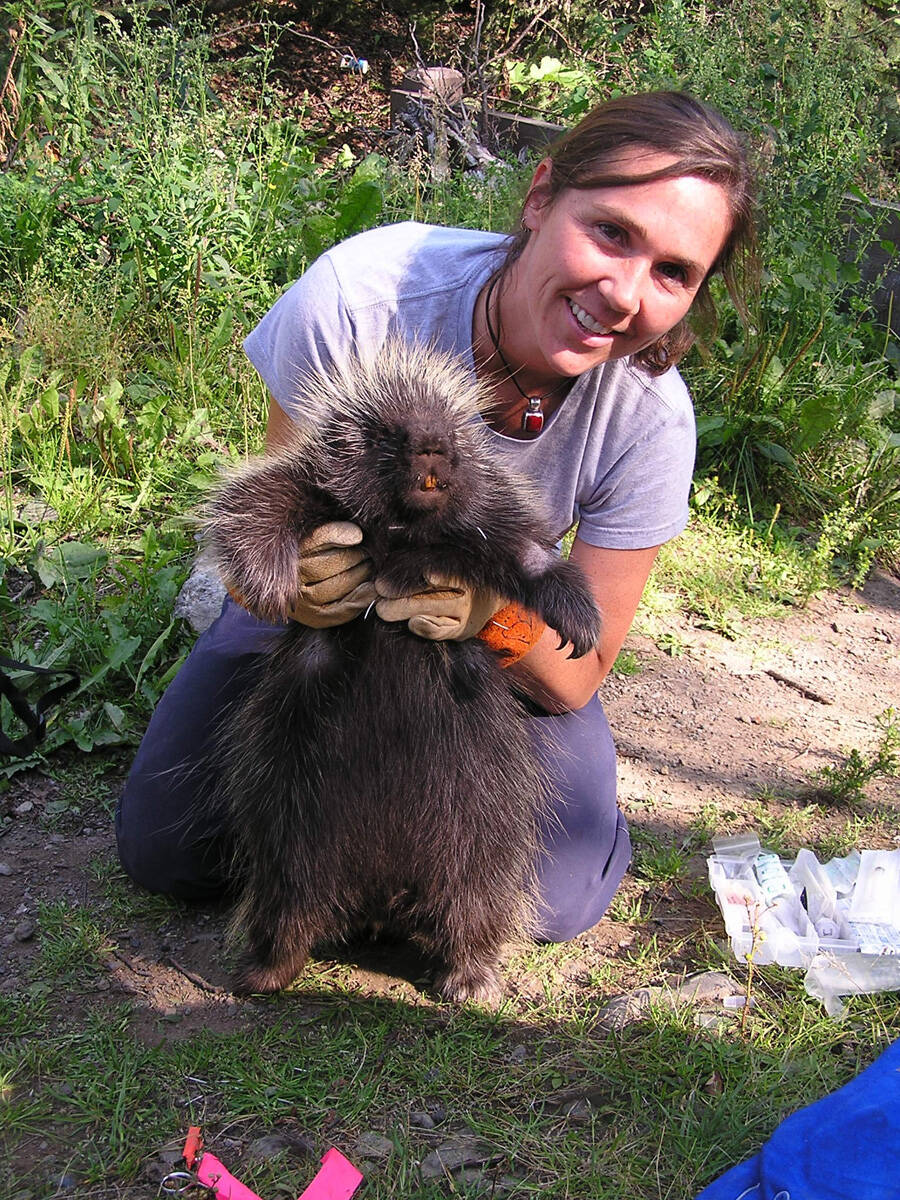
Jessy Coltrane and her study subject in Anchorage. (Courtesy Photo / Jessy Coltrane)
Winter porcupine behavior “doesn’t happen,” she joked at her defense.
But that lack of activity in a subarctic winter made porcupines more intriguing to her. The porcupine doesn’t avoid winter by hibernating like a bear, nor does it curl up in an earthen womb like the beaver (the only larger rodent in Alaska). She saw porcupines most often in trees, with no protection from the elements.
In designing her study, Coltrane mused about the challenges of an exposed life during an Alaska winter: Bitter air temperatures would probably require a porcupine to take in more calories, she thought. This seemed puzzling when a porcupine’s major food was to be the inner bark of white spruce trees and the tree’s bitter needles, rich with toxins that discourage most every other animal from chewing them.
To begin her study, she searched for detailed studies of far-north porcupines. She found none. With advice from biologists she respected, she set up her own study, installing radio collars on porcupines in the forests of Anchorage and with the help of her husband building pens for a few in Fairbanks. The captive porcupines helped her understand how they functioned on such a poor diet.
After a study that took her more than six years, Coltrane presented these porcupine insights during her thesis defense:
— Alaska porcupines are almost twice as large as Lower 48 porcupines.
— Porcupines in her study area didn’t “hibernate on the hoof” by lowering their body temperatures to save energy; whether it was 30 above or 30 below, porcupines — insulated by their quills and dense guard hairs — remained at about the same body temperature as a human’s.
— The porcupines in her study, each of which she named, ate a highly toxic winter diet that required lots of energy to process. They survived the winter by burning body fat and moving very little.
— Fifty percent of a porcupine’s weight in fall was in the form of fat. “That’s ridiculously fat,” Coltrane said. “Like a polar bear or a seal.”
— Despite eating low-protein foods in winter, porcupines did not lose lean tissue. They instead lost 30 percent of their fat reserves.
— More than 20% of their meager dietary intake was lost in their urine, most likely a result of ridding their bodies of toxins stored in spruce needles.
— Her Alaska porcupines had larger winter home ranges than did Lower 48 porcupines, and spent time in mixed hardwood and conifer forests.
— Porcupines she studied spent 79% of their time in and around white spruce trees, the rest of the time in birch. “(Eating) birch gives them a break from the toxins,” Coltrane said. “Maybe that’s why they prefer mixed forest.”
— While dealing with winter “for a ridiculous number of months,” Coltrane’s porcupines depleted their fat reserves. To survive, porcupines depend on nutritious springtime greenery, which must be delicious after months of nibbling bark and spruce needles.
• Since the late 1970s, the University of Alaska Fairbanks’ Geophysical Institute has provided this column free in cooperation with the UAF research community. Ned Rozell is a science writer for the Geophysical Institute. A version of this column ran in 2011.
