
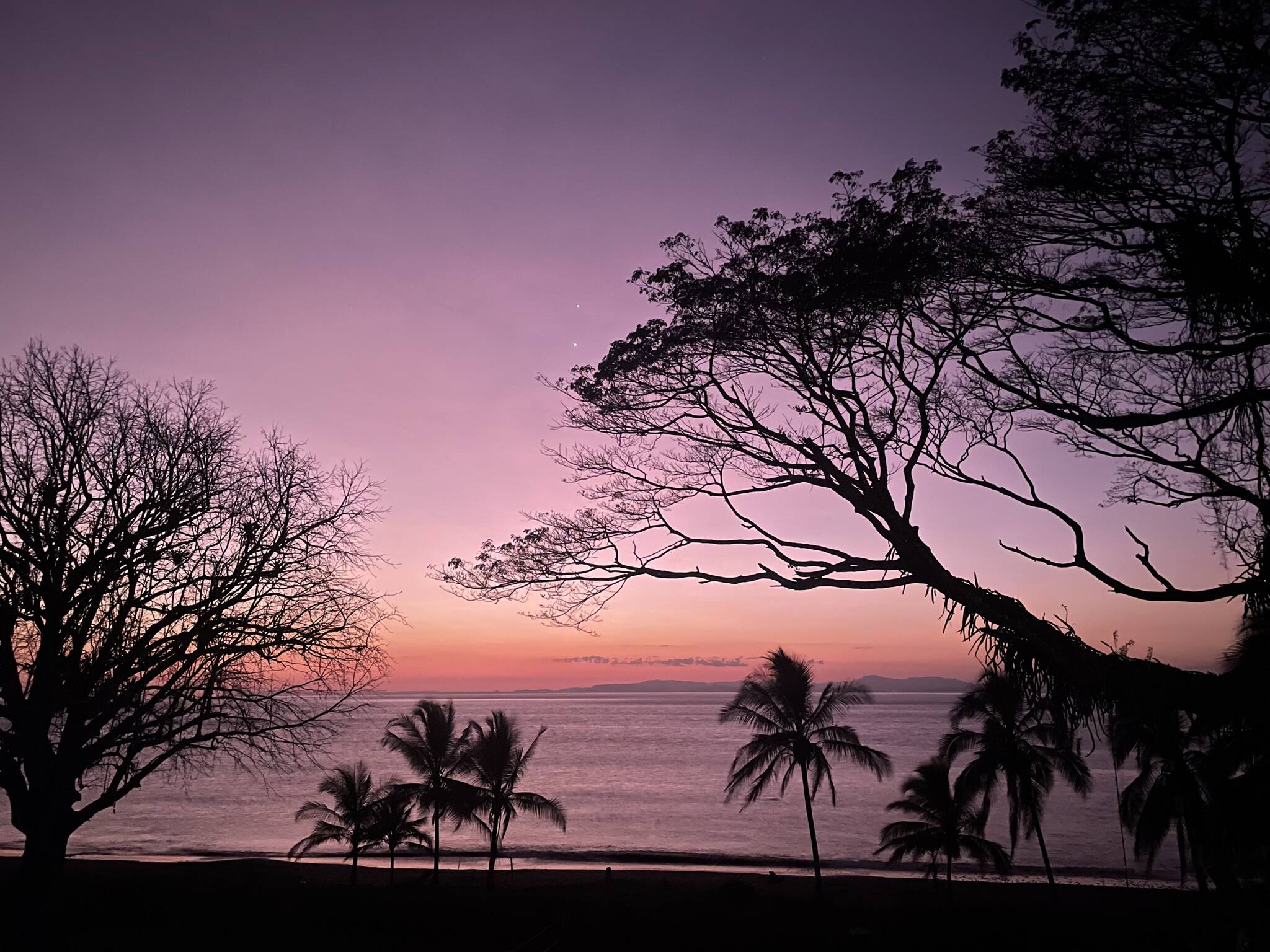
Things an Alaskan notices while standing on a road in Costa Rica:
— Trees are shaped like mint-green umbrellas rather than charcoal-green rocket ships.
— Flesh-colored flowers smell like warm honey as they fall with a plop from a tree to sticky pavement.
— A bird perched on a power line has turquoise eyebrows and a double tail that looks like a pair of blue canoe paddles.
— The air does not hurt.
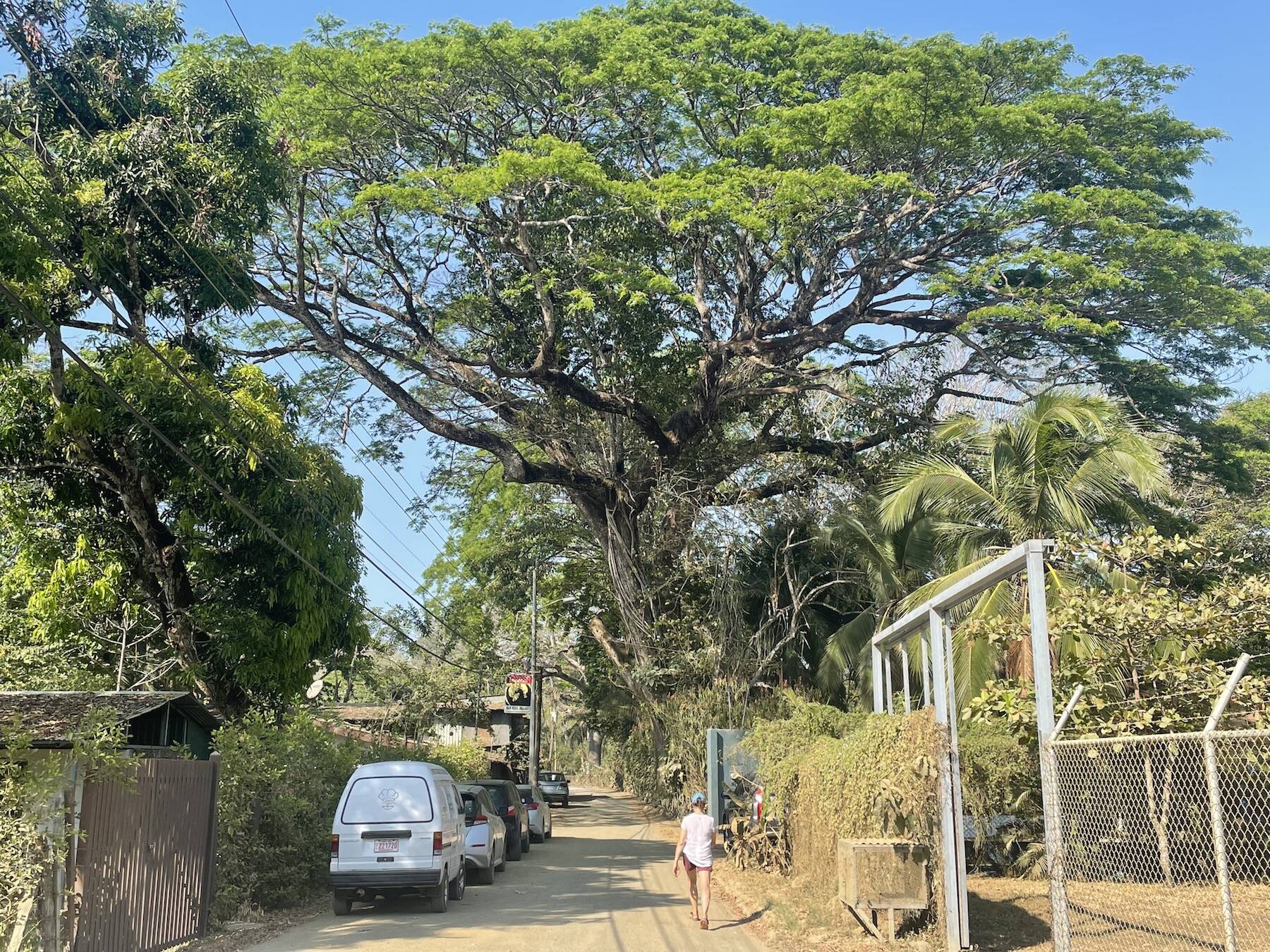
A woman walks beneath a tree with an expansive canopy containing at least three bird nests in a small village of Costa Rica. (Courtesy Photo / Ned Rozell)
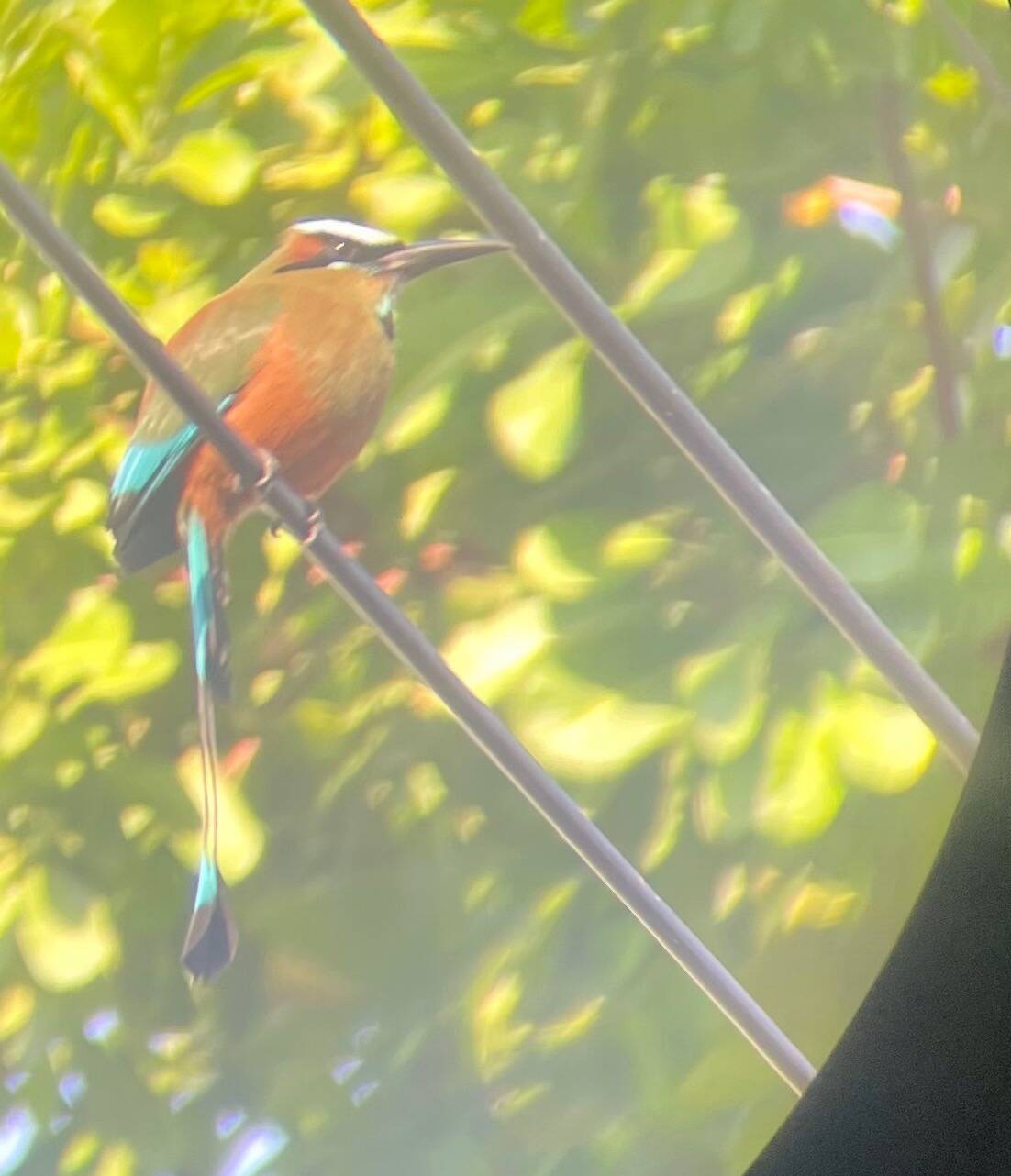
In a photo taken through a binocular lens, a turquoise-browed mot mot perches on a power wire above a street in a small village on the Pacific Coast of Costa Rica. (Courtesy Photo / Ned Rozell)
After three long flights spanning 53 significant degrees of latitude, I am back home in sub-Arctic Fairbanks. I just counted the living things that sounded off or moved during a recent one-hour walk with the dogs north of the university: Six, including red squirrel, raven and gray jay.
Down in the forested backbone of Central America, we couldn’t finish our first porch coffee without seeing multiples of six. Dinosaur-like iguanas clinging to tree bark, black-headed vultures picking through stinking beach trash cans and other birds, insects and mammals flitting and scurrying.
That begged the question: Why are there so many animals closer to the Equator than there are here in Alaska, where we sleep much closer to the North Pole?
In his guidebook to Costa Rica wildlife that I bent and stained, biologist Les Beletsky noted that tropical rainforests like those in Central America cover only about 7 percent of the planet but are home to at least half of the species on the planet.
That was easy to believe when flipping through the 800-plus list of Costa Rica birds, which includes a few dozen hummingbirds alone. Hopping beneath them are 120 species of frogs and toads, 68 different lizards and 127 different snakes, including the poisonous eyelash viper whose terrifying, spiky scales above each eye I hope to never see after pushing through a bush.
I don’t walk with much fear with the dogs up here in winter, but I’m sure I missed some Alaska animals in my count. On the pathway of packed snow, I probably stepped over a few wood frogs — brains and hearts frozen hard beneath two feet of fluff. They are northern Alaska’s only amphibian. Our reptile count is zero.
It seems obvious that our extreme winter tilt away from the sun here is what limits our species count.
Beletsky wrote that richness and diversity of plants, while not the only reasons, seem like a logical explanation of why areas near the equator are home to so many living things.
“Plants grow better in warm, continuously wet environments, conditions that pretty much define the tropics … Animals, aside from depending on plants for food, also live in, on, or around plants.
“When animals do not need to devote much of their energy into surviving extreme temperatures or aridness … they can then channel that extra energy into reproduction. Animals in the warm, wet tropics, therefore, can reproduce prolifically, which, although certainly not on the minds of the breeding individuals, is a good way to enhance species survival and success.”
Costa Rica is a vibrant place, no doubt, but of course Alaska is not always the frozen dead-zone it appears to be in December and January.
For example, individuals within a few hundred species of bird are now twitching on their tropical-hardwood branches and turning northward. In the next few months, the great frozen swamplands of Alaska will soften and green. Billions of buzzing insects will hatch, setting the table for creatures about to depart a tropical paradise for a far-northern one.
• Since the late 1970s, the University of Alaska Fairbanks’ Geophysical Institute has provided this column free in cooperation with the UAF research community. Ned Rozell ned.rozell@alaska.edu is a science writer for the Geophysical Institute.
