

By Ned Rozell
Charles Deehr will never forget his first red aurora. On Feb. 11, 1958, Deehr was a student at Reed College in Portland, Oregon. He asked a Fulbright student from Norway named Tone to the Portland Symphony that night.
They went for a stroll on a golf course after the concert. Looking past the treetops, they noticed the sky was blood red.
People as far south as Mexico saw the red sky that night. Some thought Martians. Others thought Christ was visiting for the second time. In Portland, people thought a forest fire was causing the glow.
Deehr knew better, because he was studying the physics of Earth and space. Under the crimson sky, he was sure of two things: he and Tone were seeing a great red aurora, and he would ask her on another date.
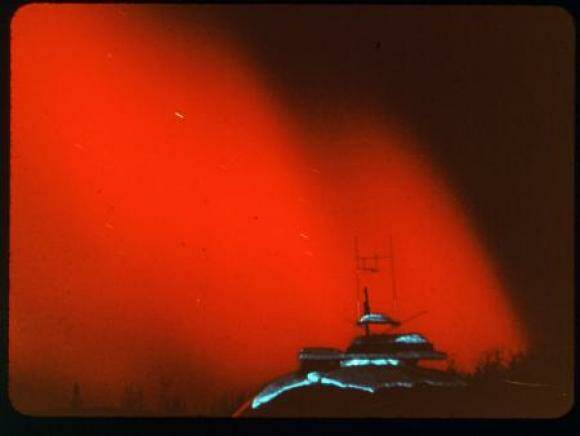
A rare red aurora over Alaska in February 1958. (Courtesy Photo / Geophysical Institute)
The Deehrs have now been married 61 years. Charles — Chuck to his friends — was a space-physicist and aurora forecaster at the University of Alaska Fairbanks for most of that time. In decades of sky-watching in the north, he has seen a few red auroras, but not many.
Fringes of red and blue hanging from aurora curtains — the result of particles from the sun reacting with nitrogen in the upper atmosphere — happen often, but the great displays that flood the sky with diffuse red light are rare.
Red aurora displays happen so high in the sky they are often the only form of aurora ever seen by people in the mid-latitudes.
In A.D. 37, a great red aurora showed itself to the citizens of Rome. Those in London gazed up at a red sky in September 1839. A blazing display in 1938 lit the sands of the Sahara Desert in northern Africa. Deehr and his date witnessed one of the most spectacular displays in 1958. Others have happened in 1989, 2000 and 2001.
Great red auroras are rare because they require a perfect mix of heavenly conditions.
“To get a pure red aurora, you need two things from the sun,” Deehr said. “Lots of solar flares with ultraviolet radiation to heat the Earth’s atmosphere, and lots of coronal mass ejections to power the Earth’s magnetospheric generator of aurora.”

Charles and Tone Deehr with their daughter Tina near Dawson City, Yukon in 1961. (Courtesy Photo / Charles Deehr)
The green aurora northerners enjoy almost every dark night is a product of particles cast off by the sun that stream outward into space. This solar wind takes a day to two to reach Earth. It flows over the planet and reacts with Earth’s magnetic field. In the upper atmosphere, this electrical discharge reacts with gases, causing them to glow in the same way electricity fires up a neon light.
Green auroras occur at about 60 miles above Earth. Pure red auroras are much higher, from about 200 to 300 miles up, which allows people closer to the equator to see them. An important gas remaining at that altitude is oxygen, and electrons that excite the oxygen atoms there produce a red light as pure as a laser.
Cameras and phones that can capture more light wavelengths than our eyes sometimes show red in aurora photos in which the photographer only saw greens. Red auroras have to be 10 times as bright as green auroras for us to see that color with the naked eye.
Red auroras are unpredictable, but in the past they have tended to bunch themselves around periods when the solar cycle — an 11-year period of sun activity — features lots of solar activity.
Today, Chuck Deehr is a professor emeritus at the Geophysical Institute of the University of Alaska Fairbanks. He doesn’t expect to ever see a red aurora as brilliant as the night of Feb. 11, 1958, but some things — like a first date that leads to a 63-year partnership, four daughters, and seven grandchildren — happen only once in a lifetime.
• Since the late 1970s, the University of Alaska Fairbanks’ Geophysical Institute has provided this column free in cooperation with the UAF research community. This year is the institute’s 75th anniversary. Ned Rozell, ned.rozell@alaska.edu, is a science writer for the Geophysical Institute.
