
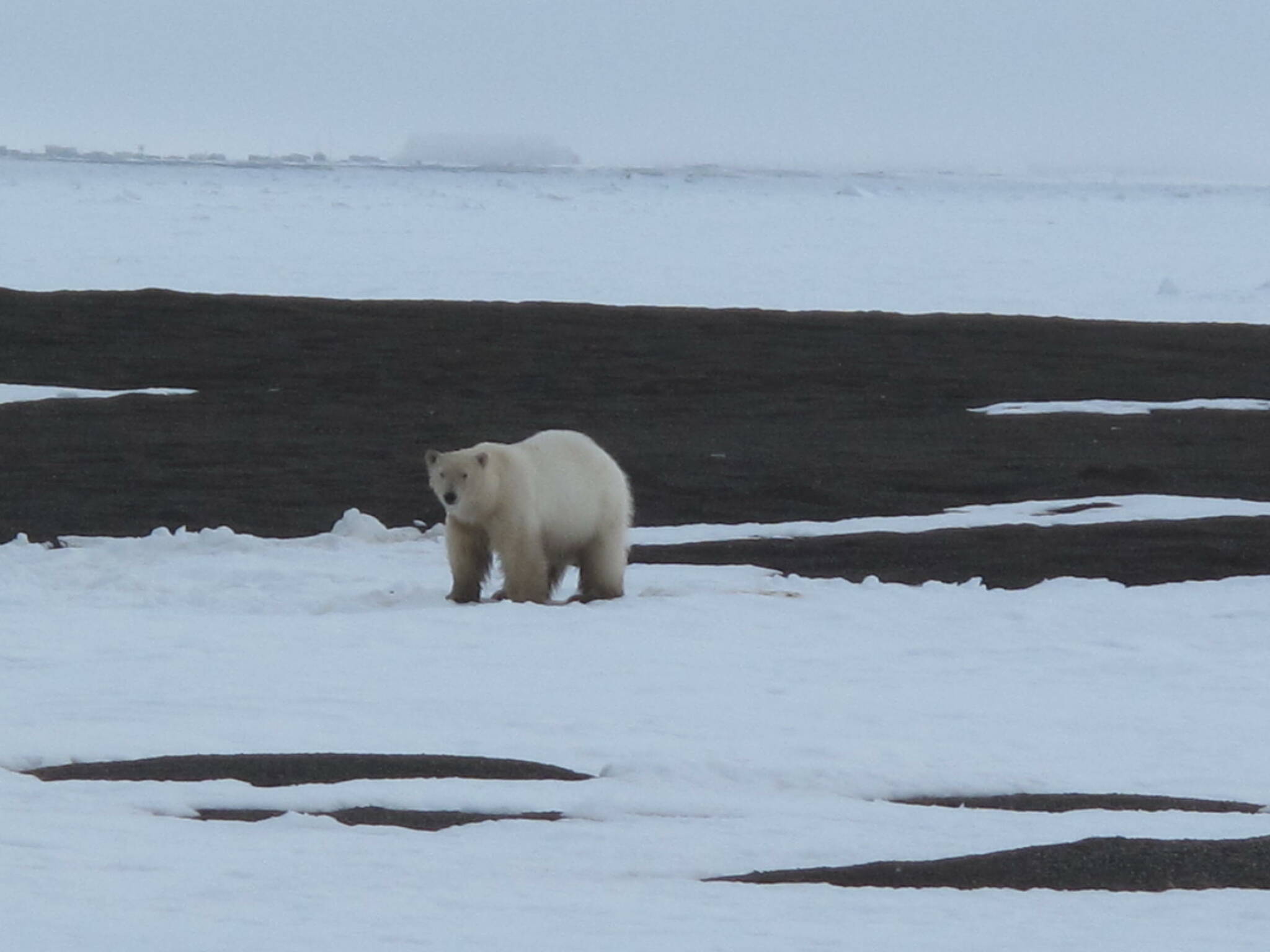
In a recent paper, scientists wrote that a small population of polar bears living off Greenland and Arctic Canada increased by 1.6 times when they compared the numbers from the 1990s to 2013 and 2014. They concluded that lighter sea ice might have benefitted the animals.
That’s because sunshine penetrates thinner ice better, which stimulates small living things. That means more food for seals, the main food of polar bears.
The scientists, led by Kristin Laidre of the University of Washington’s Polar Science Center, concluded in their May 25, 2023, paper in Endangered Species Research that “these benefits are likely temporary given predictions for continued climate change.” In the long run, they concluded, the further loss of ice means less of a platform from which polar bears hunt.
But just how grim is the situation for the giant carnivores that depend on ice floating on northern oceans? A while ago, analysis of an ancient jawbone led scientists to believe that polar bears survived a period that was warmer than today.
Sandra Talbot, formerly of the U.S. Geological Survey’s Alaska Science Center and now with the Far Northwestern Institute of Art and Science in Anchorage, was among scientists who wrote a 2010 paper on a polar bear jawbone found amid rocks on a frigid island of Norway’s Svalbard archipelago.
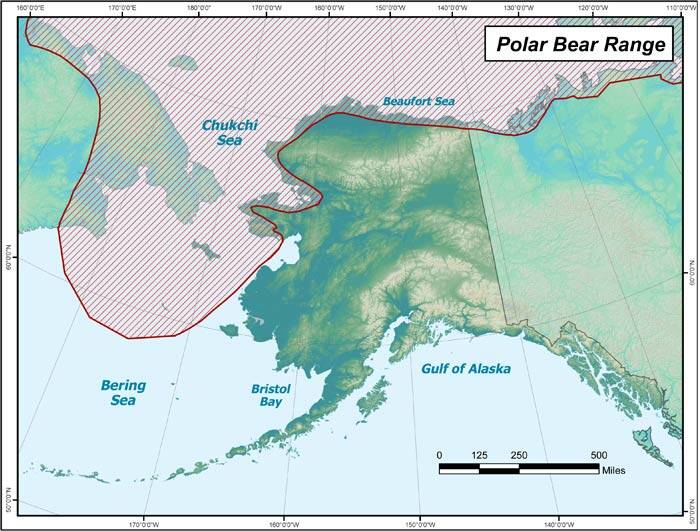
The range of polar bears on land and sea ice around Alaska. (Alaska Department of Fish and Game)
The scientists determined the bear was an adult male that lived and died somewhere between 130,000 to 110,000 years ago, and that bear was similar to polar bears today. Charlotte Lindqvist of the University at Buffalo in New York was the lead author on the paper, published in the Proceedings of the National Academy of Sciences.
An Icelandic researcher had found the fossilized lower jawbone, in excellent condition and complete with a canine tooth, on a narrow spit of land on the far west edge of Svalbard. There aren’t many fossils of polar bears around. The largest bears in the world spend most of their lives on sea ice, so they often die there, and their remains either sink or get scavenged by something else.
With bone and tooth in hand, scientists got to work with the latest techniques for finding the age of formerly living creatures and determining their genetic backgrounds. The latter is the specialty of Talbot, a research wildlife geneticist who earned her doctorate at the University of Alaska Fairbanks.
Talbot said the evidence of a polar bear from 130,000 years ago showed the creatures somehow survived conditions warmer than they face today.
“This is verifying that the polar bear lived through at least one warming period,” Talbot said. “The Eemian was a very hot period and polar bears survived it.”
During the Eemian, about 125,000 years ago, the planet was warm enough that hippos lived where London is now. Polar bears, now adapted to eating seals that live only near sea ice, somehow made it through a few thousand years when there may not have been much sea ice, if any existed at all.
“It gives us hope that they survived that stage,” Talbot said. “It does make you think about refugia more.”
“Refugia” are places that polar bears may survive without ice. Svalbard may have been one of those places. Biologists today think polar bears would have a difficult time living solely on land, because other species like the grizzly bear could outcompete them (though there are no grizzly bears in Svalbard today).
The warm period of the Eemian might have come at a time when the polar bear wasn’t such an ice specialist, Talbot said.
“We can’t predict whether the polar bear is too far out (in its evolution towards a life on ice),” she said. “It’s interesting that there are a few examples of hybridization (between polar bears and brown bears). That’s something worth watching.”
Maybe polar bears have been trying to adapt to life on land, but one species has blocked that avenue of evolution. Polar bears that wander onto land, especially near a human settlement, tend to get shot. And humans — who didn’t wander out of Africa until about 45,000 years ago — weren’t present on the edge of the sea ice when polar bears first made it their home.
“We weren’t impacting them then the way we are now,” Talbot said.
• Since the late 1970s, the University of Alaska Fairbanks’ Geophysical Institute has provided this column free in cooperation with the UAF research community. Ned Rozell is a science writer for the Geophysical Institute.
