

“We found microplastics in every single rain sample (gathered in Juneau),” Sonia Nagorski told a group of people listening to her talk at the American Geophysical Union Fall Meeting in New Orleans two winters ago.
Nagorski — a professor at the University of Alaska Southeast in Juneau — was presenting via her computer while she sat in Alaska’s capital city during the New Orleans conference. Not long after she disappeared from the screen, she replied to a list of questions emailed to her:
What inspired you to do this study?
“When I started reading about plastics being detected virtually everywhere on Earth — from the bottom of the Mariana Trench to the Arctic Ocean; in rivers, lakes, and even in the air we breathe — I wanted to know how much was in Juneau.
“In the fall of 2019, I taught a new course on plastic pollution. I had twice as many students as expected. I decided to make use of the high number by sending everybody out to various environments in Juneau to collect samples.
“We collected water and sediment from various streams, lakes, and beaches; from the Mendenhall and Herbert glaciers, and we collected rainfall.
“We were amazed by how many small plastic fibers and fragments we easily found, especially considering we were seeing only a fraction of them using our fairly simplistic methods. In 2020-2021, I collected rain and snow samples with a couple of students, and added to the dataset I built with the class.”
What is a microplastic?
“A piece of plastic less than 5 millimeters in size, about the length of a grain of rice or smaller. So, you can see those that are at or close to 5 millimeters, but it’s very difficult to see much smaller than that without close inspection or a microscope.”
How does a Clorox bottle or a scrap of plastic wrap become a microplastic particle?
“Plastic doesn’t really biodegrade, at least not on the scale of centuries or maybe even millennia. Instead it mechanically breaks apart into smaller and smaller pieces as it’s tossed around by waves, water, or wind, or driven over by vehicles. It can also become weakened and fragmented when baked in the sun.”
How did microplastics get everywhere on Earth, even Alaska?
“Microplastics are either intentionally manufactured so small, or come from larger plastics that break apart into smaller and smaller pieces over time. Humans are pretty much everywhere, and we bring plastics with us. Plastics are also dispersed via the atmosphere and ocean currents.
“Here in Juneau, microplastics get into the environment every time there’s a food wrapper left on the ground to be washed into a stream and into the channel, or a plastic bag picked up by the wind.
“Based on studies elsewhere, a major source is from the wear-down of car tires (which are partly composed of synthetic rubber) and brakes on cars. The laundering of synthetic fabrics is also a common source.
Where did most of the Juneau microplastics come from?
“If local sources were important, then we’d expect to see more microplastics in the Mendenhall Valley, for example, where there are lots of roads, houses, and other human development and activities, but we didn’t find that.
“Given that many of the microplastics in the rain seem to be coming in from elsewhere, I can only suspect that most of it is coming from the Pacific Ocean, because this is the source of most of our wind and rain.
“Other researchers have looked into the mobilization of microplastics off the upper ocean, noting that they are generally low-density, lightweight, accumulate near the surface, and can be aerosolized easily by wind or wave action.”
Despite Juneau’s extreme amounts of rain, ALL your samples had microplastics? Why wouldn’t they get washed out?
“Yes, they all had microplastics, and quite a few (an average of 57 fibers and fragments raining down on every square meter per day, about half of what has been measured in the Lower 48).
“I’d collect the samples every one to three weeks, and so they were a composite over many rainy days. So, I don’t have the resolution over the course of a storm, but the samples indicate a large and steady source.”
Do microplastics harm animals? Human animals? Seems like we must ingest them all the time without noticing.
“While larger plastics (fishing nets, six-pack rings, bottle caps) are well known to entangle and starve animals, the effects of microplastics are less well understood. There is some evidence of them being harmful, and they can be carriers of other contaminants.
“We most certainly ingest microplastics all the time. It’s in the soils, dust, plants, seafood, and even the salt we sprinkle on our foods. Plastic packaging breaks off onto our food, and plastic water bottles can shed particles into water. We might be eating a ‘credit card’ per week [according to a study by researchers at the University of Newcastle in Australia].”
Are there microorganisms that eat microplastics?
“Yes, there have been some lab studies showing that there are some microbes and fungi that can break down microplastics, at least on a petri-dish/lab scale.
“It is really important that more research goes into producing sustainable substitutes for plastic and promoting less consumption, better waste management, recycling, and microbial breakdown of existing plastic.”
• Since the late 1970s, the University of Alaska Fairbanks’ Geophysical Institute has provided this column free in cooperation with the UAF research community. Ned Rozell is a science writer for the Geophysical Institute. This column originally ran in 2021.
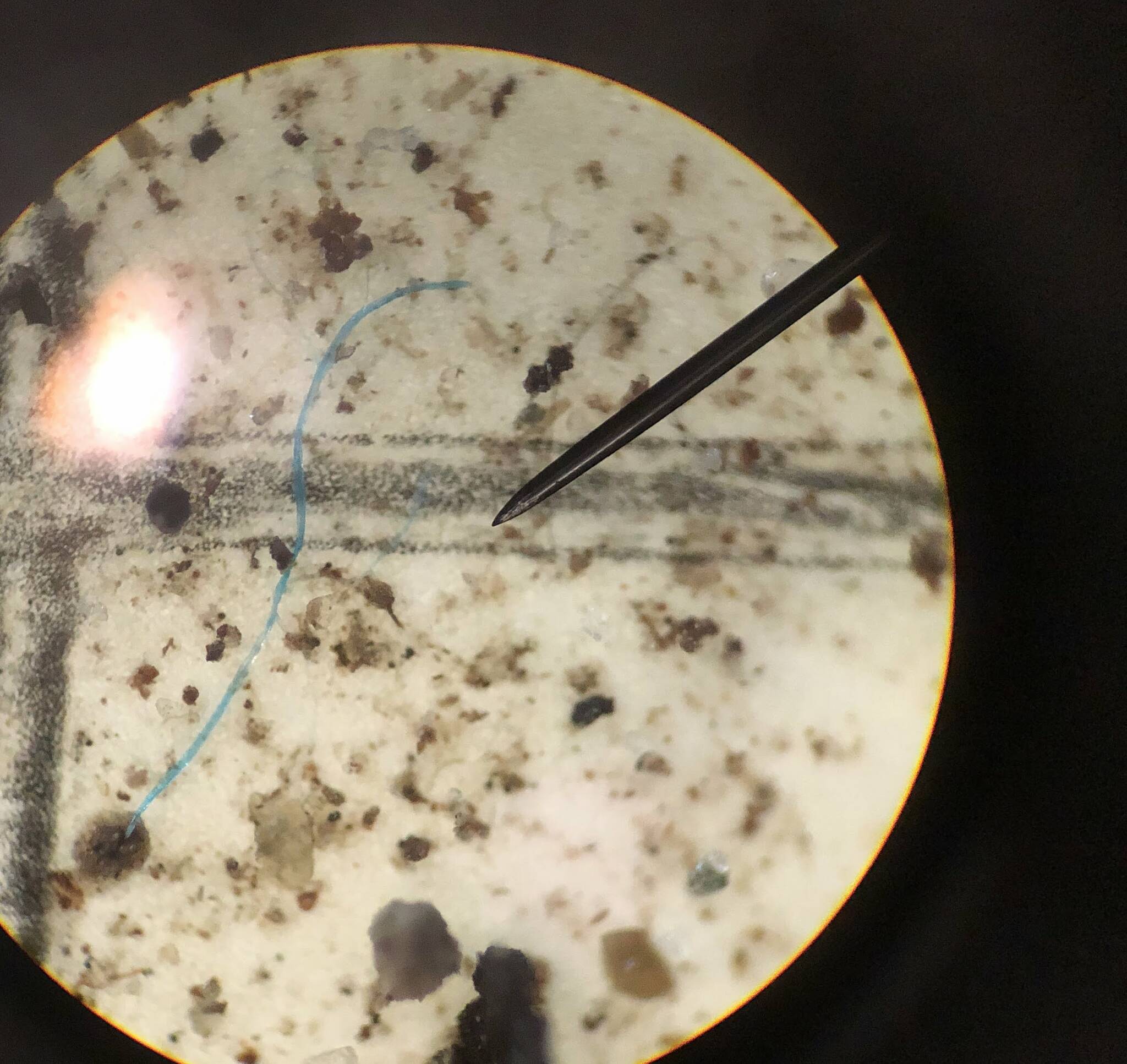
A tiny blue plastic fiber that fell within a raindrop in the Thane area of Juneau. The view is of filter paper that captured the plastic fiber, as viewed through a microscope. (Photo courtesy Sonia Nagorski)
