
By Ned Rozell
NORTH OF COLDFOOT — The lynx looks out from inside a chicken-wire cage. Despite its loss of freedom and the nearby squeaking of boots on cold snow, the wild cat looks calm, as if it might be resting while digesting a snowshoe hare.
Knut Kielland, a professor with UAF’s Department of Biology and Wildlife, used to trap lynx for their fur. Here, he has captured this 22-pound female lynx as part of an Alaska-wide project he leads to better understand the ecology of the animal.
He started live-trapping lynx back in 2008, at the Bonanza Creek Long Term Ecological Program in the forest near Fairbanks. Here north of the Arctic Circle, Kielland partnered with Donna DiFolco of the National Park Service in 2014 to study lynx.
Expanding what Kielland started, biologists at both Tetlin and Yukon Flats national wildlife refuges are also trapping and following lynx, as have scientists with Kanuti and Koyukuk-Nowitna refuges.
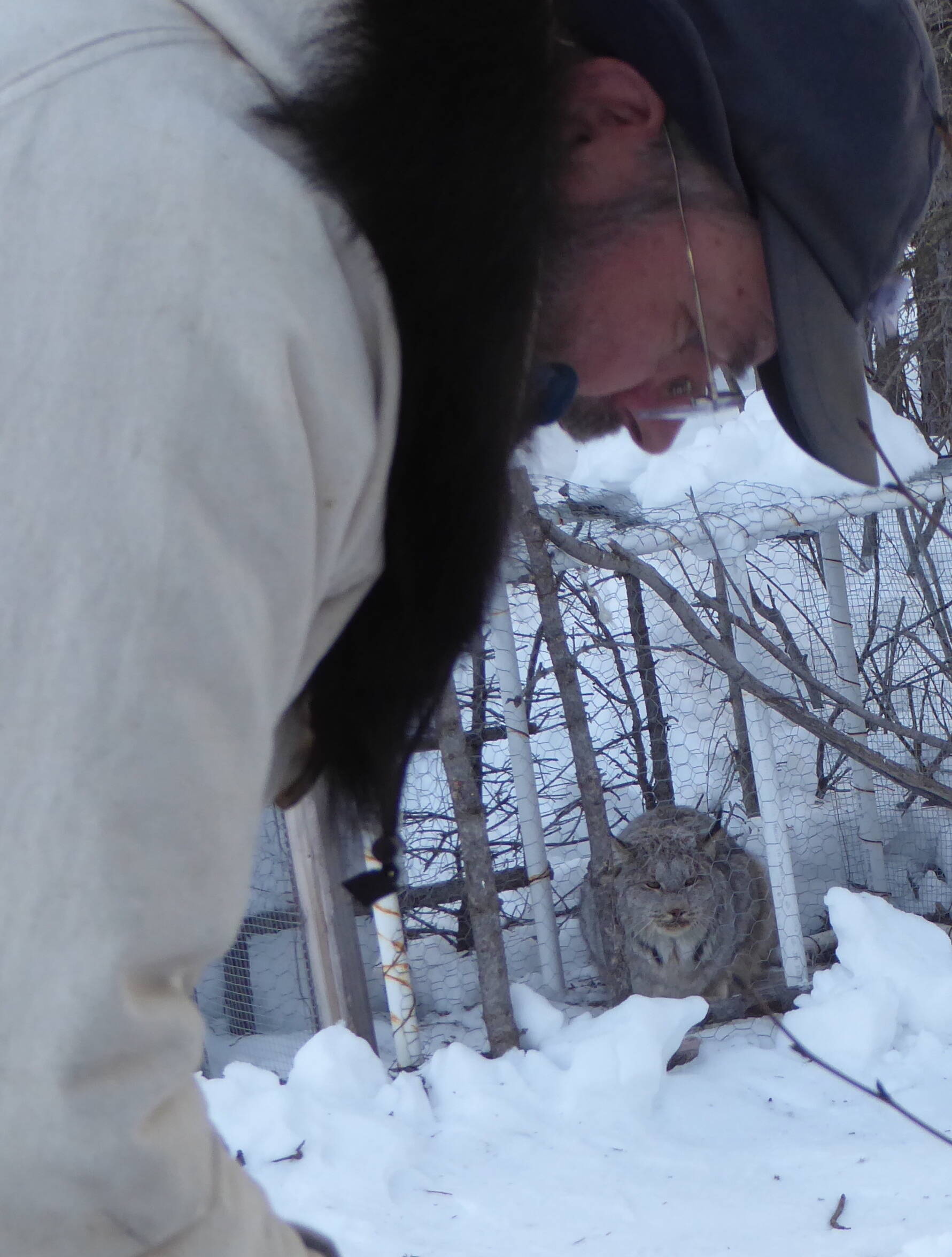
A female lynx watches UAF ecologist Knut Kielland from within a live trap. (Courtesy Photo / Ned Rozell)
In hushed tones, Kielland asks for help in preparing a syringe attached to a pole. He measures out a dose of anesthesia that will immobilize the lynx for one hour.
While Kielland works, the lynx stares out, not blinking. This is maybe the same animal that visited this same trap one week ago, after Kielland wired the guillotine-style door open with bait inside.
With the local snowshoe hare population at a low in its cycle and food harder to come by, this lynx returned to the trap in which Kielland hung a roadkill grouse he stopped for on his drive up the Dalton Highway.
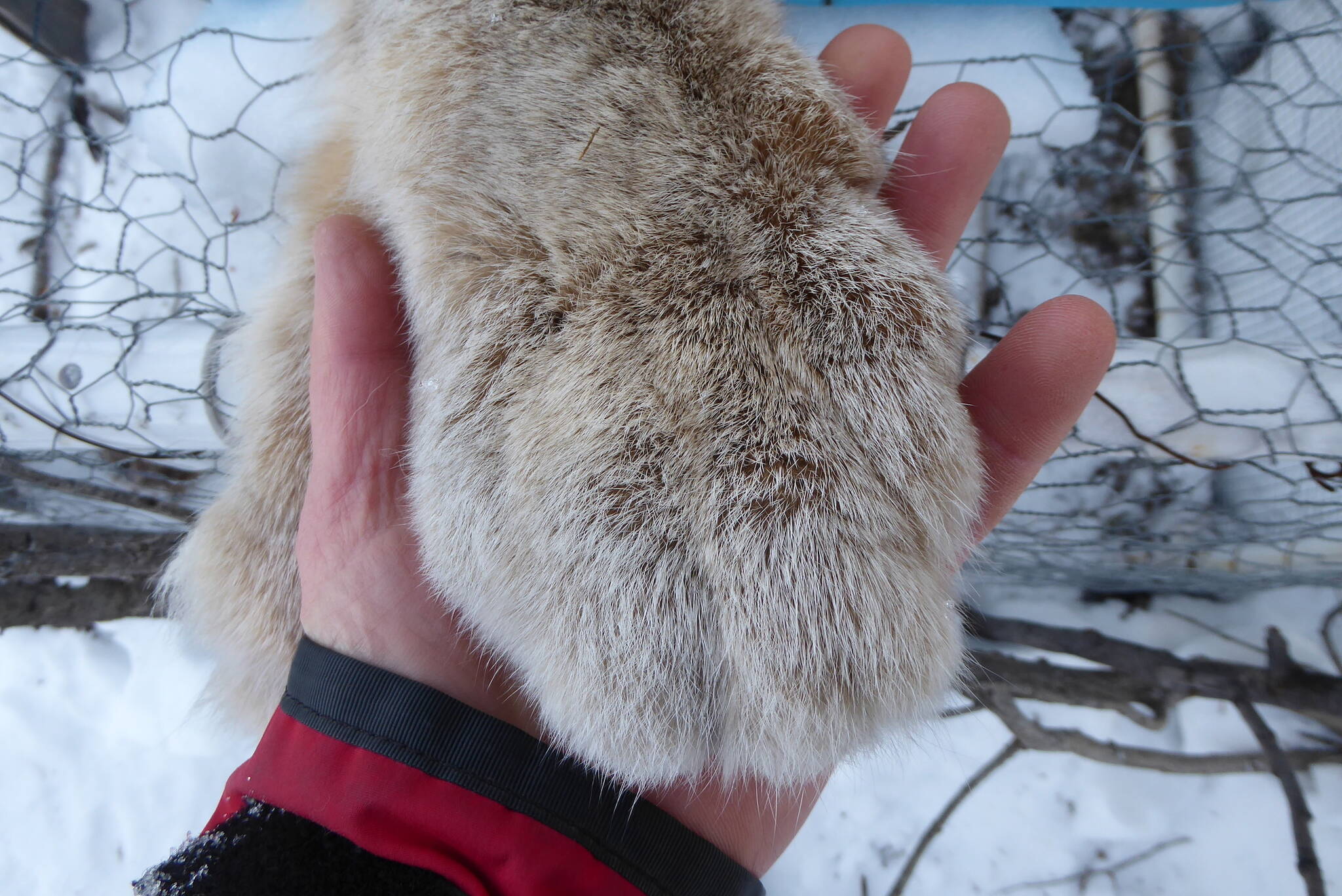
The female stepped inside the trap and pressed a broad paw on a rectangle of plywood. That action stretched a wire that pulled a bolt from the trap door, which fell shut.
Kielland approaches the trap with his syringe attached to the 4-foot metal rod.
Through the chicken wire, Kielland pokes the lynx in a rear haunch. The cat jumps, and then settles down. Its tongue darts in and out of its mouth. Kielland knows this serpentine reaction means the drug is working.
[Alaska Science Forum: Happenings north of the Arctic Circle]
After a couple of minutes of silence, Kielland whispers to me.
“Go up and tell me what you see.”
I take a few steps toward the trap.
“Looks like it’s sleeping,” I say.
Kielland waits another minute. He approaches, and then pokes the lynx with a dead spruce branch through the chicken wire. It doesn’t move.
He then pulls up the trap door and secures it with the bolt. He reaches in and gently pulls out the lynx, much as he once lifted his sleeping daughters off the couch. He lays the limp cat on a foam pad on top of the cage.
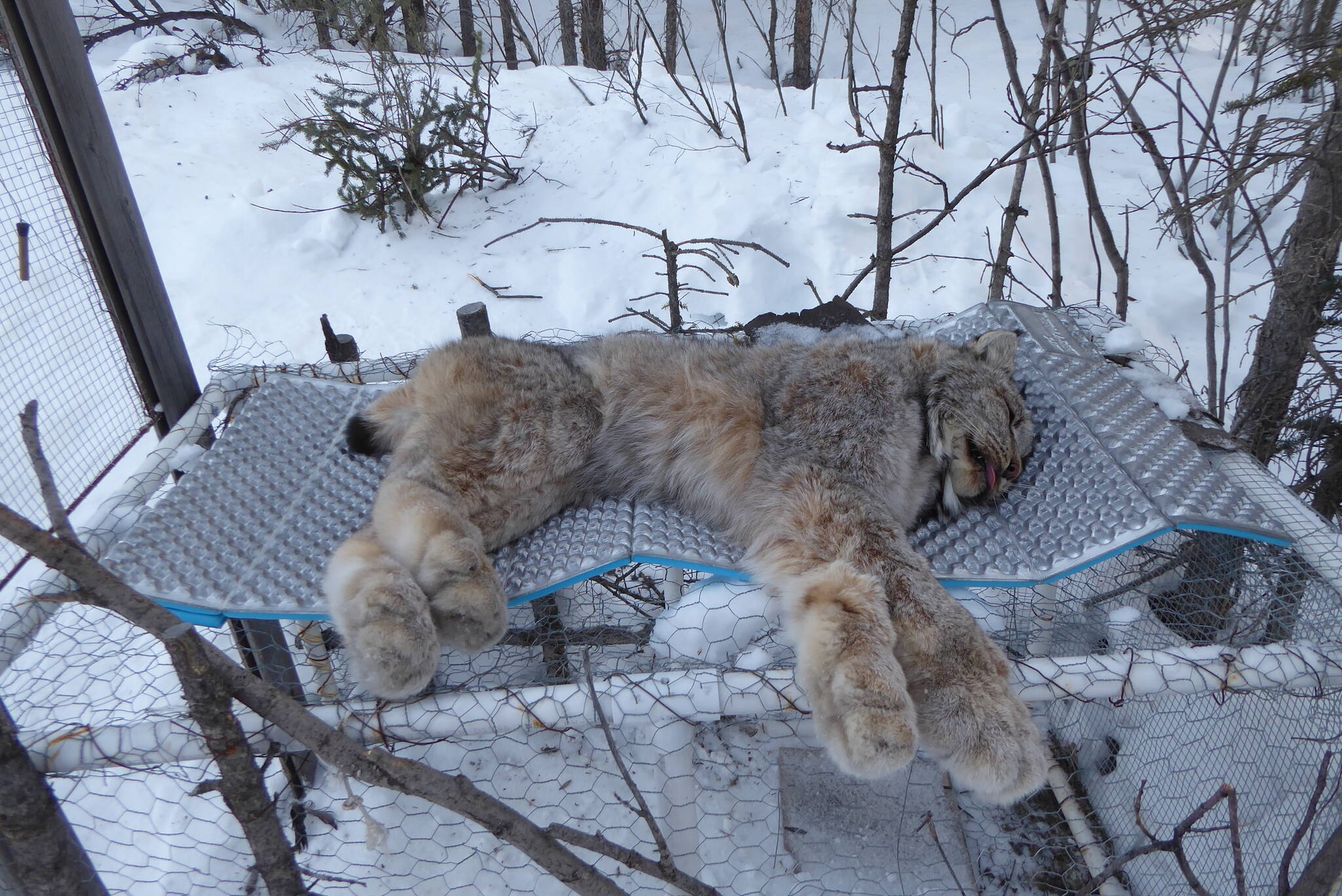
A healthy female lynx lies anesthetized for about an hour on top of the cage-trap that captured it north of the Arctic Circle. (Courtesy Photo / Ned Rozell)
In the 10-degree F air, I pull my hand from a mitten. Here is a rare opportunity to touch a wild living creature. I place my hand on the small of the lynx’s back. I feel it breathing, steady and slow. I don’t feel heat through its thick, supple fur until I press down.
The trapper/ecologist who lost his taste for killing things like lynx has handled many live animals. He works fast and sure.
He lifts the cat’s leg and squints, determining the lynx is a female (he had guessed male, because of her large head and lanky body). He feels the animal’s sides and belly.
“She’s pretty lean,” he says.
He reads the animal’s pulse and blood-oxygen level with an instrument attached to a plastic clip that pinches the lynx’s tongue. He measures the length of its hind foot and its ear tufts, the latter with his middle finger.
“Some of us are lucky enough to have finger segments that are each exactly an inch long,” he says.
He adjusts a plastic collar to the thickness of the lynx’s neck by matching up holes in the strap. He secures the two collar bolts with a nut-driver. The block of transmitter and battery on the collar will allow him to see where the animal wanders via satellite. The device also has a timer: the collar will pop off the animal this August and fall to the forest floor.
As the lynx begins to twitch, Kielland performs the final task — installing a small metal ear tag with a specialized pair of pliers. As he squeezes, the lynx looks at me with blazing yellow eyes; I imagine that chilling look as the last thing a snowshoe hare might see.
With the science completed, Kielland returns the lynx gently to the cage. He wants it to recover from the drug before he sets it free. The anesthesia is wearing off.
Soon, the animal recovers. He lifts the door and it leaves the cage. The lynx wanders toward the frozen creek, disappearing into the spruce forest.
“I sure hope she stays around,” Kielland says.
The ideal scenario for him and his fellow researchers is that this female would mate and give birth to kittens here in the blue-and-white valley of the Dietrich River. But several of the lynx collared here — the first lynx in Alaska ever fitted with satellite collars — took off.
One wandered to Cape Krusenstern on the Chukchi Sea north of Kotzebue, a place with tundra vegetation that does not nourish snowshoe hares. Another, nicknamed Goldie, roamed from here to Norton Sound, passing near the villages of Koyuk and Shaktoolik before continuing to the mouth of the Yukon River. A third went all the way to British Columbia in Canada, a distance of 1,000 miles.
Lynx have also traveled far from all the other study sites in middle Alaska.
“One thing we learned is their capacities for dispersal,” Kielland said. “Not only the sheer distance, but straight across country, sometimes almost on a compass bearing.”
The scientists noted was that during peak hare populations, lynx can have lots of kittens.
“Lynx are supposed to have two to four kittens, but we found litters of five, six, seven and eight,” he said.
His trail cams, placed near each live-trap, have also captured images of males and females hanging out together at times other than breeding season, and kittens staying with their mothers for nearly the entire first year of their lives. Researchers thought lynx were more solitary than that.
Why do the boreal-forest lynx take off, even to where there are no trees (or their favorite food, snowshoe hares)?
Scientists don’t really know that answer yet, but they suspect that hunger is a major driver.
Before his three weeks is over here in the Brooks Range north of the Arctic Circle, Kielland will spend many hours baiting, setting and checking his 20 live-traps along a 56-mile line he accesses by truck and foot along the Dalton Highway. He will capture and collar one more lynx, a male Kielland and his helpers saw on trail-camera images last fall.
He will return home and to his office at the University of Alaska Fairbanks Institute of Arctic Biology. There, he will log into his computer and see where the recently trapped female lynx is roaming. As of this writing, she is wandering the hillsides and creek bottoms within a few miles of where she stepped into the trap.
In early June, she may show a tight pattern of location dots in the same area around Wiseman, lingering at a hidden den site on the flank of a mountain. There, she might give birth to the next generation of cats surviving at the limits of the great northern forest.
• Since the late 1970s, the University of Alaska Fairbanks’ Geophysical Institute has provided this column free in cooperation with the UAF research community. Ned Rozell is a science writer for the Geophysical Institute.
