
One of the downsides of the oil-based materials that keep us warm is that they spew a lot of carbon into the atmosphere when they are made. And those blue and pink sheets of foam insulation never die, often polluting the land and floating on our waterways when we are done with them.
A few Alaska researchers are working to create insulation that removes carbon from the atmosphere and stores it for the life of a building and beyond. When a structure is at the end of its life, the insulation between the walls makes a fine soil.
Robbin Garber-Slaght is a Fairbanks engineer who works for the National Renewable Energy Lab’s Cold Climate Housing Research Center. She notes that Alaskans pay more than double the national average to keep their homes warm during the winter and also pay a lot for sheets of foam insulation, which travels a long way to get here by truck and boat.
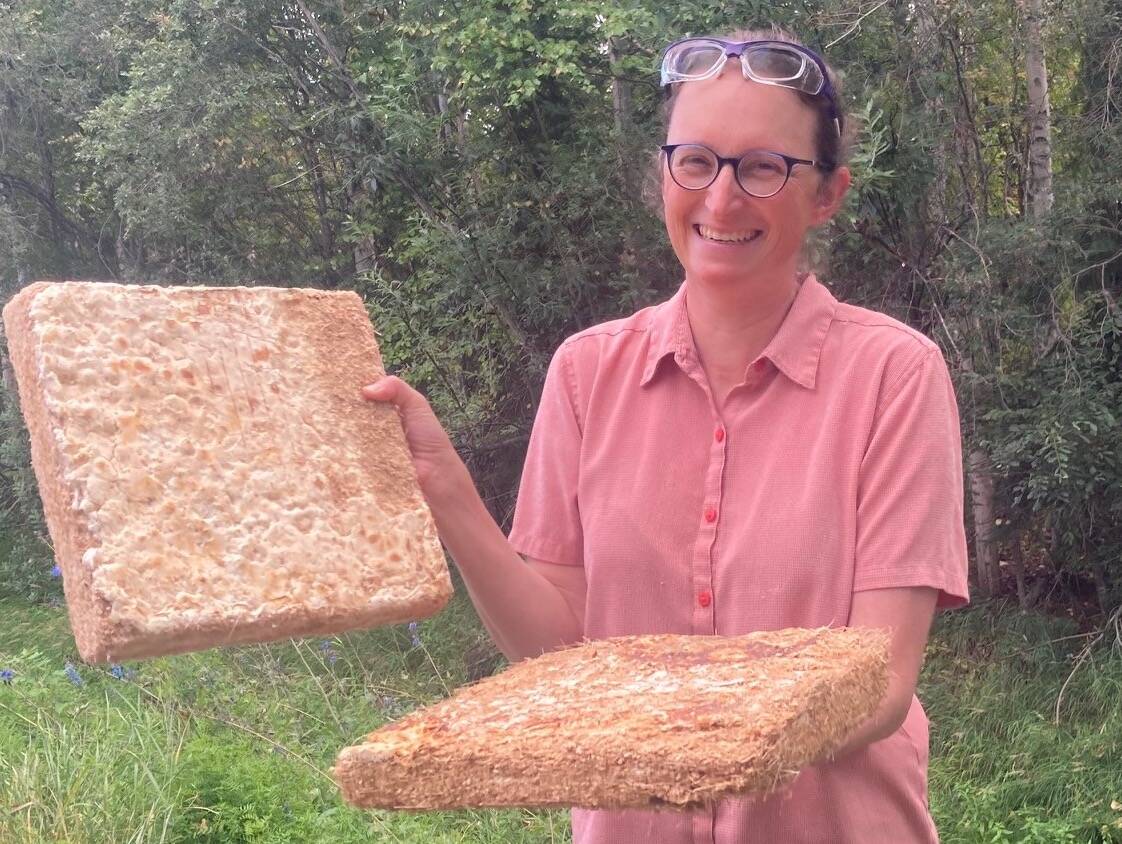
Engineer Robbin Garber Slaght holds prototype insulation panels made of wood fiber held together by a fungus species. (Courtesy Photo / Molly Rettig)
She is teaming with Phillipe Amstislavski to develop insulation boards made of wood fiber bound by mycelium, the root-like tendrils of fungus.
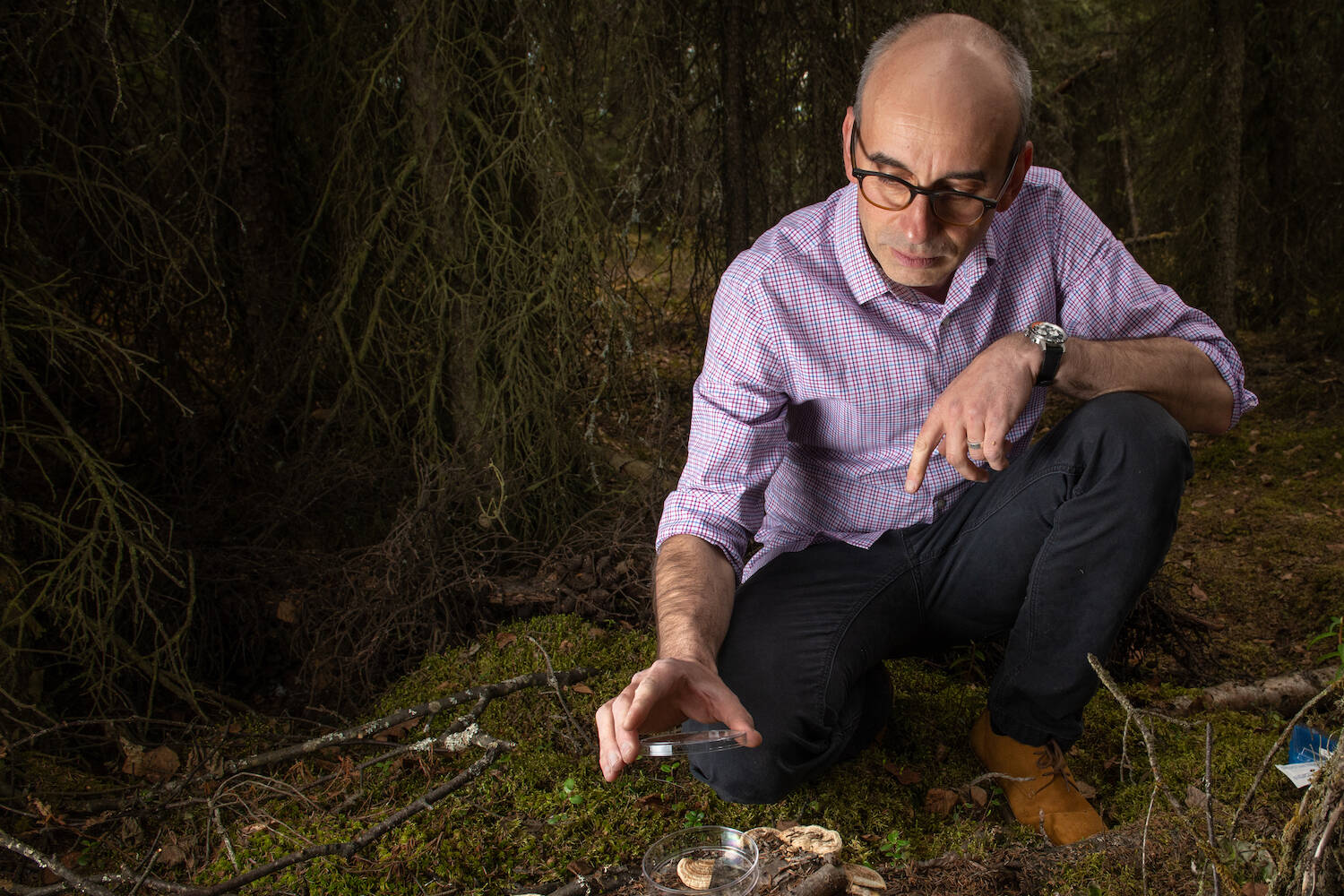
Amstislavski, a mycologist (fungus expert) explained the idea by phone from his biomaterials lab in Anchorage, where he is a professor at the University of Alaska Anchorage.
The scientists aimed at rethinking housing materials because about 75 percent of buildings worldwide are homes. Plastic foam insulation has the second-highest carbon-dioxide emission during manufacture, just behind steel production.
“We thought, ‘How can we turn buildings materials into carbon storers instead of emitters?’” Amstislavski said.
Garber-Slaght and Amstislavski say their biological product has a similar insulative value to foam, repels water but doesn’t trap it, and can be produced in Alaska so it doesn’t need a long ride.
Here are details of their idea:
Certain types of fungi digest wood fiber; we can see it happen when conks form on birch trees.
While a Fulbright scholar in Finland with the VTT Research Centre, Amstislavski learned how to transform wood into a foam that’s easy for mycelium fungus to digest.
Mycelium fungus cells feed off wood fibers and form a dense matrix, kind of like a sponge. When that living mixture grows into a batt of insulative material, the researchers stop its growth by drying it.
Garber-Slaght and Amstislavski have created insulation panels using ground-up birch and spruce wood, which they are working to make fire-resistant.
Garber-Slaght envisions a portable insulation-making system that can be shipped to communities — perhaps those with lots of spruce trees killed by the bark beetle — for use as the woody raw material.
“They can process the trees, and out comes mycelium insulation in boards,” she said. “It would save on shipping insulation (to remote communities). Instead of shipping six containers of foam, we ship one conex and a harvester.”
Amstislavski has already produced experimental mycelium coolers for shipping frozen seafood from Alaska. He thinks the new project with Garber-Slaght is a needed step to keep carbon dioxide out of the atmosphere and plastic out of the ocean, and is worth his effort.
“If not now, when?” he said, quoting the Jewish sage Hillel the Elder.
Garber-Slaght, who worked for years to make housing more efficient in rural
Alaska, says this is a product she wants for those communities.
“Grow your own house, why not?” she said.
• Since the late 1970s, the University of Alaska Fairbanks’ Geophysical Institute has provided this column free in cooperation with the UAF research community. Ned Rozell ned.rozell@alaska.edu is a science writer for the Geophysical Institute.
