
By Ned Rozell
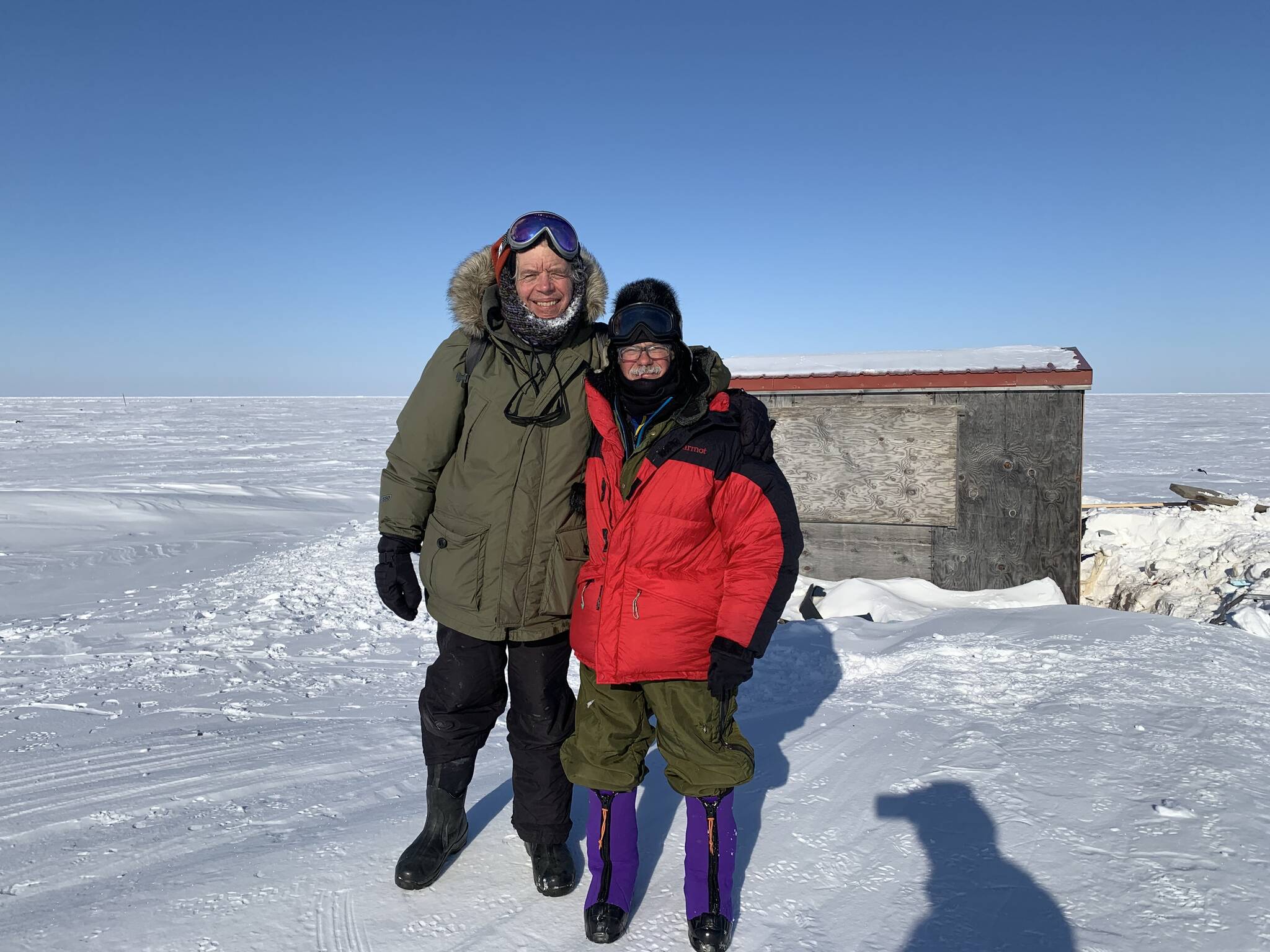
This June, George Divoky will refurbish a cabin that sits on a lonely gravel island north of Alaska.
He was not planning a remodel this year. Sometime during the winter, a polar bear tore through a plywood wall of the cabin Divoky moved 20 years ago to Cooper Island.
Cooper Island is a crescent of gravel in the Beaufort Sea, 25 miles east of Utqiaġvik, the northernmost settlement in the United States.
With a lot of help from his friends, last week Divoky patched up the trashed shelter. He is now ready for his 48th consecutive summer on Cooper Island studying a bird that has become a symbol of a warming planet.
That bird is the black guillemot, a sleek ebony sea bird that spends its entire life in the Arctic. Fifty years ago, Divoky was doing a pre-trans-Alaska pipeline assessment of birds in the Beaufort Sea. The guillemots caught his eye.
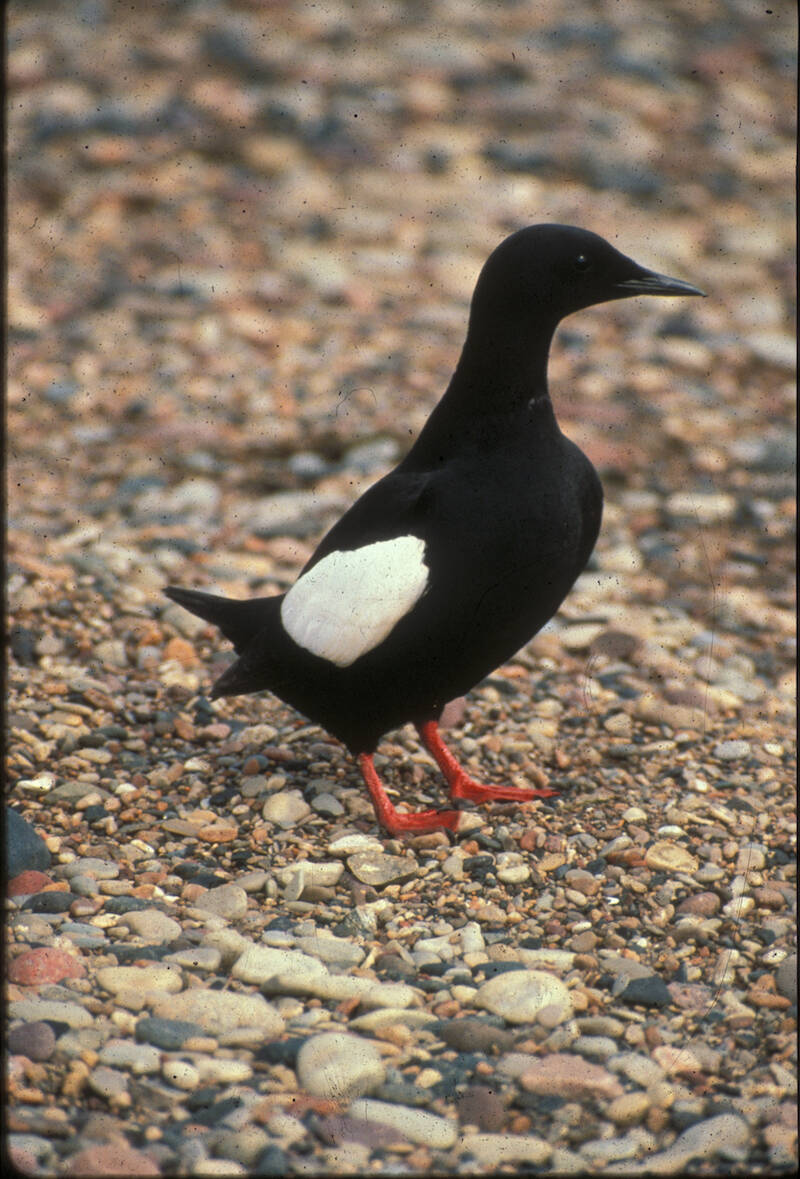
A black guillemot, sentinel of a changing planet, on Cooper Island off the coast of northern Alaska. (Courtesy Photo / George Divoky)
Three years after that, in 1975, Divoky set up nest boxes for the birds on Cooper Island, using wood left behind from a U.S. military exercise. With his nest boxes — which later evolved to polar-bear proof plastic camera cases — Divoky has charted the downward trajectory of a bird that depends on sea ice.
In the 1980s, 225 pairs of black guillemots nested on Cooper Island. Last year, Divoky counted 25 pairs.
“I had no idea for the first 15 years that this was a climate-change study,” Divoky said recently from his home in Seattle.
Black guillemots prefer to feed their nestlings arctic cod, which live in cold waters at the edge of sea ice. When sea ice was close to Cooper Island in the summers of the 1970s, 1980s and 1990s, parent birds were able to bring home rich, fatty cod.
In recent years, the ice edge has been hundreds of miles from Cooper Island during the birds’ August feeding time.
Parent birds now feed their chicks sculpin and other fish that are less abundant and less energy-rich than the cod. Divoky has watched nesting success plummet due to the shrinking sea ice, just as he watched them succeed as the ice freed up Cooper Island in the early 1970s.
He has seen other changes. During his decades of spending each June through August on the cold, foggy island, Divoky did not see many polar bears until one summer day in 2002.
“I was weighing chicks and I looked up and saw this bear walking by the tent that had the gun in it,” he said.
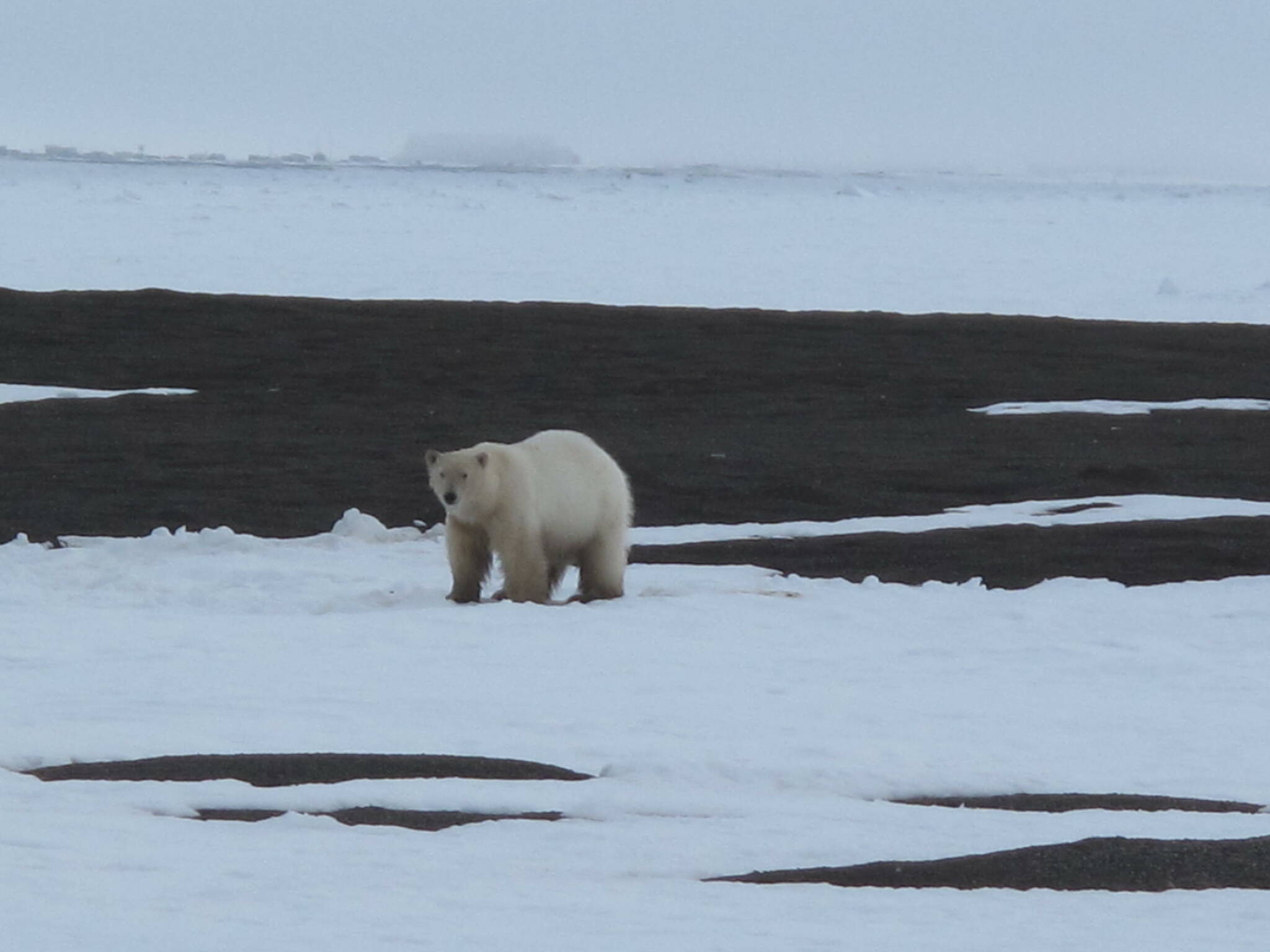
A polar bear stands near the meeting of land and sea ice north of Utqiaġvik in May 2010. (Courtesy Photo / Ned Rozell)
He encountered 16 polar bears that summer, one of which wrecked several mountaineering tents he used as a camp. He then decided he needed a more solid shelter.
A friend told him of a newly built 8-by-12-foot cabin for sale in Utqiaġvik. Local resident Barrow Brower hauled the cabin out to the island for Divoky, who has used it ever since. He has enhanced his polar-bear protection with electric fences and motion detectors.
“I’ve always felt safe there,” Divoky said.
Last week, Divoky and his friends Craig George, Geoff Carrol, John Citta and Matt Thomas — with logistical support from staffers at the North Slope Borough Department of Wildlife Management — snowmachined with supplies and tools from Utqiaġvik to Cooper Island, a bumpy 25-mile ride.
They cleaned the mess the polar bear had left (“There was almost nothing functional that could be salvaged,”) and went to work patching the wall with new plywood.
“We were out there five hours and suddenly — boom — it was all fixed,” Divoky said.
Now back in Seattle, the energetic 76-year-old biologist is ordering a new cookstove and other necessities to stock his plywood refuge on Cooper Island.
Though he sees irony in the destruction of a cabin that bears had left unmolested for 20 years (“As the colony is collapsing, now the infrastructure collapses,”) he is compelled to return to Cooper Island and the project he started the summer after Richard Nixon resigned as U.S. president.
“If I wasn’t in love with the Arctic and that colony, I wouldn’t have gone back,” he said.
Author’s note: A story I wrote about late-1800s U.S. Army explorer Henry Allen upset some Alaska Natives. I didn’t intend to cause harm; non-Natives like me can never truly understand the painful history of white intrusion on Alaska Native culture. But we can try to appreciate and learn from the past.
• Since the late 1970s, the University of Alaska Fairbanks’ Geophysical Institute has provided this column free in cooperation with the UAF research community. Ned Rozell is a science writer for the Geophysical Institute.
