
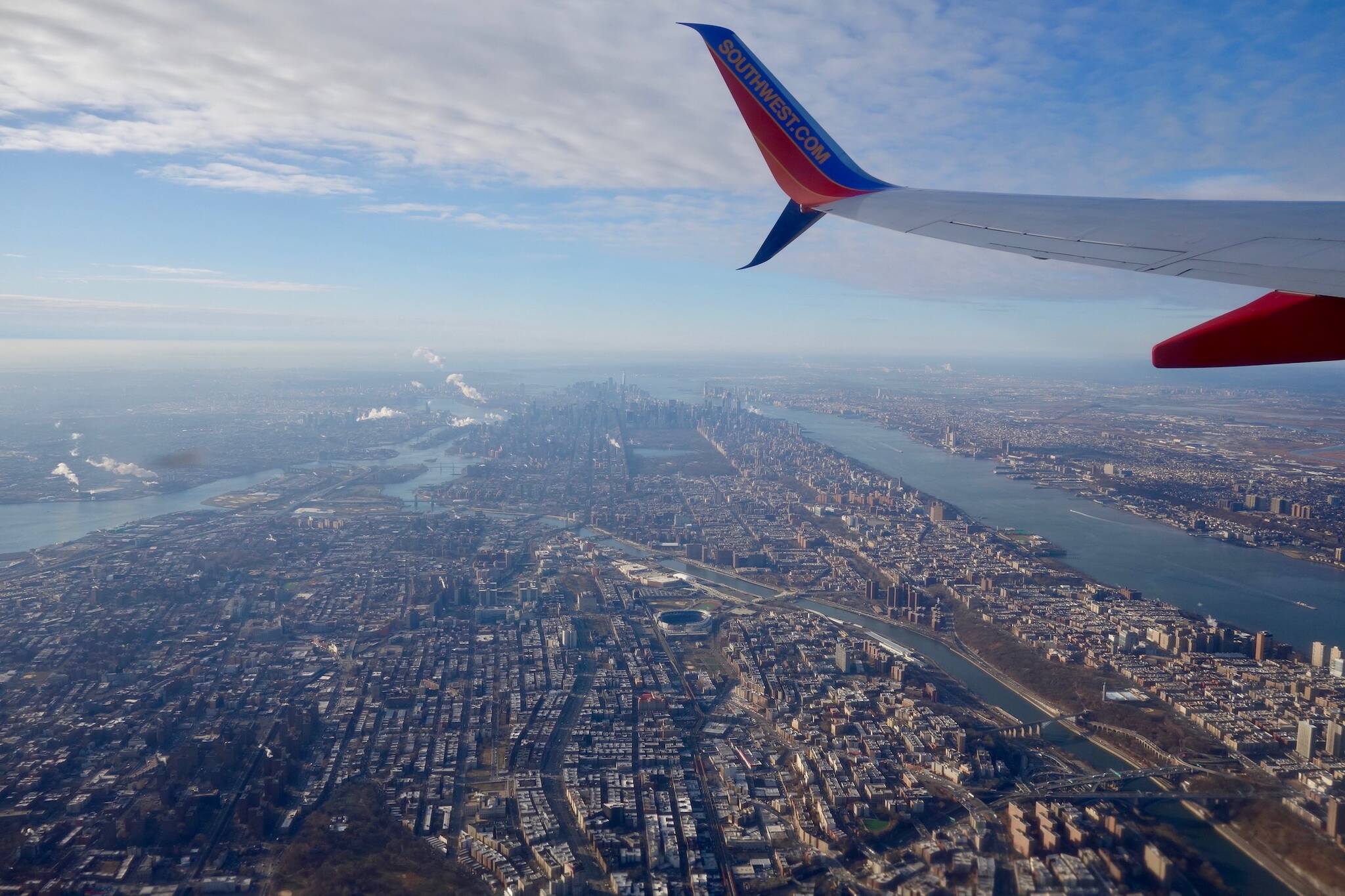
When I left my sister’s house in Brooklyn yesterday afternoon, I was 4,200 miles from my home. That’s a long way, but I slept in my Fairbanks bed before the next sunrise.
Enabling this incredible time travel are modern jet aircraft like the Boeing 737-700, which carried me and 125 others on the first leg of my journey, from John F. Kennedy International Airport in New York to Seattle-Tacoma International Airport.
I settled into my window seat to savor an experience I sometimes take for granted — the traverse of our country in one day.
As the plane roared off the busy runway, we looped over the salt water of the Atlantic Ocean. We arced westward until the pilot had the nose pointed toward the other coast.
In minutes, we were over northern Pennsylvania, the second of ten states and one province (Ontario) we would hurdle during the next 5 1/2 hours.
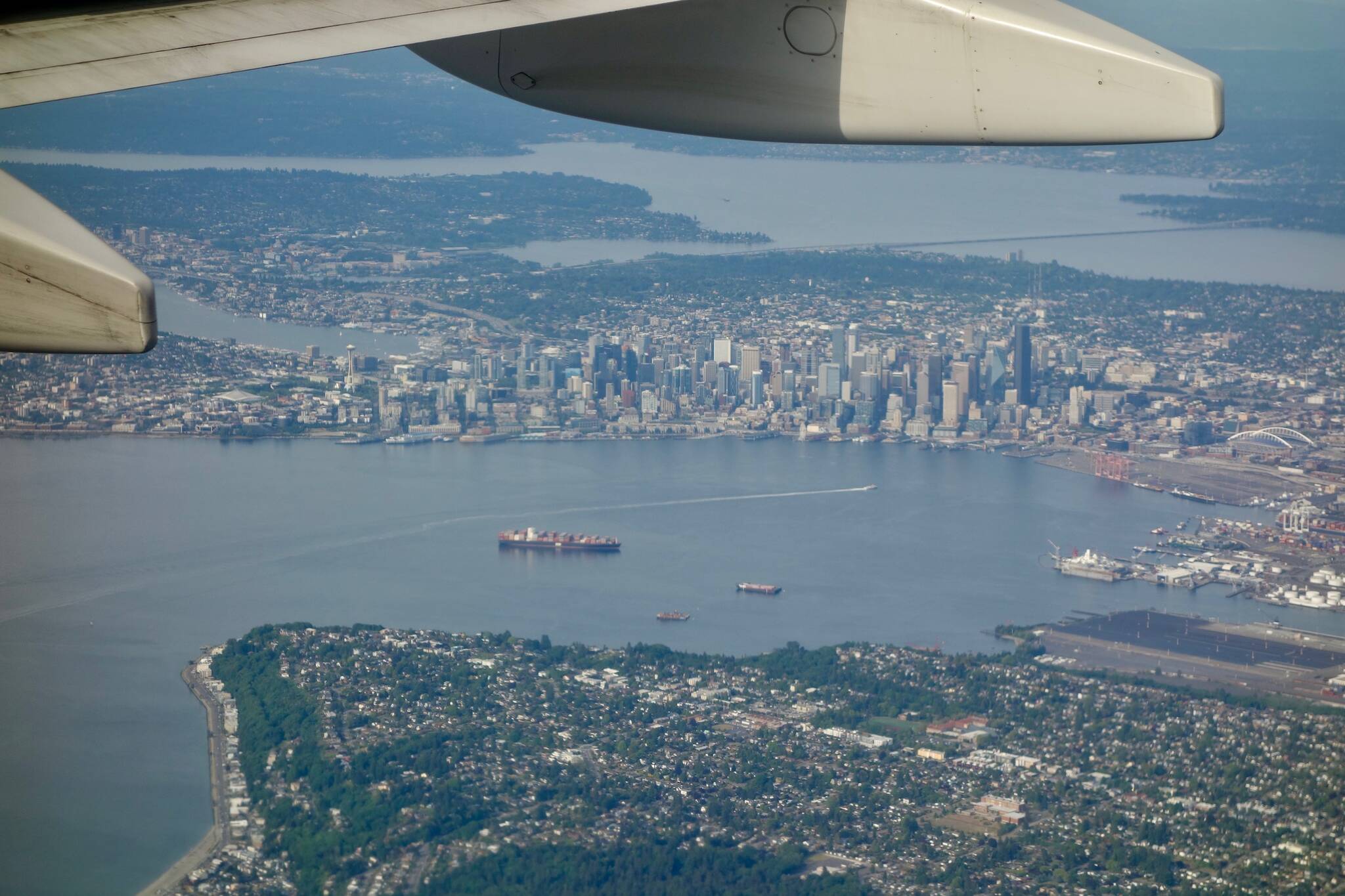
This photo shows Seattle, as seen from the window seat of a New York to Seattle flight. (Courtesy Photo / Ned Rozell)
We soon climbed to smooth air about six miles high. The pilot chose this cruising altitude because less air molecules exist up high. The plane glides with less friction, saving fuel, while the engines still have enough oxygen to combust the fuel. At that height, we were more than one mile above the tallest mountain on Earth but still more than 50 miles beneath the aurora borealis.
Tiny feathers of frost formed on my window. The temperature outside the plane was minus 62 degrees Fahrenheit. We were near the tropopause, the frigid boundary between Earth’s atmosphere and the troposphere.
That 737-700, the most common commercial airliner, carried more than 6,500 gallons of jet fuel, giving the aircraft a range of more than 5,000 miles. The pilot could have flown me straight from New Jersey to Fairbanks.
The plane burned 750 gallons of jet fuel each hour. That was about 33 gallons apiece for each passenger, which seems pretty efficient when compared to those toy trucks hauling our goods on the highways below.
As it burned, each gallon of jet fuel combined with 23 pounds of oxygen and turned into 20 pounds of carbon dioxide and just over nine pounds of water, noticeable as flowing white contrails. By taking this flight, me and the other passengers were each contributing about 800 pounds of carbon to the atmosphere, the 30-mile shell of gases surrounding Earth.
Propelled by two jet engines, we were zipping along at 514 miles per hour. Thirty-five thousand feet above St. Cloud, Minnesota, we were ten times faster than cars approaching the city, 40 times faster than a rider on horseback.
It’s hard to fathom 500 miles per hour, but we reached the border of Idaho at 6:07 p.m. Our route took us over the northern portion of the panhandle. We entered Washington at 6:15, spending just eight minutes in Idaho airspace.
We were not the only aircraft above Idaho. Workers for the company Flight Aware estimated that there was an average of 9,928 planes in the sky every moment of every day. That means 1.3 million people are now sipping a drink a few miles above our heads.
• Since the late 1970s, the University of Alaska Fairbanks’ Geophysical Institute has provided this column free in cooperation with the UAF research community. Ned Rozell, ned.rozell@alaska.edu, is a science writer for the Geophysical Institute. A version of this story appeared in 2018.
