
By Ned Rozell
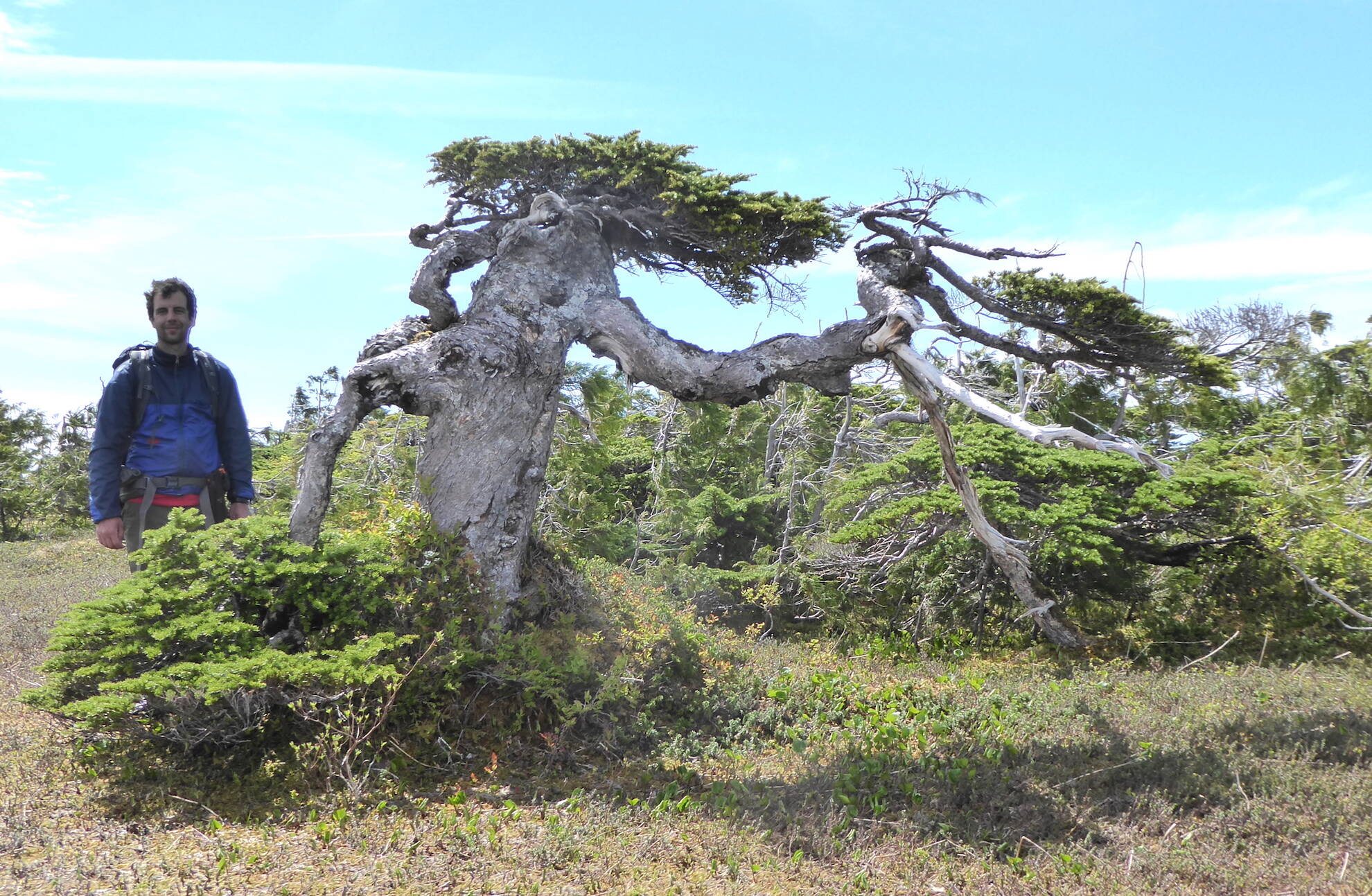
A GREEN PLATEAU NORTH OF LITUYA BAY — “These are museum-class bonsais,” Ben Gaglioti says as we walk through an elfin forest.
Gaglioti, a University of Alaska Fairbanks ecologist, has led me into another landscape I have never seen in Alaska. This terrace of spongy ground above the rainforest is home to trees that Dr. Seuss might have dreamed up.
Winter storms spinning off the Gulf of Alaska have sculpted these hemlocks on the outer coast of Glacier Bay National Park into mountain men waving at you, the letter Z, and umbrellas.
Gaglioti sees the damaged trees as messengers from the past, carrying memories of hard winters within their gnarled stems.
Here, about 10 miles north of Lituya Bay, it is breezy enough to be chilly here even on this summer day. The exposure makes it easy to imagine winter storms blasting through.
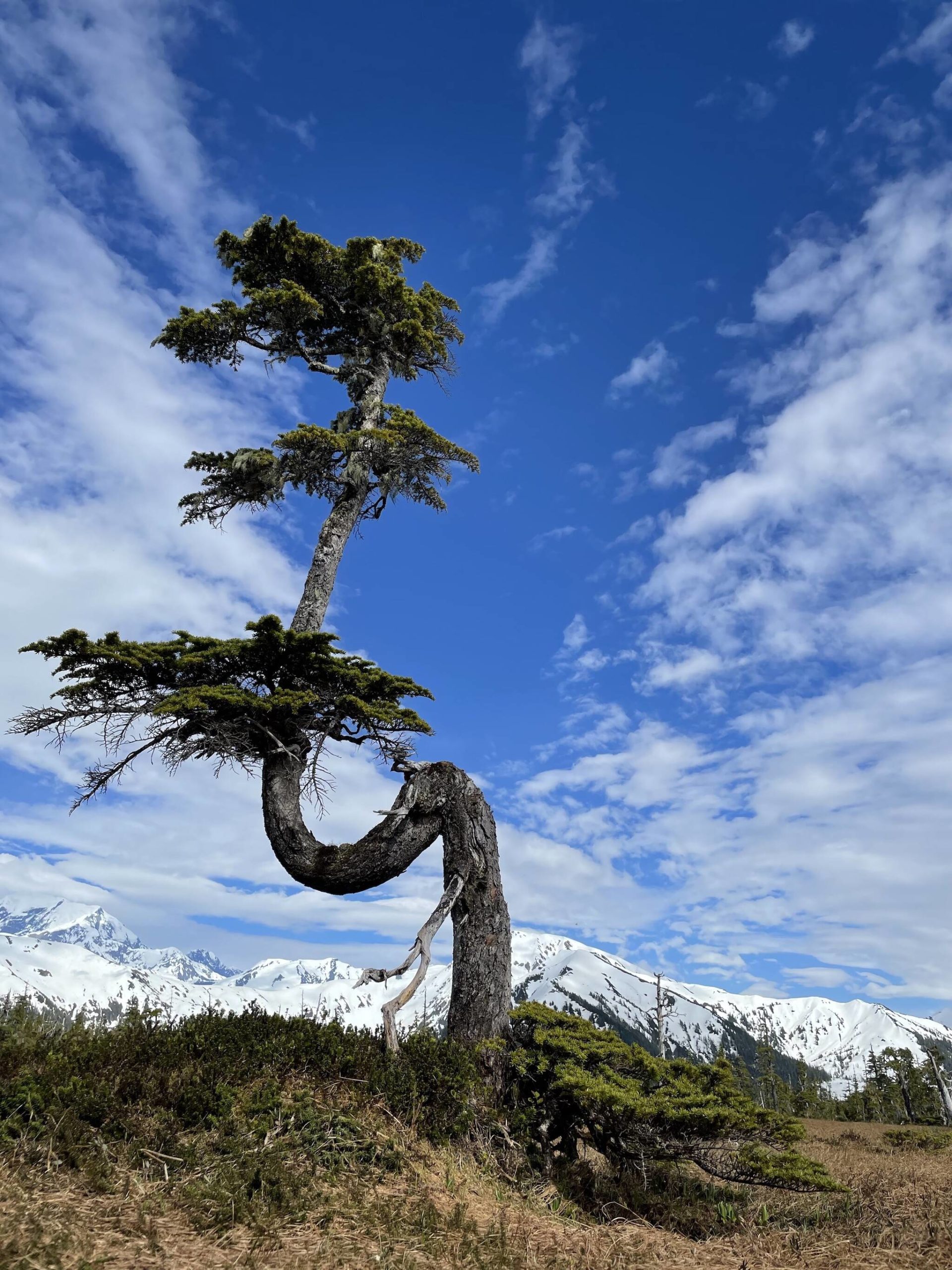
A mountain hemlock tree shaped by winter storms grows on the outer coast of Glacier Bay National Park.
“Nothing is stopping the winds between here and Hawaii,” Gaglioti says, pointing to the blue-green expanse of ocean that ends at a line that looks like you might fall off if you sailed past.
During winter storms, high winds scour these trees’ bark with ice crystals. Rime ice also forms on branches and breaks them. The trees endure, shooting out new growth, sometimes sideways.
How are these trees useful to a scientist? Gaglioti noticed these hemlocks grow a dark, resin-rich ring during the summer after a winter storm has dinged them up. Most tree-ring records are blind to what happens in winter, when the trees are dormant.
Standing on a few 1,800-foot terraces here in the rugged wilderness are crooked indicators of what has gone on in the North Pacific off Alaska during the winter for the last four centuries. Gaglioti has found this by taking tree cores.
Today, he screws an increment borer into the trees with an action that resembles changing a tire. The plateau rings with “Tock, tock, tock,” as he backs the corer out of the tree.
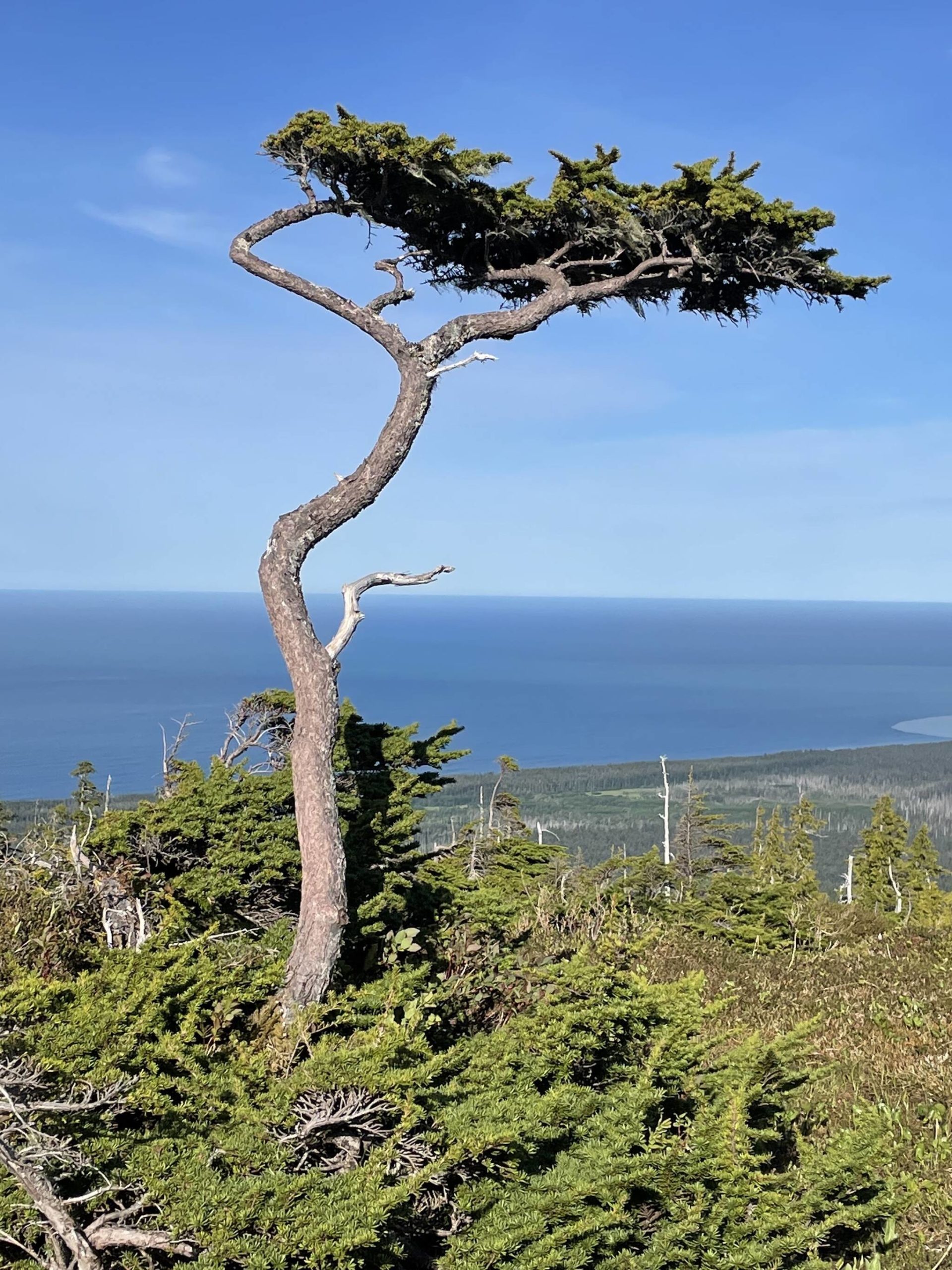
A mountain hemlock tree shaped by winter storms grows on the outer coast of Glacier Bay National Park.
He twists out a cylinder of wood thinner than a pencil. It smells like a lumberyard.
“This is a really old tree,” he says. “Really tight rings. Maybe 400 years.”
Gaglioti has seen years when a quarter or more of the trees showed the dark ring indicative of a tough winter.
With more than 300 of these cores, he was able to reconstruct the severity of winters going all the way back to about 1786, when Commander La Perouse declared nearby Lituya Bay the Port of France (before he lost 21 men at the bay’s dangerous entrance and sailed away).
The trees have told him that giant weather systems like the Aleutian Low seem to have persisted despite human-caused warming.
During winters when the Aleutian Low is strong, warmer temperatures and southerly winds create icy, stormy conditions that increase the likelihood of trees being damaged.
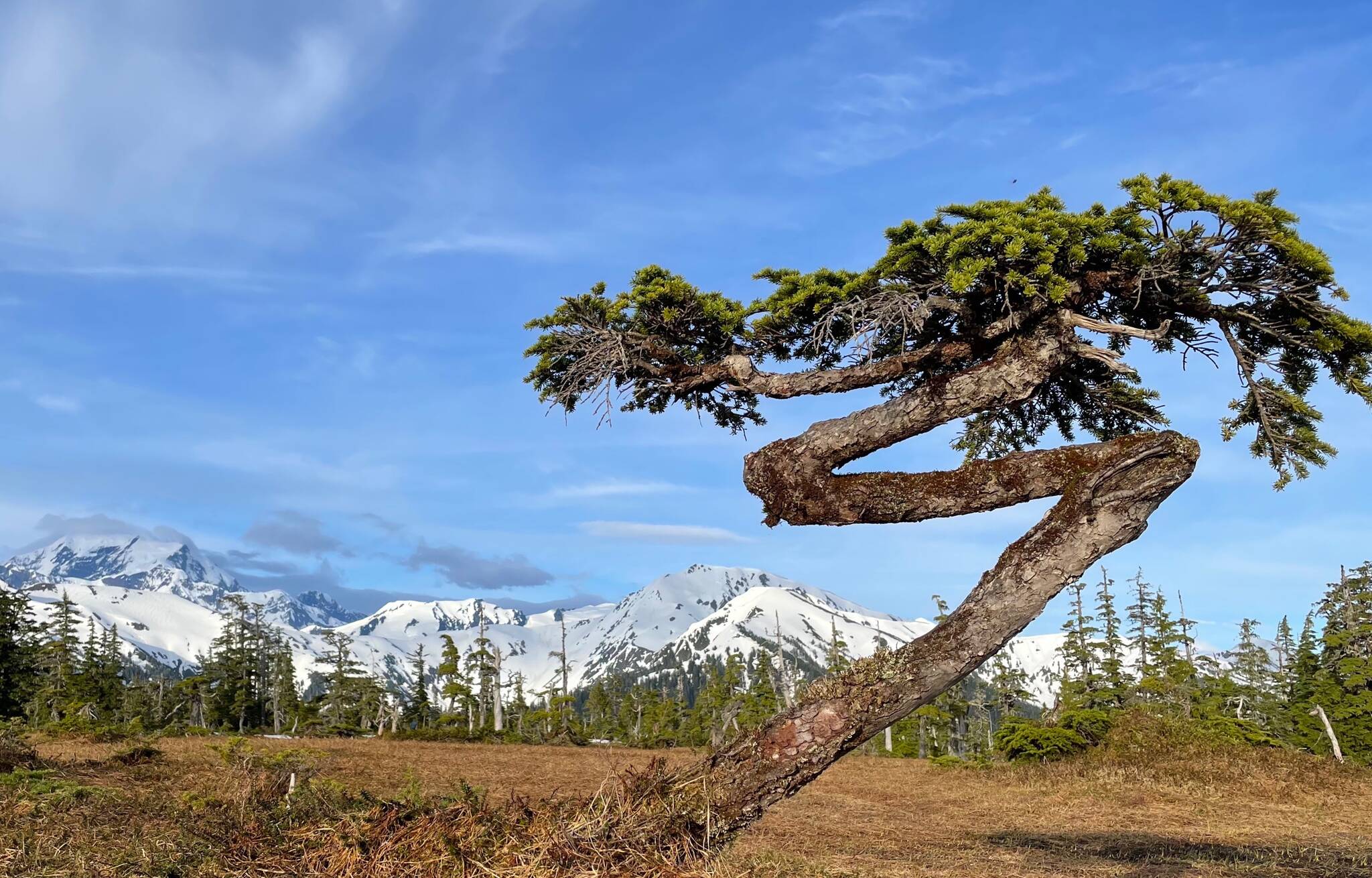
A bonsai mountain hemlock tree shaped by winter storms grows on the outer coast of Glacier Bay National Park.
On a larger scale, the Aleutian Low twirling over this giant body of water causes droughts, floods and wildfires in western North America. Scientists have also tied cycles in the Aleutian Low — which switches from strong to weak every few decades — to Arctic sea-ice extent and the strength or weakness of salmon runs along the Pacific Coast from California to Alaska.
After gathering 20 cores and storing them inside paper straws, Gaglioti seals them inside a Ziploc. They will add to the load he will carry in his backpack out of here. Someday, probably in the darkness of winter, he will look at them under magnification and see what these trees have to say about hard times they have endured.
• Since the late 1970s, the University of Alaska Fairbanks’ Geophysical Institute has provided this column free in cooperation with the UAF research community. Ned Rozell is a science writer for the Geophysical Institute.
