
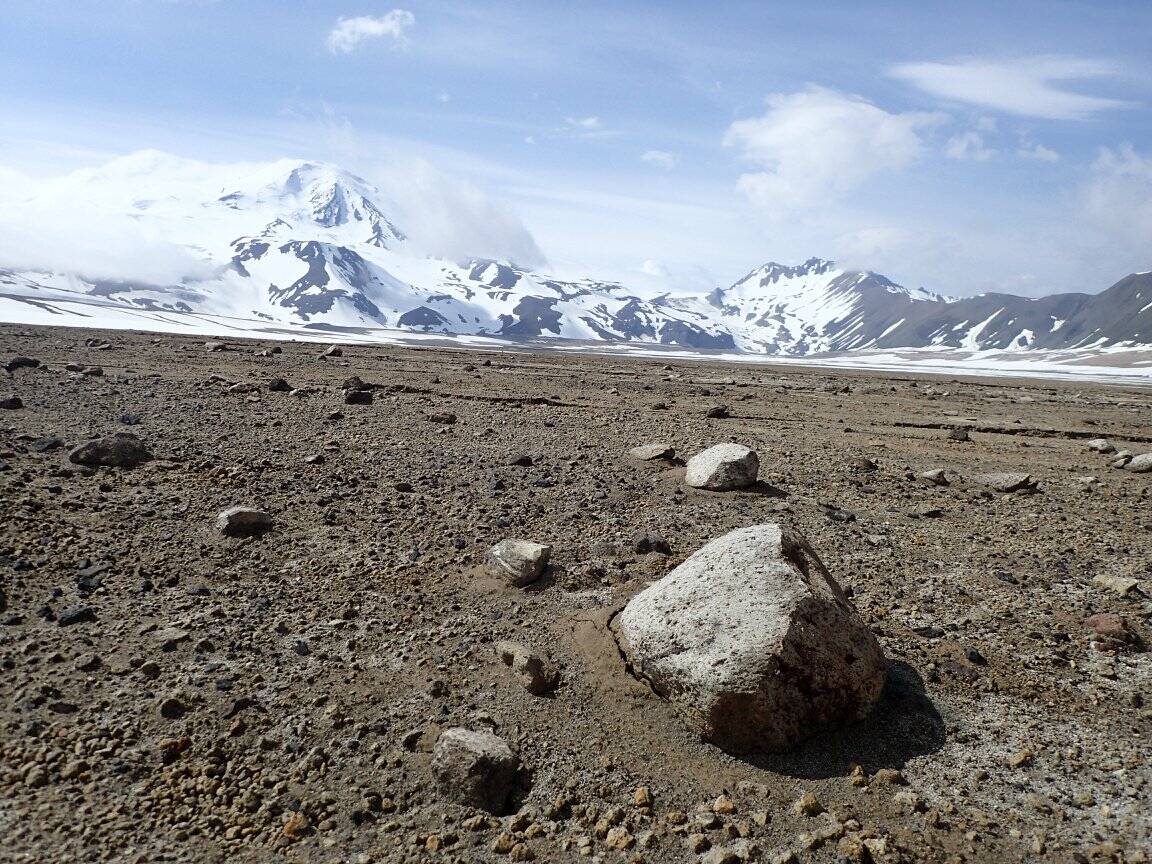
To put the largest eruption in Alaska’s written history in context, Robert Griggs pondered what might have happened if the volcano that erupted in summer of 1912 was located on Manhattan Island rather than the Alaska Peninsula.
“In such a catastrophe all of Greater New York would be buried under ten to fifteen feet of ash and subjected to unknown horrors from hot gases. The column of steam and ash would be plainly visible beyond Albany (150 miles away) … Explosions would be heard as far as Atlanta and St. Louis.
“The fumes would sweep over all the states east of the Rocky Mountains. In Denver they would tarnish exposed brass.”
Griggs, a botanist from Ohio State University, ventured to what he named the Valley of 10,000 Smokes a few years after the giant eruption.
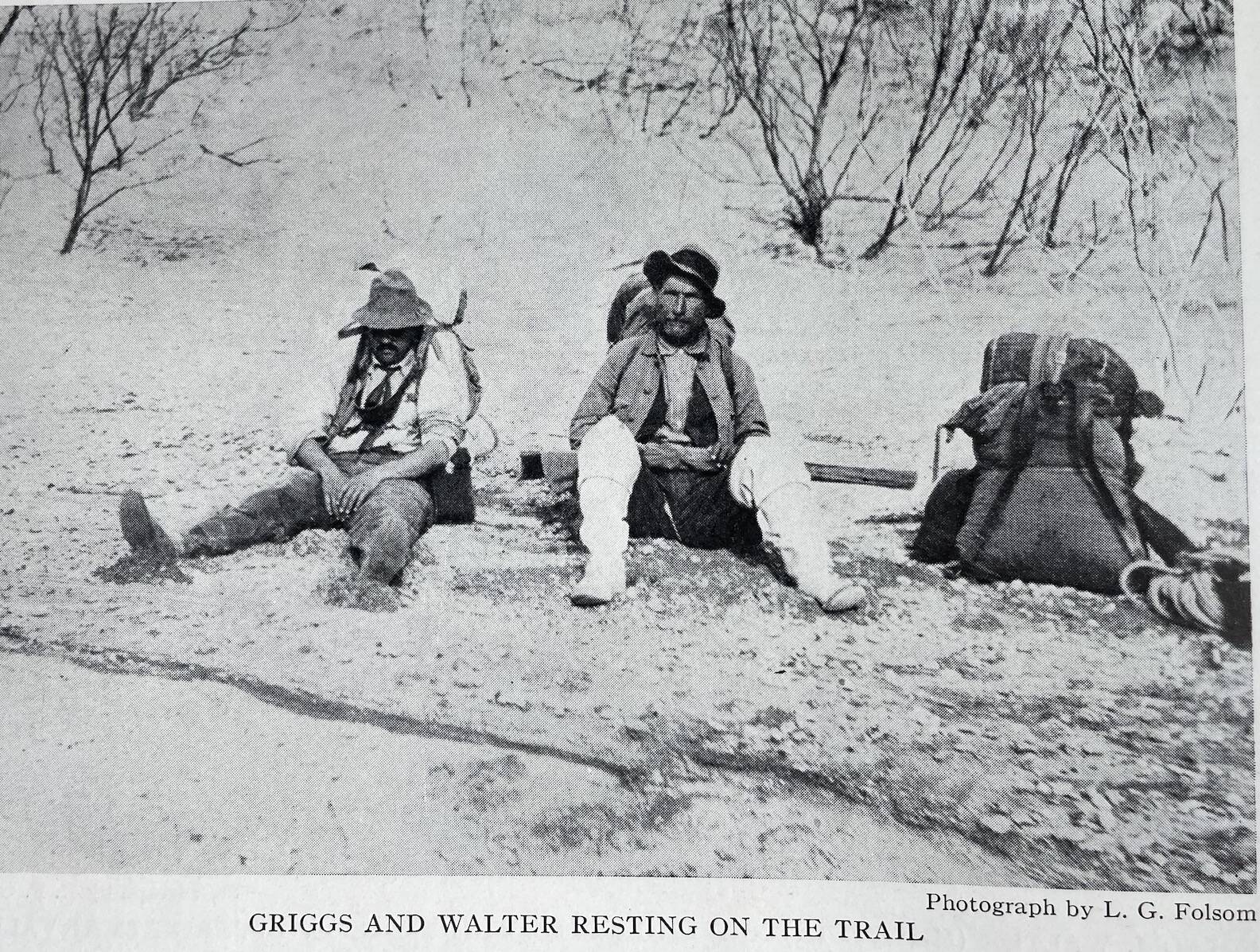
Robert Griggs, left, and Walter Metrokin of Kodiak rest during a 1916 expedition into the Valley of 10,000 Smokes on the Alaska Peninsula. (L.G. Folsom, from the book “The Valley of 10,000 Smokes” by Robert Griggs)
His connection to this grand, strange landscape was a bit of a fluke: One year after the June 6-8, 1912, eruption, he visited Kodiak Island to determine if kelp beds might be a possible source of fertilizer. While there, he became fascinated by the foot of ash that had blanketed much of the island.
Griggs just had to see what had caused such an effect 100 miles from its source. The National Geographic Society soon funded several of his expeditions to the mysterious eruption site. For that organization, Griggs late wrote a book on one of the most remarkable events in Alaska’s natural history.
In “The Valley of 10,000 Smokes,” published 10 years after the eruption, Griggs wrote of what he and his partners saw as they first entered the valley in 1916.
“Stretching as far as the eye could reach … were hundreds — no, thousands — of little volcanoes.
“Many of them were sending up columns of smoke that rose a thousand feet before dissolving.”
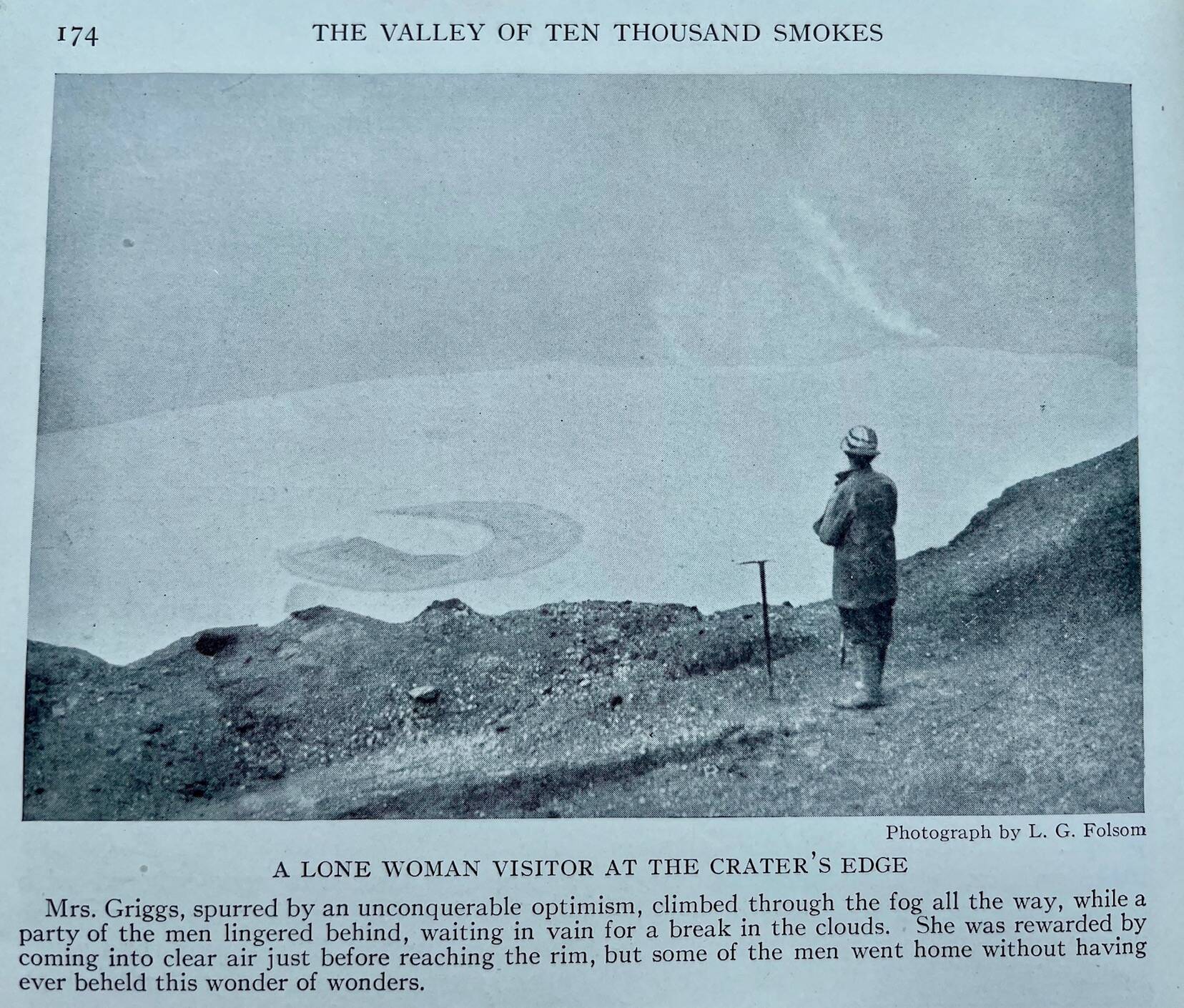
Laura Griggs, wife of botanist Robert Griggs, stands at the rim of Katmai Caldera, a crater located where the top of Mount Katmai stood before the 1912 eruption. (L.G. Folsom, from the book “The Valley of 10,000 Smokes” by Robert Griggs)
The valley has cooled enough in the past century that those geysers of steam no longer greet visitors to Katmai National Park and Preserve, but the eruption site is still pretty much a moonscape, with scant vegetation popping through the pumice.
Though no one was killed during the 1912 eruption, the ash spewed from the volcanic vent known as Novarupta created a haze in the air as far away as Virginia, Griggs wrote. The ash was also responsible for a global cooling in the second half of 1912, because “the dust cloud absorbed 10 percent of the sun’s heat.”
If the largest eruption of the 20th century was to repeat itself tomorrow, its effects on humans would be much greater than in 1912. Though no one lives close to the Valley of 10,000 Smokes, many thousands of people circle the globe in jet aircraft. A researcher once used a computer model to simulate a Novarupta’s effects on air travel. Most of the airports in the Northern Hemisphere would close to prevent jets from flying through clouds of ash, Rebecca Anne Welchman wrote.
In Griggs’ day, air travel was not yet a thing. He was a scientist “overawed” with the eruption site that became the focus of his research career. In large part because of Griggs’ return visits to the valley and his reports on its drama and magnificence, President Woodrow Wilson created Katmai National Monument in 1918. It later became Katmai National Park and Preserve, with a land area greater than Connecticut.
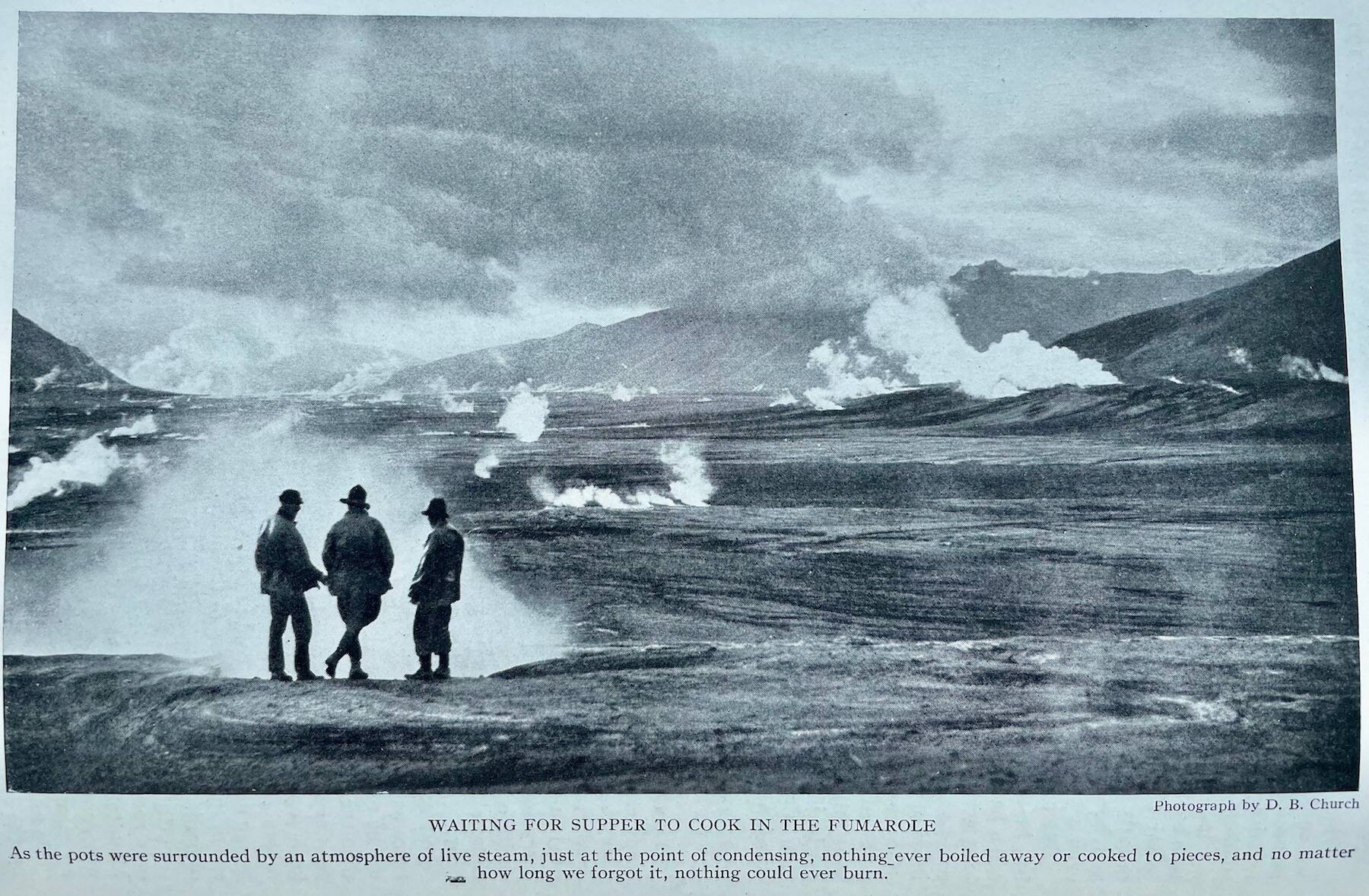
Explorers of the Valley of 10,000 Smokes after its eruption in 1912 stand at a campsite above the valley floor. (L.G. Folsom, from the book “The Valley of 10,000 Smokes” by Robert Griggs)
Griggs died in 1962 in Colorado. Fulfilling one of his final wishes, his son David travelled to the valley soon after and climbed Mount Griggs, named for his father in 1956. There, in a summit rock cairn, David placed the ashes of his father and his mother, Laura, who had joined Robert on several trips to the Valley of 10,000 Smokes.
• Since the late 1970s, the University of Alaska Fairbanks’ Geophysical Institute has provided this column free in cooperation with the UAF research community. Ned Rozell is a science writer for the Geophysical Institute.
