
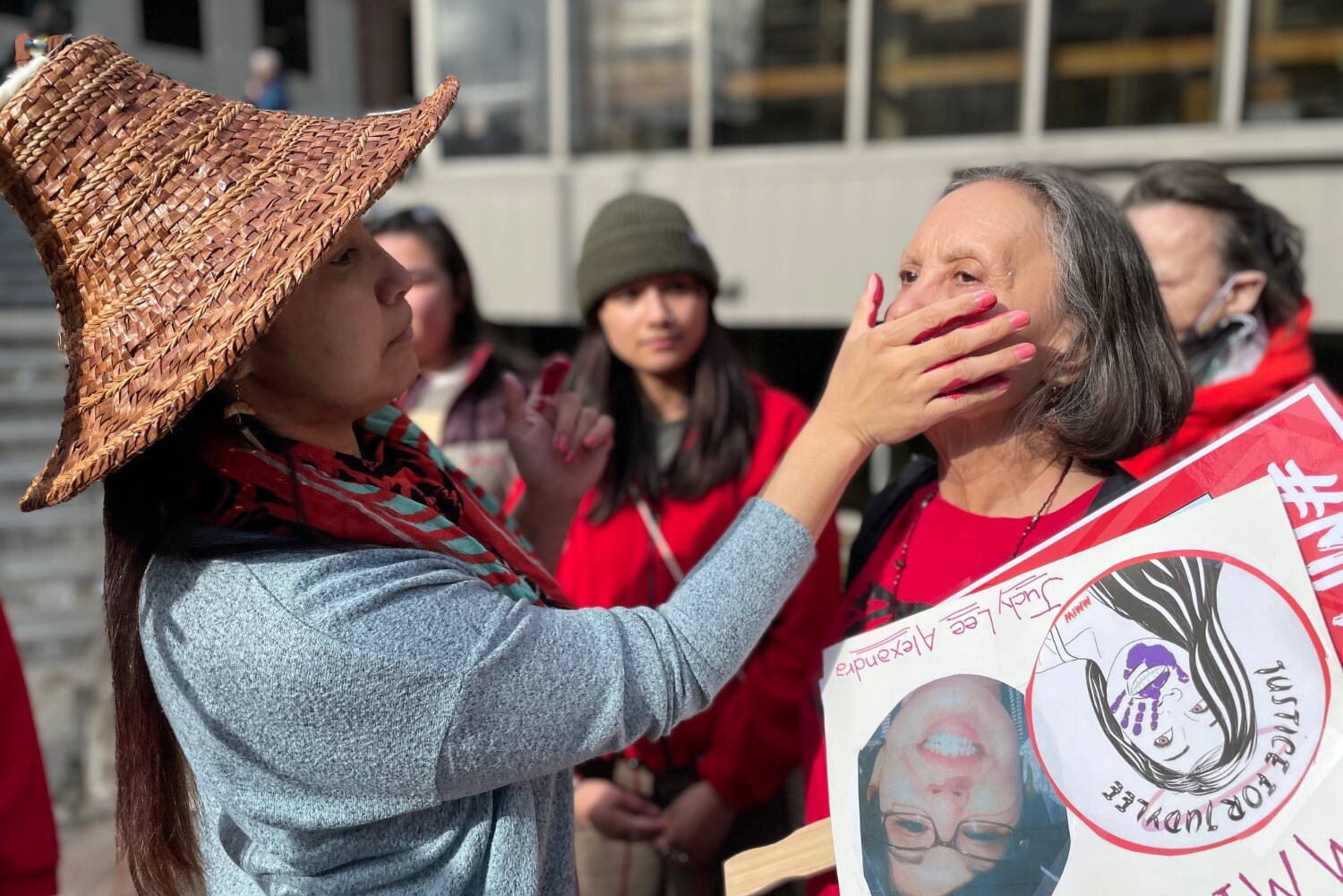
Alaska is the only state with its own chapter in a report on missing and murdered Indigenous people that describes a failure of the federal government to fulfill its trust responsibilities to tribal nations, resulting in a public health, public safety and justice crisis nationwide.
The report was written by the Not Invisible Act Commission, a cross-jurisdictional advisory body that makes recommendations for how to address public safety in Native American communities. Report authors included the chapter to detail the specific challenges to addressing the MMIP crisis in Alaska, such as distance, governmental structures and lack of technology or transportation.
Alaskans testify at the Not Invisible Commission meeting in Anchorage on April 25, 2023. Image courtesy of the Department of the Interior.
Michelle Demmert, a University of Alaska Fairbanks professor and mostly retired tribal judge and attorney, serves on the commission. She said Alaska tribes face unique challenges and have not had the same resources as tribes in the Lower 48.
“We felt that the issues in Alaska are so unique, and the historical experience that we’ve had in comparison to the Lower 48 tribes has really put a disadvantage on some of the resource and access issues that we have,” she said.
To that end, one of the Alaska-specific recommendations is that the Department of Justice and Department of Interior conduct an equity assessment that includes law enforcement, court and related government services for every Alaska tribe.
Another related recommendation is that Congress appropriate funds to help Alaska tribes develop and sustain their own court systems. A 2022 federal law clarified that Alaska tribes can assert their inherent authority, including civil and criminal jurisdiction, over the areas covered by the U.S. Census Bureau’s village maps; the recommended funding would help put courts in place to make that possible.
Demmert said part of the reason for those recommendations is the result of laws that disadvantage Alaska tribes. One of them is Public Law 280, which designates Alaska as one of a handful of states where tribal courts are managed by the state government rather than the federal government. Demmert said the law is an unfunded mandate that leads to a lower quality of response in Alaska: “So many of our communities lack any law enforcement whatsoever and the response time is often so delayed,” she said.
Another recommendation seeks to change that by allowing tribes to remove state jurisdiction for Alaska Native villages. That would give those communities concurrent jurisdiction with the federal government, “which we think might be better partners, when it comes to investigating crimes,” Demmert said. “The federal government has a trust responsibility and the state does not.”
The commission also recommended an expanded definition of the term “Indian country” to include Alaska Native villages in order to reduce the funding gap between Alaska Native tribes and those in the Lower 48. Alaska, unlike states in the Lower 48, does not have Indian country, with the exception of the Metlakatla Indian Community, the state’s only reservation.
“A lot of federal grants and jurisdictional statutes reference ‘Indian country,’ so that would exclude us because we don’t meet the definitions for those services,” Demmert said.
Demmert said she has seen positive movement towards change in regards to the MMIP crisis and she hopes to see some progress come from the recommendations.
“To me, it’s a humanitarian crisis — and it does meet some of the definition of that,” she said. “We rush to foreign countries’ aid; it’s just tragic that we have never been properly resourced to take advantage of keeping our communities safe and healthy. Isn’t that what we all want?”
The Department of Justice and the Bureau of Indian Affairs will have 90 days from the day the report was submitted to respond.
• Claire Stremple is a reporter based in Juneau who got her start in public radio at KHNS in Haines, and then on the health and environment beat at KTOO in Juneau. This article originally appeared online at alaskabeacon.com. Alaska Beacon, an affiliate of States Newsroom, is an independent, nonpartisan news organization focused on connecting Alaskans to their state government.
