
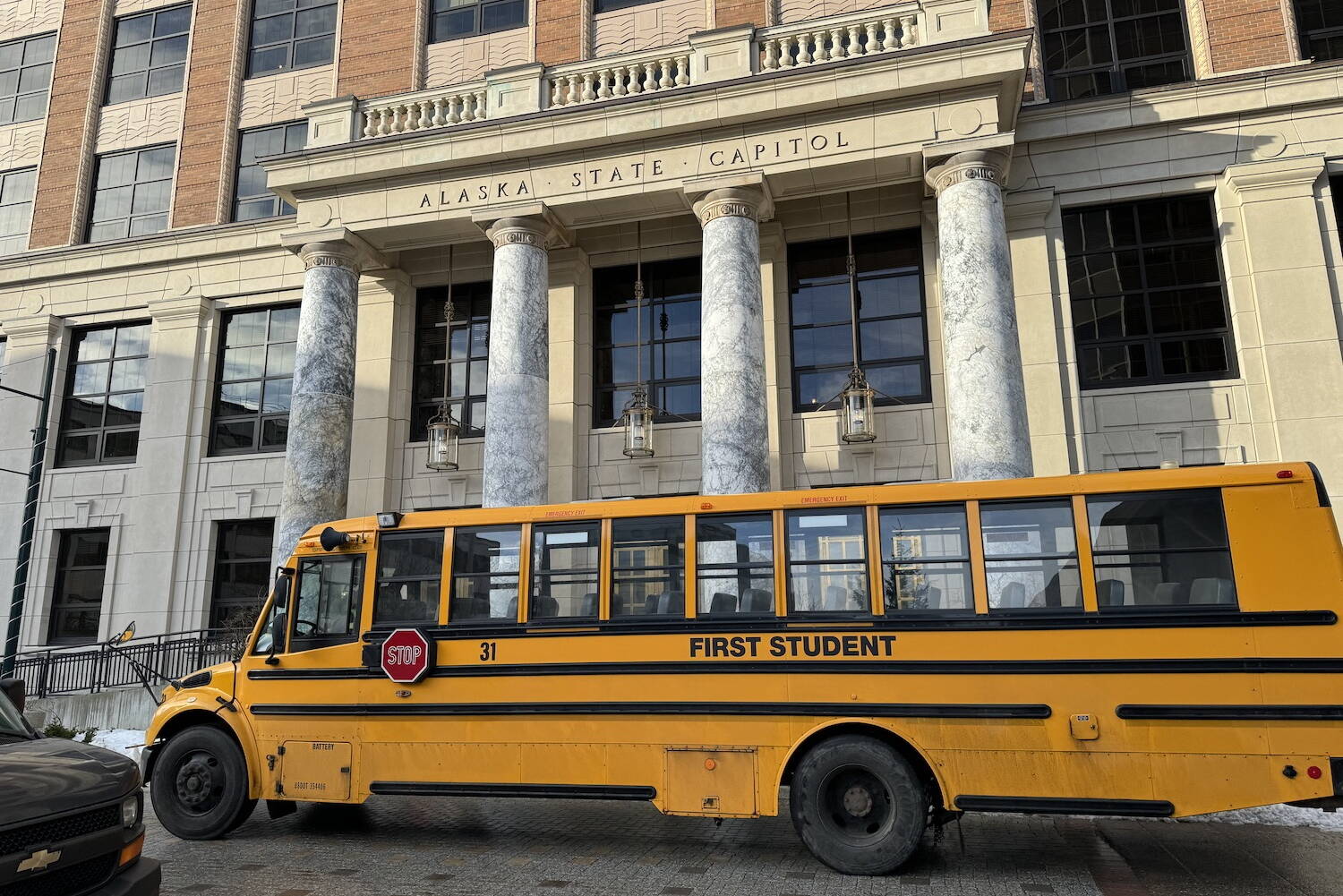
The Alaska Legislature on Friday passed a major increase to K-12 education funding, worth $1,000 in the state’s per-student funding formula. Gov. Mike Dunleavy has indicated he will veto the proposal, saying lawmakers failed to include policy changes he requested.
In an 11 to 9 vote, senators narrowly passed House Bill 69, one day after the Senate Finance Committee removed all education policy changes previously proposed by the state House and the Senate Education Committee. That left an abbreviated version with only the increase in per student funding, known as the base student allocation.
Hours later, the House voted 21-16, with three legislators excused as absent, to approve the Senate changes. That action will send the bill to Dunleavy, who said before the vote that he would veto the bill if it passed without changes.
On Thursday, Dunleavy posted a statement on social media calling the bill a “joke,” and said unless legislation includes policy changes, “it will be vetoed immediately.”
On Friday, Senators debated the bill on the floor, largely focused on the state of Alaska schools’ financial picture and the cost of the education funding bill — estimated at $253 million per year.
Sen. Löki Tobin, D-Anchorage and chair of the education committee, urged support for school districts facing dire financial shortfalls.
“We have heard from hundreds of parents and students and teachers asking us to raise the base student allocation,” she said. “There’s little else contained in those missives about other types of education reforms. What they’re asking us to do is increase school funding because our schools are in crisis, and we must respond.”
Senate Minority Leader Mike Shower, R-Wasilla, said he couldn’t support the funding without a balanced budget. “We’ve all said this is important, the BSA needs to be increased. Nobody is arguing that,” he said. “But at what cost, and at what reasonable cost that we think we can make work while we’re not negatively impacting everybody else to a significant degree?”
Shower argued not all parents support the funding boost. “I’ve heard lots of parents from back home and others that are saying, ‘Don’t do this.’ I’ve had lots of folks reach out and say, ‘This is not affordable. This is not what we’re looking for. By the way, we want to see policy (changes) in this.’ They’re not necessarily opposed to (a BSA increase), but they’re asking for some of the policy changes.”
The Legislature has a mandate to provide education funding under the state constitution. Sen. Bill Wielechowski, D-Anchorage, argued the state risks a lawsuit if lawmakers fail to act. “The state was sued because we didn’t adhere to our constitutional obligations,” he said. “In 2007, the Supreme Court found that, yes, adequate funding is a constitutional responsibility of the state.”
Senators considered, and then voted against proposals to add education changes back into the bill, including open statewide enrollment, increasing per-student funding for homeschooled students, and grants for districts that show improvements in reading proficiency.
Sen. Lyman Hoffman, D-Bethel and a co-chair of the Senate Finance Committee, said he could not support the bill given the state’s financial picture. “So I plan on voting no on this bill, regretfully,” he said, addressing Senate President Gary Stevens, R-Kodiak. “But I promise to work on revenue measures — I know you as (Senate) president and the Senate caucus have made that a priority. Because in order to address education and all the other things that we need to address that are coming before us require additional revenue.”
Hours after the Senate voted, the state House took up the Senate’s version of the bill and voted along caucus lines, with members of the House majority — 14 Democrats, five independents and two Republicans — voting in favor and members of the House’s all-Republican minority opposed.
“I do support a permanent BSA increase … however, the amount that’s in this bill is not something we can afford at this time,” said House Minority Leader Mia Costello, R-Anchorage, adding that she would support a $680 permanent increase, the same size included as a one-time boost this year.
Rep. Justin Ruffridge, R-Soldotna, was among several members of the House who alluded to the governor’s veto threat and said that if the House approved the change, it would turn into “a step in the process” rather than be a final action.
A veto override requires approval from 40 of 60 lawmakers meeting in a joint session. Several legislators said they do not expect an override. If the governor rejects the bill, they expect work to continue on a bill that contains a smaller increase.
“And maybe, just maybe, we’ll go back to a compromise,” Ruffridge said.
• James Brooks is a longtime Alaska reporter, having previously worked at the Anchorage Daily News, Juneau Empire, Kodiak Mirror and Fairbanks Daily News-Miner. Corinne Smith started reporting in Alaska in 2020, serving as a radio reporter for several local stations across the state including in Petersburg, Haines, Homer and Dillingham. She spent two summers covering the Bristol Bay fishing season. Originally from Oakland, California, she got her start as a reporter, then morning show producer, at KPFA Radio in Berkeley. This article originally appeared online at alaskabeacon.com. Alaska Beacon, an affiliate of States Newsroom, is an independent, nonpartisan news organization focused on connecting Alaskans to their state government.
