
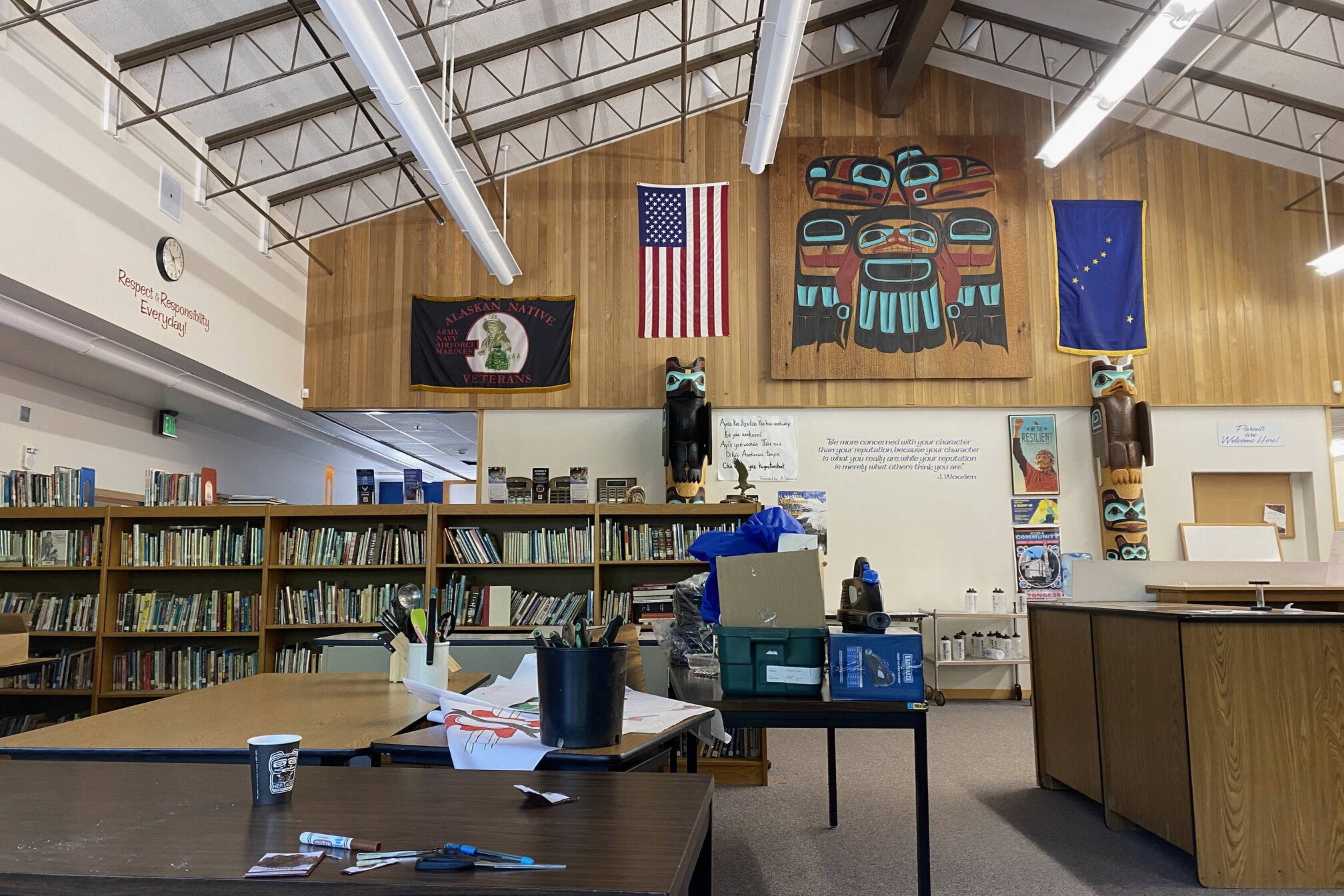
A view from the library of the Angoon High School, one of Alaska’s public schools, is seen on June 19, 2023. (Claire Stremple/Alaska Beacon)

A view from the library of the Angoon High School, one of Alaska’s public schools, is seen on June 19, 2023. (Claire Stremple/Alaska Beacon)

Alaska board of education sends the plan for tribally run public schools to lawmakers

A report detailing the framework for tribally run public schools will be sent to the legislators and the governor’s office. The intent is that it could become a bill that would create the first tribal compact public schools in the state.

The Department of Education and Early Development developed the framework for tribally operated public schools after the Legislature approved a bill in 2022 directing it to do so.

Joel Isaak led the project as director of tribal affairs for the state’s education department; he is now the agency’s deputy commissioner. He will continue to lead the effort.

“Part of the excitement of this work is it’s about transforming a system. It’s a creative process, it’s additive. And there’s space for everybody in it,” he said. “Tribes, school districts, parents of students who are Alaskan Native and American Indian, parents of students who aren’t are interested in this work and excited to see how it can really come to fruition.”

Isaak said part of the significance of the effort is how tribally run public schools could be a turnaround from the state’s boarding-school-era history.

“This is part of a connection to needing to transform some of the historical effects into something that brings tribes back into having a role in education that has been missing for the last almost 150 years,” he said.

The report is the product of five years of work and 10 months of intensive negotiations, Isaak said. The state board approved the framework unanimously on Wednesday.

The plan requires $1.5 million in grant funding to get the first tribally operated state schools up and running. The Legislature would need to appropriate this money. Districts would have three years to spend it; any unspent funds would be returned to the state. Participating districts would also receive 45% more in state per-student funding than the standard base student allocation for one year, according to the report.

• Claire Stremple is a reporter based in Juneau who got her start in public radio at KHNS in Haines, and then on the health and environment beat at KTOO in Juneau. This article originally appeared online at alaskabeacon.com. Alaska Beacon, an affiliate of States Newsroom, is an independent, nonpartisan news organization focused on connecting Alaskans to their state government. This article was produced as a project for the USC Annenberg

More in News

The northern lights are seen from the North Douglas launch ramp late Monday, Jan. 19. A magnetic storm caused unusually bright northern lights Monday evening and into Tuesday morning. (Chloe Anderson/Juneau Empire)
Rare geomagnetic storm causes powerful aurora display in Juneau

The northern lights were on full display Monday evening.

teaser
Juneau activists ask Murkowski to take action against ICE

A small group of protesters attended a rally and discussion on Wednesday.

A female brown bear and her cub are pictured near Pack Creek on Admiralty Island on July 19, 2024. (Chloe Anderson for the Juneau Empire)
Pack Creek permits for bear viewing area available now

Visitors are welcome from April 1 to Sept. 30.

Cars pass down Egan Drive near the Fred Meyer intersection Thursday morning. (Clarise Larson / Juneau Empire file photo)
Safety changes planned for Fred Meyer intersection

DOTPF meeting set for Feb. 18 changes to Egan Drive and Yandukin intersection.

Herbert River and Herbert Glacier are pictured on Nov. 16, 2025. (Mari Kanagy / Juneau Empire)
Forest Service drops Herbert Glacier cabin plans, proposes trail reroute and scenic overlook instead

The Tongass National Forest has proposed shelving long-discussed plans to build a… Continue reading

A tsunami is not expected after a 4.4-magnitude earthquake northwest of Anchorage Wednesday, Feb. 4, 2026. (U.S. Geological Survey)
No tsunami expected after 4.4-magnitude earthquake in Alaska

U.S. Geological Survey says 179 people reported feeling the earthquake.

ORCA Adaptive Snowsports Program staff member Izzy Barnwell shows a man how to use the bi-ski. (SAIL courtesy photo)
Adaptive snow sports demo slides to Eaglecrest

Southeast Alaska Independent Living will be hosting Learn to Adapt Day on Feb. 21.

Cars drive aboard the Alaska Marine Highway System ferry Hubbard on June 25, 2023, in Haines. (Photo by James Brooks)
Alaska’s ferry system could run out of funding this summer due to ‘federal chaos problem’

A shift in state funding could help, but a big gap likely remains unless a key federal grant is issued.

Photo by James Brooks/Alaska Beacon
U.S. Sen. Dan Sullivan stands with acting Coast Guard Commandant Adm. Kevin Lunday during the after the commissioning ceremony for the Coast Guard icebreaker Storis on Sunday, Aug. 10, 2025, in Juneau, Alaska.
Coast Guard’s new Juneau base may not be complete until 2029, commandant says

Top Coast Guard officer says he is considering whether to base four new icebreakers in Alaska.

Most Read