
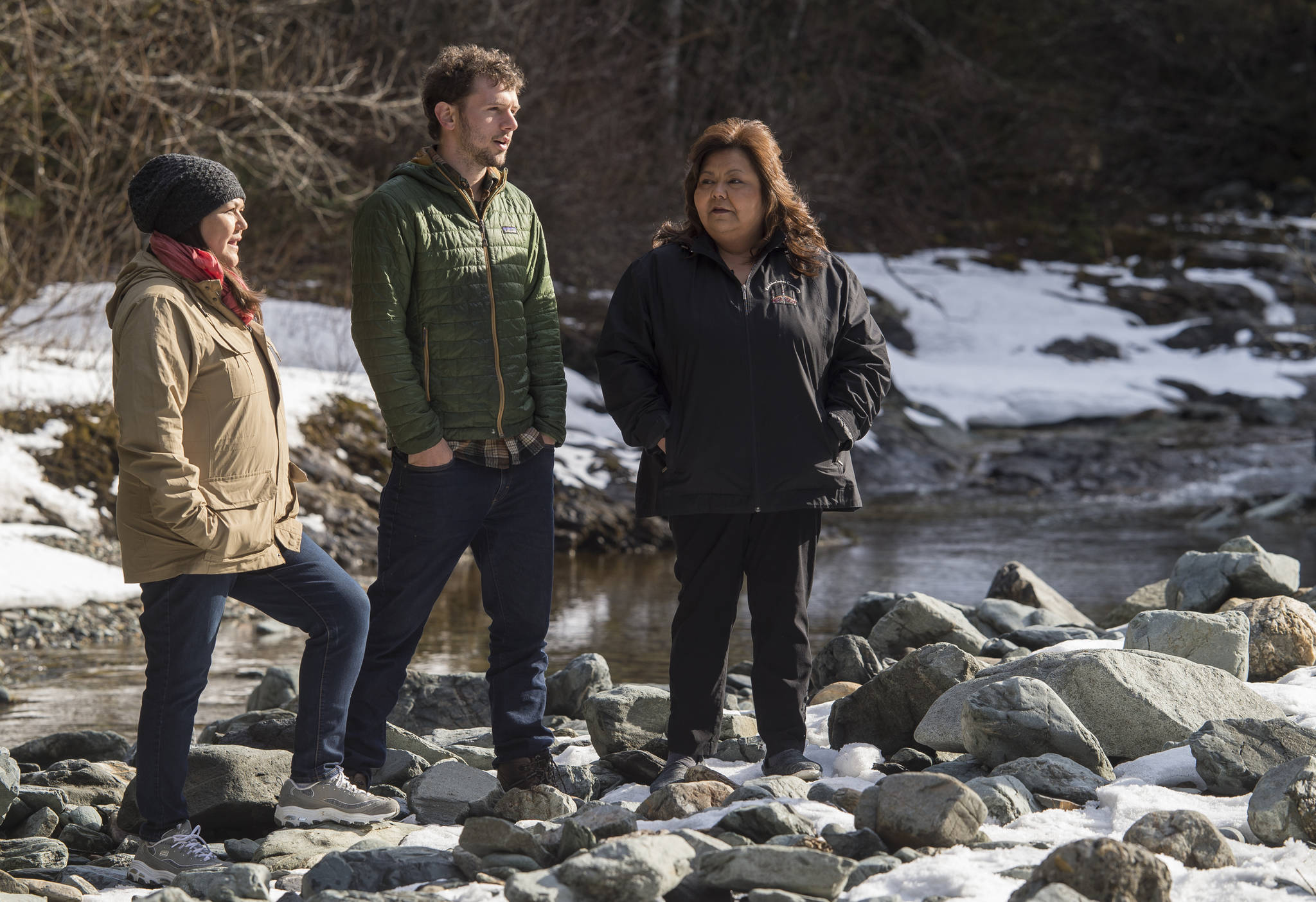
Indigenous activists Jacinda Mack and Carrie James come from two different countries and opposite ends of rivers their livelihoods depend on. One issue unites them: concerns over under-regulation of Canadian mining projects on the U.S.-Canada border.
Mack, a Canadian from the Indigenous Xat’sull community, hails from Williams Lake, a small town near the headwaters of the Fraser River. She’s experienced environmental disaster before. In August 2014, a tailings dam failed at Mount Polley mine, sending 847 million cubic feet of mining waste into nearby rivers, places she used to harvest subsistence foods to feed her family.
Ketchikan Tlingit and Haida woman Carrie James, 44, fears a repeat of Mount Polley could happen in her backyard. The Kerr Sulphurets-Mitchell (KSM) mining project is pursuing mineral exploration at the headwaters of the Unuk River, which flows into Southeast Alaska above Rivillagiggedo Island, near Ketchikan. The KSM project, designed to be one of the largest such mines in the world, is governed by the same B.C. mining regulations that allowed the Mount Polley disaster to happen.
The Empire met with Mack, James and filmmaker Matthew Jackson at Cope Park recently to talk about their documentary “Uprivers.” The film tells the story of Mack’s activism and James’ fears for her subsistence lifestyle.
The situation with intervention on transboundary issues is at a bit of a standstill. Several Alaska politicians, including Alaska’s congressional delegation, have asked the U.S. State Department to intercede and broker binding enforcement between the U.S. and Canada for mines on transboundary watersheds. It’s the latest such request of many but the first put toward the State Department’s new administration.
Meanwhile, mining projects upriver from Alaska waters are moving forward with exploration and permitting.
This inteview has been edited for length and clarity.
Kevin Gullufsen: Why make this documentary?
Carrie James: To educate our communities. If they visually see the destruction that happened at Mount Polley, that would make a big impact on them. We don’t want that happening in our backyard, and the KSM and the Unuk River are just on the back side of the island where I live, Revillagigedo. Being Tlingit and Haida, I have a lot of family across the border. When I see the devastation of Mount Polley, my heart just broke. My kids and my parents were driving through Canada and they had a hotel in Williams Lake and they left the same morning that the breach happened. I just figured we need to talk to all our communities. I did travel around with Salmon Beyond Borders and Dr. Dave Chambers when the XBoundary film was showing and we had community meetings. Back then it was pretty obvious that people didn’t realize what was going on. They didn’t realize how much is at stake. The (commercial) fishing industry is $1 billion dollars. Our tourists are expecting to see pristine environment around them.
KG: It seems Mount Polley figures into a lot of your fears and concerns. KG: Jacinda, you said you were part of the response team, what did you learn about Canadian mining practices from that disaster?
Jacinda Mack: It’s a s—show. It’s basically a self-regulated industry. Government caters to promoting mining and it’s supposed to be protecting other interests as well. It’s a completely flawed system where it’s a fox in the henhouse. There’s no disaster response plans required. There’s no money for disasters. The laws aren’t enforced. My mother actually pressed criminal charges against a company when B.C. failed to follow its own laws. We had hoped that they would let her proceed with those charges but they ended up taking the charges over and dismissing them. We’ve seen at the federal level there was a fisheries case brought forward by MiningWatch Canada that was dismissed. At the provincial level, the provincial charges were dismissed. So we’ve seen zero consequence. There have been no charges, no fines and the company is back in full operation with full dumping into Quesnel Lake. So this is the standard, this is the precedent that this mine is setting and it is totally OK by the industry and totally OK by the governments of Canada and that’s a real problem.
I came up here and saw how beautiful it is here and how connected people are to the land. Everybody I meet fishes and hunts and hikes and skis. They’re all out walking the trails. People really have a deep appreciation of what they have here and if I can help raise that awareness to try and prevent another Mount Polley, I tell people all the time, whatever you need, I am here to share that story.
KG: What was that like dealing with that aftermath? What did you see?
Jacinda Mack: It was awful. It really was traumatic. The whole Fraser watershed has been so heavily impacted by mining. … There was very little information. People had a very low literacy about mining, what the impacts are and it was extremely frustrating because we were consistently silenced. Our concerns were ridiculed. We were technically part of the process but it ended up becoming a closed door process driven by industry. The government just ended up handing over all of the monitoring to the company and the industry ended up taking back control of the whole process. That’s the Canadian model. That’s what we’re dealing with and that’s what people in Alaska need to understand, how these mining companies in Canada work with the government. The communities and impacted people don’t even have a voice in this process.
Matthew Jackson: I think that Canada has this global reputation as being America’s better, northern counterpart that does everything better. You know, they’ve got social medicine. They’re with it. And a lot of people in Canada have the same perception. Jacinda, you have more of the facts than I do, but half of the publically traded mining companies in the world are based in Vancouver. The other half are based in South Africa and it’s because Canada and especially British Columbia have Third World environmental standards. B.C. is acting as a regulatory haven in the same way that the Virgin Islands or Cyprus acts as a banking haven, where companies can be based there and have protections because B.C.’s regulations are so out of whack, they basically don’t exist.
Jacinda Mack: They’re not enforced. There were over 15 charges that were laid under the Environment Act under B.C. that were just dismissed, even though they were under clear violation. The relationship, it’s just corrupt.
KG: How would you respond to people who might charge the transboundary watershed movement with being anti-mine?
Jacinda Mack: I think that’s polarizing the issue. That’s something that government and industry especially does. Industry will always say, ‘If you have concerns about mining, it means you’re against jobs.’ That’s not at all what we’re saying. We’re for clean water, we’re for protecting a way of life. We’re for having healthy environments for our children and next generations. That comes from a deep responsibility to our families, a deep responsibility to the lands that we come from. That’s what we’re upholding, those responsibilities. It doesn’t just benefit us, it benefits everybody that’s here. That’s what we’re focused on. People who try to say that we’re against mining and we’re against jobs really don’t understand what we’re talking about.
Matthew Jackson: Somebody just asked me the other day how many jobs are represented by these mines and if the value of jobs could be compared to the potential cost of cleaning pollution out of these rivers. I was kind of like, ‘Dude, you’re missing the point.’ If we accept that a certain number of jobs justifies a mine as opposed to everything else that’s at stake — a salmon that could provide sustainable jobs in perpetuity, people’s ways of life, their cultures, the integrity of our environment — those things are priceless and they could last forever. To try and quantify that is kind of missing the point. There’s this intrinsic argument that’s above dollar signs, but on the other hand, there’s commercial fishing and tourism industries that can provide jobs forever. It doesn’t make sense to put those forever jobs.
KG: Carrie, I am interested in hearing your answer to this because Ketchikan has gone through the closing of the pulp mills, which was driven partly by environmental concerns. Do people in your community express frustration for jobs not being there because of environmental concern?
Carrie James: Ketchikan relies on the toursim industry and the fishing industry. They understand that if there’s going to be pollution from mining of any kind, that that’s going to be in jeopardy. The pulp mill already closed. There’s very little logging going on. What we have left in our economy is based on having a pristine environment. It’s based on having the fish return when they’re supposed to. So I don’t think the community as a whole is concerned. The cruise ships, they’re not going to come if there’s a mine breach.
KG: What do you hope Alaskans learn from “Uprivers”?
Matthew Jackson: One, that this is an international issue and that we have friends in Canada that we need to be reaching out to. Jacinda talks about sharing our love stories with the land and not playing to the mine’s agenda but instead empowering ourselves in our own communities. I hope people can kind of identify better after seeing this why they care about the Taku or the Stikine or the Unuk. Start from there and lead them to some sort of action. It’s a really hard issue for people to grapple with because we can’t just write our senators. You can, it’s good, but we’re kind of past that point and it’s in this weird, international diplomatic process. So just getting people in touch with the places they call home and empowered to be an advocate for that.
Jacinda Mack: We did a water ceremony in Wrangall a couple years ago and I had the good fortune of being brought out on the Stikine River and out on the ocean as well. It hit me then, ‘When was the last time I felt this way?’ It was on Quesnel Lake before the disaster happened. Can you imagine if folks in Southeast never went out on their boat again and never ate salmon again? How would that change your life? That’s the impact it’s had in our community. No clean water, no more salmon, never go out on your boat. That’s the scale we’re talking about. That’s the reality.
• Contact reporter Kevin Gullufsen at 523-2228 and kgullufsen@juneauempire.com. Follow him on Twitter at @KevinGullufsen.
