
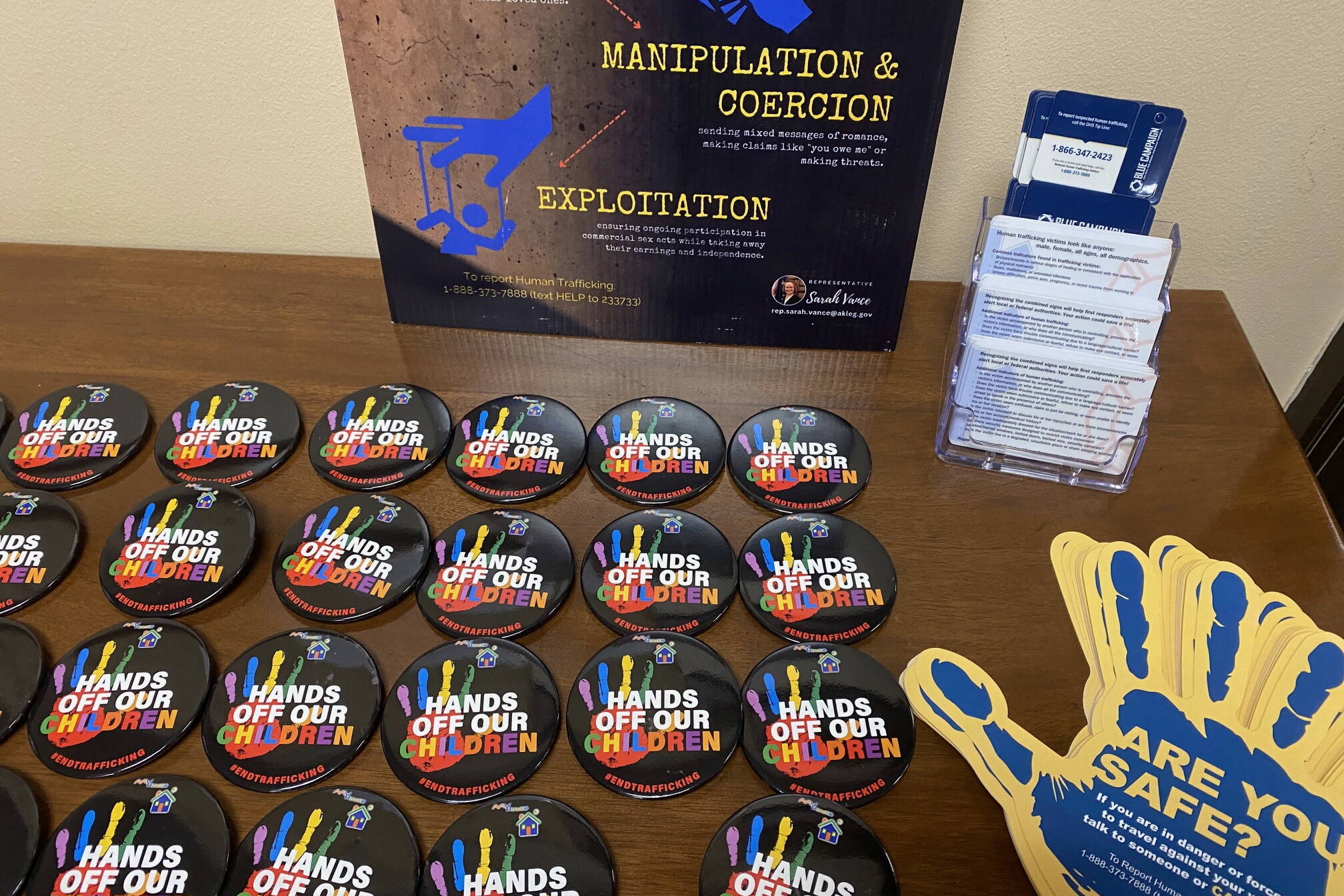
Human trafficking, which affects an estimated 27.6 million people forced into labor or sex around the world, is happening in Alaska. Nearly 30% of homeless youth in Anchorage identified as victims of human trafficking.
“We have trafficking stories in all six of our high schools in Anchorage,” said Gwen Adams, founder of the nonprofit, faith-based advocacy group Priceless in a presentation at the Capitol on Tuesday.
Adams said there were 40,000-60,000 online advertisements for trafficked people per month in Anchorage alone, though some of these were advertisements for the same person posted more than once. She said that Alaska Native teens or young adults who travel to Fairbanks or Anchorage from villages are approached by a trafficker within 72 hours, according to Federal Bureau of Investigation data.
Her colleague, Adam Legg, said that there are a lot of vulnerable youth in Alaska that are prime for exploitation by traffickers. “We all know that rape, domestic violence, sexual assault, suicide, mental health issues in our state — these all create vulnerable people that traffickers can easily prey on,” he said.
He added that predators now use the chat features in online children’s games to befriend and groom increasingly young victims. Yet most people are recruited into trafficking by family members, Adams said, followed by intimate partners and employers.
Alaska lawmakers are working to codify a more robust response to the growing public safety concern, and advocates say the matter has become even more urgent as victims trend younger and the issue moves more online.
Increased criminal penalties for perpetrators
Trafficking is the exploitation of a person’s labor or body through “force, fraud, or coercion.” In a trafficking situation, the person who does the work is not the person who profits.
Gov. Mike Dunleavy has introduced crime bills through the rules committees in the House and Senate that would make sex trafficking a more serious crime and increase the penalties for perpetrators and those who buy services from people who have been trafficked. The legislation would also allow prostitution or low-level drug crime convictions to be vacated if the person can show they were a victim of sex trafficking.
Sen. Shelley Hughes, R-Palmer, said she supports the legislation because research shows that Alaska is a draw for perpetrators.
“We should probably have the highest penalties in the nation because of that, because you’re gonna have to counter that,” she said, adding that prevention is another important component.
Hughes said she has seen legislation like this before when she chaired the Senate Judiciary Committee, but it has not yet become law. This year, she said she would like to see it get through, but she is concerned it could hit a “bottleneck” in the finance committees: “We do have a constitutional obligation of passing a budget; we don’t have a constitutional obligation to pass various policy pieces,” she said.
Sen. Jesse Kiehl, D-Juneau, a member of the Governor’s Council on Human and Sex Trafficking, had a similar concern about resources. “It certainly needs to be in the mix. I think there’s value in it,” he said. “I think as we work with the Department of Law and others on the governor’s team, we’ll see where we put all our resources this year.”
Kiehl said crime bills are “delicate” and that it is typically easier for legislators to pass simple, targeted bills. He added that crime legislation is not the only way to prevent human trafficking, but that preventative measures should be explored, too.
“One of the most effective things we can do about trafficking is give people options so they don’t get trapped. If addiction treatment is available when you need it, if emergency housing is available when you need it, if even something as simple as a meal is available, it becomes much harder for someone without morals to take advantage of someone desperate,” he said.
Prevention
Rep. Sarah Vance, R-Homer, introduced a package of legislation that would codify a response to human trafficking in the state. As the chair of the House Judiciary Committee, she invited advocates and victim services providers to speak in the Capitol and has said human trafficking is her top issue.
“I feel passionately about this, because it’s gone unnoticed for far too long. There has been little emphasis on it and yet it’s growing at an exponential rate,” she said.
She pointed to data from the Governor’s Council on Human and Sex Trafficking that shows that more than 400 youth in Alaska’s juvenile justice system reported having traded sex for something of value.
“That means a couch to sleep on. A meal. A ride to school,” Vance said. “That’s my definition of evil: If you ask a child to trade their most precious — this is their innocence — for some of the most basic necessities of life. That’s happened in Alaska.”
Vance said informational materials are so lacking in the state, that her office took the step of creating a trifold pamphlet to raise awareness. She said four of the bills she introduced this session are tied to her goal of keeping Alaskans safe from trafficking.
One of her bills would enshrine in law the Governor’s Council on Human and Sex Trafficking, which currently operates under an executive order, with a goal of reducing demand and providing services to victims. Another would create new screening questions so state agencies that deal with runaway or abandoned children can identify survivors of trafficking. Two bills that she said are related would change the term “child porngraphy” in state law to “child sexual abuse material” and create a civil liability for distributing pornography to minors.
She said that adding a council into law while the governor is working to streamline other boards and councils is challenging, but that her plan is to have the council share an executive director with the Council for Domestic Violence and Sexual Assault for cost efficiency. And she said that, in light of Dunleavy’s focus on public safety, she thinks this issue will rise to the top.
“These are our sisters. These are our daughters. These are sons. These are our friends,” she said. “We know that 59% of Alaska women have experienced some type of violence in their lifetime. That’s what we know. That is a staggering statistic. So trafficking is not something that happens to someone else. It is impacting our lives and our families more than we know. We just haven’t known to ask the right questions.”
• Claire Stremple is a reporter based in Juneau who got her start in public radio at KHNS in Haines, and then on the health and environment beat at KTOO in Juneau. This article originally appeared online at alaskabeacon.com. Alaska Beacon, an affiliate of States Newsroom, is an independent, nonpartisan news organization focused on connecting Alaskans to their state government.
