
Clarification: Though not a sponsor to Murkowski’s bill, Don Young has been a supporter of past bills for landless Alaskans and has a congruent bill currently before the House of Representatives.
Alaska’s Sen. Lisa Murkowski introduced legislation Tuesday that would create new Alaska Native corporations to receive lands on behalf of shareholders left out of the 1971 Alaska Native Claims Settlement Act.
That act divided more than 44 million acres among more than 200 regional, village and urban corporations, but thousands of Alaska Natives were left out of this arrangement for reasons that are not entirely clear. Five Southeast Alaska villages were left out of the ANCSA settlement and never received their land claims; Haines, Tenakee Springs, Petersburg, Wrangell and Ketchikan. The legislation would create new for-profit Native corporations that would be able to use the land for a variety of purposes.
In a news conference Tuesday, advocates for landless Alaska Natives said they’re hopeful Congress will finally act on legislation activists have been working for decades to pass. During the conference, activists, including members of Juneau-based Alaska Natives Without Land, recalled their parents or grandparents fighting for the right to own at least a small part of their ancestral homeland.
“We haven’t had this economic engine working for us for the past 50 years, this is in my mind an act of restorative justice and I am so pleased to see this moving forward,” said Nicole Hallingstad, member of the Sealaska Corporation Board of Directors. “For me sitting here now in 2020 knowing that over 100 years ago my grandmother was fighting for these same issues. She was confused and disappointed that Petersburg was not allowed to stand up its own corporation. I never imagined that I would have to worry that this legislation would pass during my lifetime.”
Murkowski’s bill, is supported by the entire Alaska delegation, which includes Sen. Dan Sullivan and Rep. Don Young, both Republicans. Young currently has a congruent bill before the House of Representatives. The current legislation will be the fifth attempt at legislation meant to address the issue, according to Richard Rinehart, Jr., CEO of the Tlingit and Haida Tribal Business Corporation. But Alaska Natives have been petitioning the federal government to gain control of their homeland for over a century, Rinehart said.
[Organization wants land, Native corporations for 5 Southeast communities]
“We first started petitioning Congress in 1890, we formed the Alaska Native Brotherhood and Central Council of Tlingit and Haida (Indian Tribes of Alaska) in the ’20s and ‘30s to take this all forward,” Rinehart said. “When you have taken away our land, you cut us off from our spiritual connection to the land and made us spiritually destitute. A spiritual connection that goes back thousands of years. This is what we want, this is ours, this injustice needs to be corrected.”
When ANCSA was passed, the Bureau of Indian Affairs asked all Alaska Natives to enroll in both a region and a village, said Jaeleen Kookesh, vice president of policy and legal affairs at Sealaska Corporation. But for reasons that are not quite clear, those five villages were left out of the agreement and no for-profit corporations created as they were for other Alaska Native villages like Angoon, Kookesh said.
Speaking to the Empire by phone Tuesday, Kookesh said while there was no documentation to validate these claims, it’s believed that resistance from the non-Native community played a role in excluding these villages from the agreement. Kookesh said there were pulp mills in the region at the time that took their lumber from public lands owned by the U.S. Forest Service.
“A transfer of land to private ownership means no wood to those mills,” Kookesh said. “It’s pretty clear to say at the time there was a lot of anti-Native racism and sentiment.”
Whatever the reasons for the omission, resistance to past legislation in recent years has come from recreational users concerned about losing access to the land, specific local concerns and opposition from conservation groups, Kookesh said. But in order to assuage those concerns, advocates have put considerable time into public outreach over the past two years, and even made concessions over which parcels would be transferred to the new corporations.
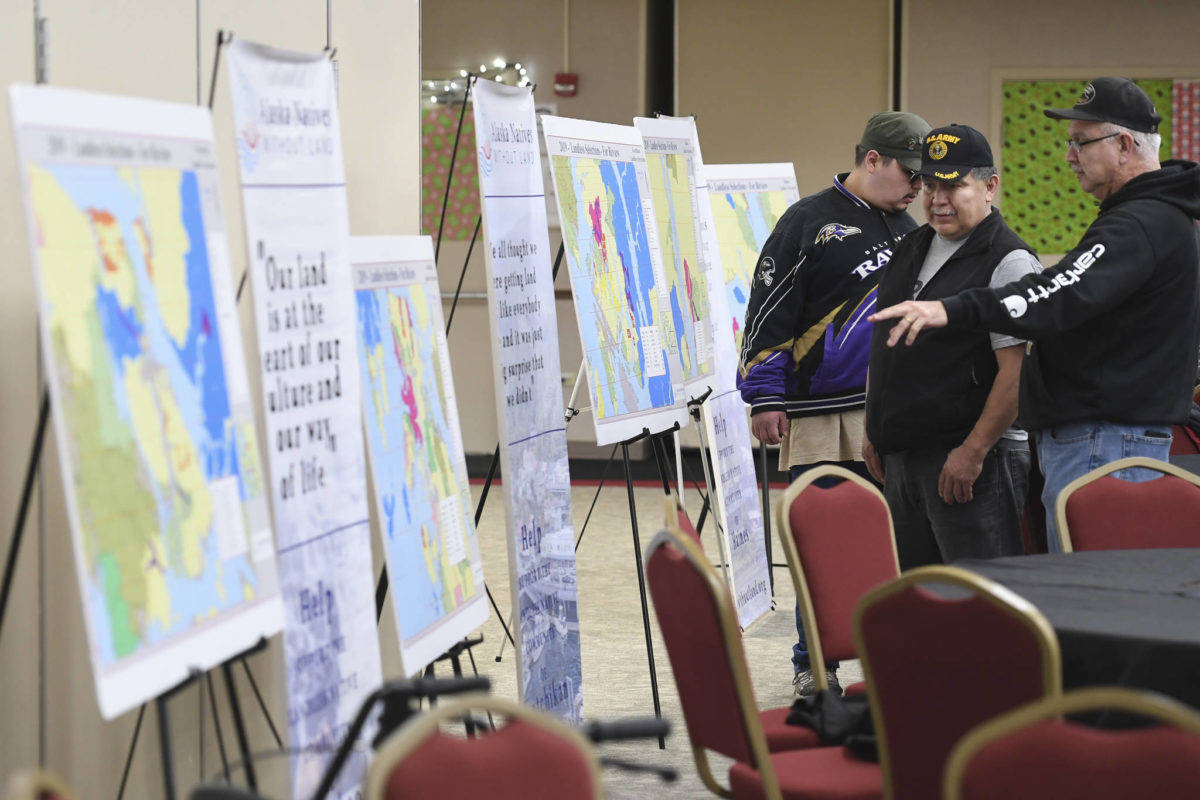
ANWL gave presentations across Southeast Alaska complete with maps to make their case to the public. Under the legislation, the new corporations would be eligible to receive up to 23,040 acres each. The corporations would then be able to use the parcels as they saw fit, for subsistence uses or resource development.
The legislation is being introduced in late into a lame-duck Congress but advocates at the news conference Tuesday said they believed there had been a sea change in national politics with regard to Native rights, and there would be enough support for the bill to pass. John Crowther from Murkowski’s office said at the conference if the bill failed to pass during this session, much of the work that went into it could be used to inform a new bill.
It will take some time between when legislation is passed and when land is actually conveyed to new Alaska Native corporations, Kookesh said, but the bill is about more than being able to use the land.
“The biggest reward for these communities is to be recognized,” she said.
• Contact reporter Peter Segall at psegall@juneauempire.com. Follow him on Twitter at @SegallJnuEmpire.
