
A previous version of this article incorrectly spelled the name of Juneau’s Economic Stabilization Task Force co-chair. His name is Max Mertz, not Merz. The article has been updated to reflect the change. The Empire regrets the error.
Local governments are starting to move from addressing the immediate needs caused by COVID-19 to preparing for what the long term effects of the COVID-19 pandemic might be.
Federal coronavirus relief money provided a huge infusion of cash for state and local governments who’ve tried to use the money to prop up their economies enough to weather the pandemic. But many of those programs are coming to an end even as more Americans sign up. A June 25, report from the U.S. Department of Labor said in the week ending June 6, the total number of people claiming benefits in all weekly unemployment insurance was 30.5 million, a 1.3 million increase from the previous week. Those payments are set to end July 31.
Businesses in Juneau are struggling to hang on, said Robert Venables, executive director of Southeast Conference, a regional development corporation.
“We’re really still assessing the immediate damage,” he said Friday in an interview. “The first phase, if you will, is stabilization, the next stage is resiliency. We’re working with economic sectors to really plot and plan the path forward, reinvent what we need to reinvent.”
On Wednesday, Southeast Conference released results from a survey of local business owners, which Venables called “grim.”
[First responder salaries, child care and business grants are top priority for CARES money]
Business revenue was down 57%, according to the survey, and business owners have had to lay off 18.6% of their workforce. About 25% of respondents said they were at risk of closing permanently, with child care, social service providers and food and drink establishments at highest risk.
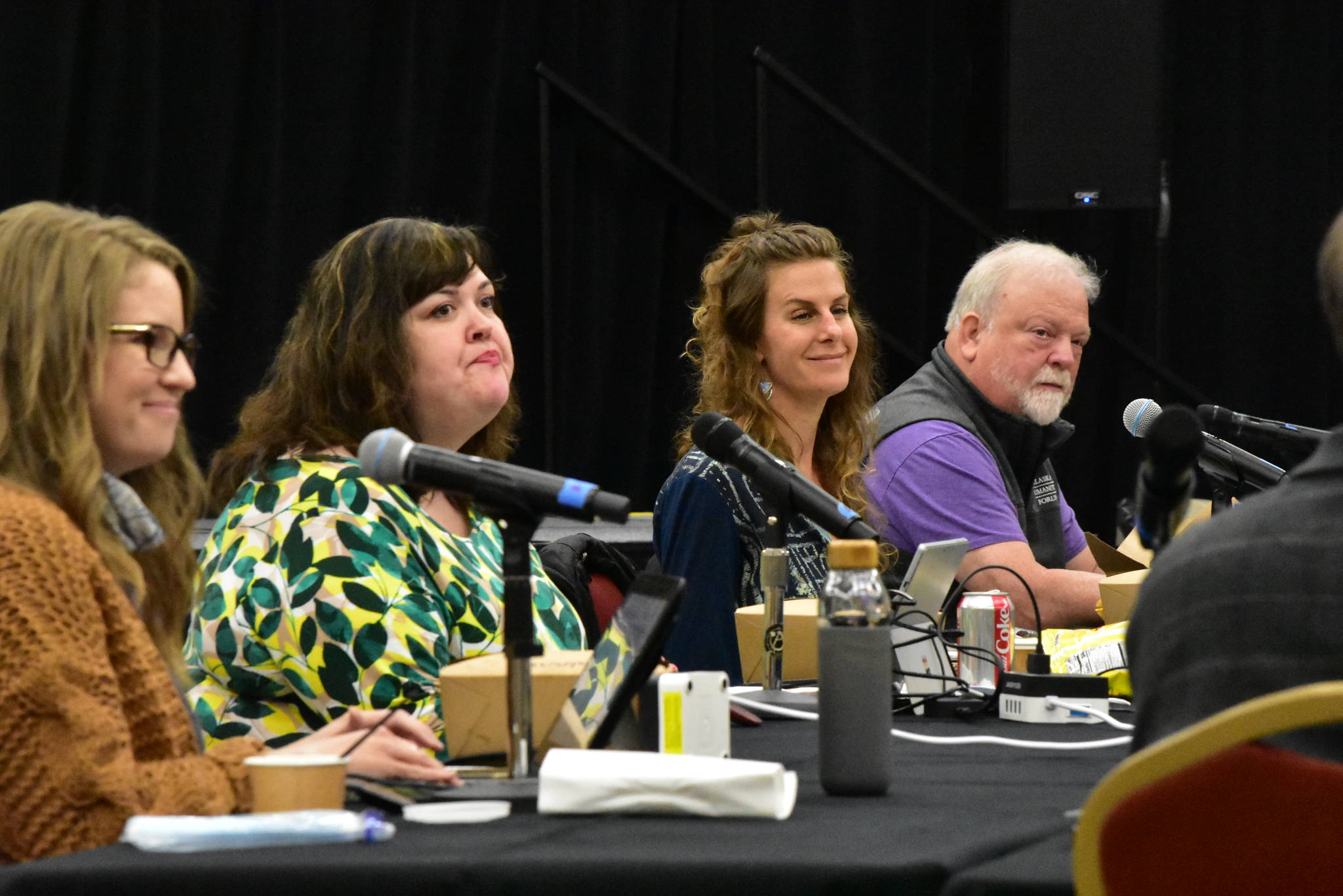
At a meeting of Juneau’s Economic Stabilization Task Force, held in-person but socially distanced at Elizabeth Peratrovich Hall, members brainstormed which sectors of Juneau’s economy needed support.
“By my count, I think there were 13 different areas that we’re going to be following up on (from) today,” said Max Mertz, co-chair of the task force.
At the meeting, members considered what the community might need into 2022 and beyond. Members commissioned studies focusing on three key areas — child care, homelessness and workforce development. The results of those studies will be carefully evaluated in the coming weeks and months, Mertz said.
What’s clear is many of these issues will remain even if federal funding for them ends, and in that absence local governments may pick up the slack. Juneau is set to receive a total of $53 million in CARES Act funding, $20 million of which was already allocated to first-responder salaries before it arrived in the city’s bank account.
“When Congress passed the original (Paycheck Protection Program) it was for an eight week period, and it was supposed to be ‘we’re in a blip, and we’re on the backside of it.’ We’re anything but on the backside of it,” Mertz said. “These are long-term issues, the need to support employment. I mean, today we have at least 2,000 people unemployed here in Juneau. That’s a huge number.”
City and Borough of Juneau has set up its own small business grant program to in addition to funds available from the state and federal governments. The CBJ Assembly recently approved a jobs program proposed by the task force and based on a New Deal program putting people to work building hiking trails and other outdoor facilities.
In another direct nod to the New Deal, the task force but in a funding request to the Assembly for a work program for out of work artists.
“In the spirit of the Work Projects Administration of the 1930s, this program delivers funding to artists who have lost gigs, had contracts or events canceled, been laid off or have otherwise been put in a vulnerable position due to the necessary restrictions to control the COVID-19,” the task force said in its fund request for $250-500,000.
However, the number of issues in need of attention continues to rise. Many of the issues discussed by the task force such as child care and homelessness, were problems well before the pandemic; COVID just made them worse.
“COVID has put a lot of pressure on our social services, in particular sheltering service,” City Manager Rorie Watt said Monday at an Assembly meeting. “And that pressure is showing cracks in that system. We have very hardworking, very good local agencies who are doing the best they can with the resources they have.”
Watt suggested it was time for the city to make a decision about getting more involved in social services like homelessness, which have traditionally been run by private non-profits with governmental support. But the traditional funding streams for those organizations were no longer enough, and additional support was needed.
But as the list of needs grows, so too does the question of how to fund those programs, which may lead to some difficult decisions, said Mayor Beth Weldon.
[City needs to weigh role in social services, manager says]
“Well, if we can’t use COVID funding we’re either going to have to stop the programs, which is sometimes hard to do, or we can raise our taxes,” Weldon said after the meeting. People don’t understand, we can do some help right now, (but) we will have to stop these programs because our current income can’t keep these programs going. That’s why a lot of us are very cautious.”
Right now the city was open to anything so long as CARES Act money could fund it, Weldon said, but the budget is already being drawn down to dangerously low levels.
According to current projections, Juneau’s unrestricted budget reserve will be drawn down to $4-5 million at the end of Fiscal Year 2021, said CBJ Finance Director Jeff Rogers.
“It still does have the Restricted Budget Reserve,” Rogers said, which currently sits at about $16.6 million. “This year the Assembly decided to use the unrestricted budget reserve, but they could (use the RBR). It’s really up to them, it’s only restricted by (the Assembly’s) own resolution.”
The Assembly could simply vote to rescind the restriction on using the RBR and tap into those funds. The reserve fund was created for emergencies and it could be argued the COVID-19 pandemic was exactly the kind of thing the fund was created for Rogers said. But the Assembly might not want to use RBR funds year after year to support programs, he said.
“I think there needs to be really careful analysis of the financial impacts,” Rogers said. “I think (the task force and the Assembly) are talking about all the right things; how to support child care and homelessness, these are perennial issues they’ve just really come into sharp focus.”
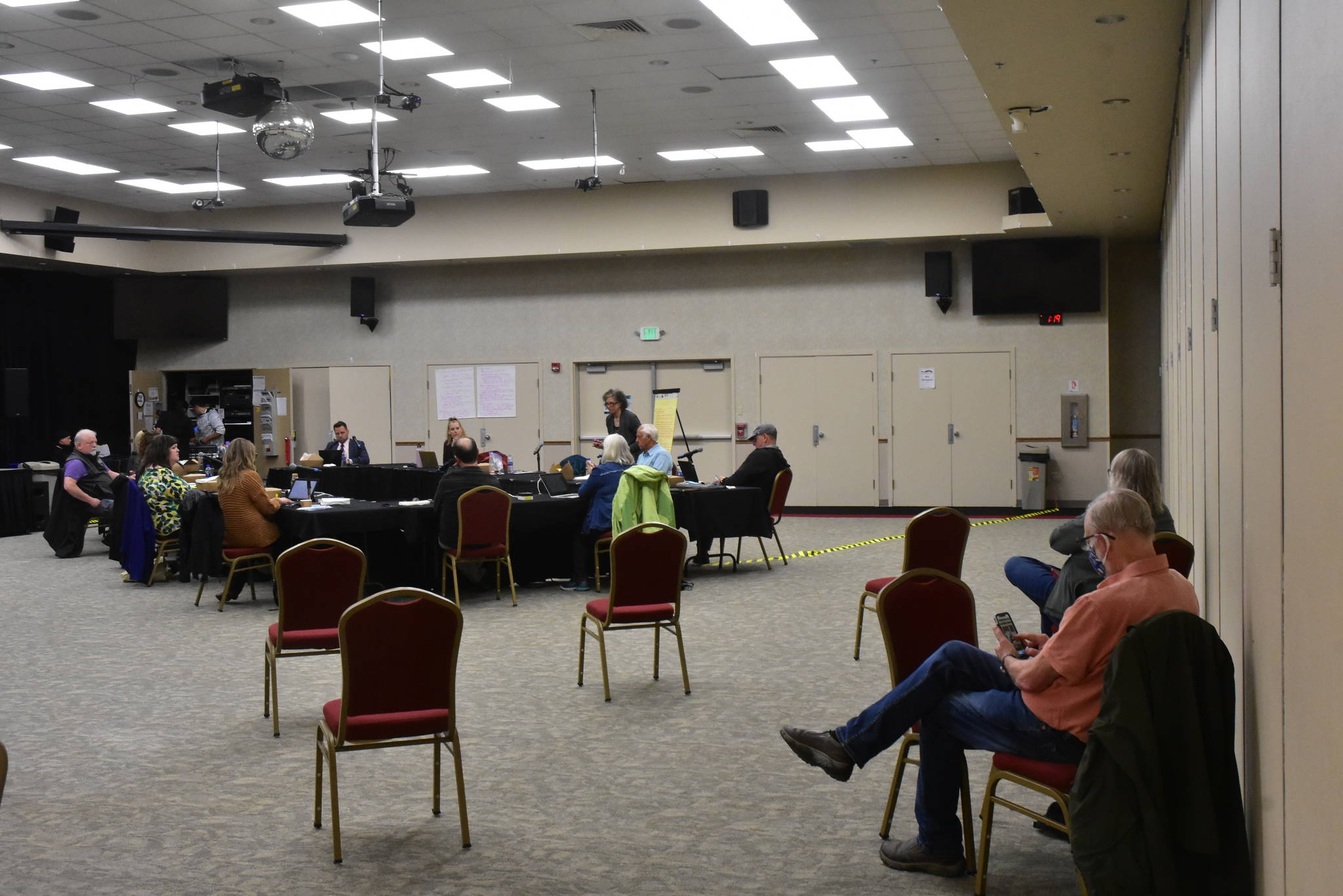
City and Borough of Juneau Assembly Member Loren Jones and Mayor Beth Weldon listen from the wings to a meeting of the Juneau Economic Stabilization Task Force at Elizabeth Peratrovich Hall on Friday, June 26, 2020. (Peter Segall | Juneau Empire)
• Contact reporter Peter Segall at psegall@juneauempire.com. Follow him on Twitter at @SegallJnoEmpire.
