
Prickles, thorns, and spines of some sort are a common type of protection, found in many organisms. Here, we are well-acquainted with devil’s club, whose prickly stems deter a hiker’s grasp and probably deter stem- and bark-munching herbivores.
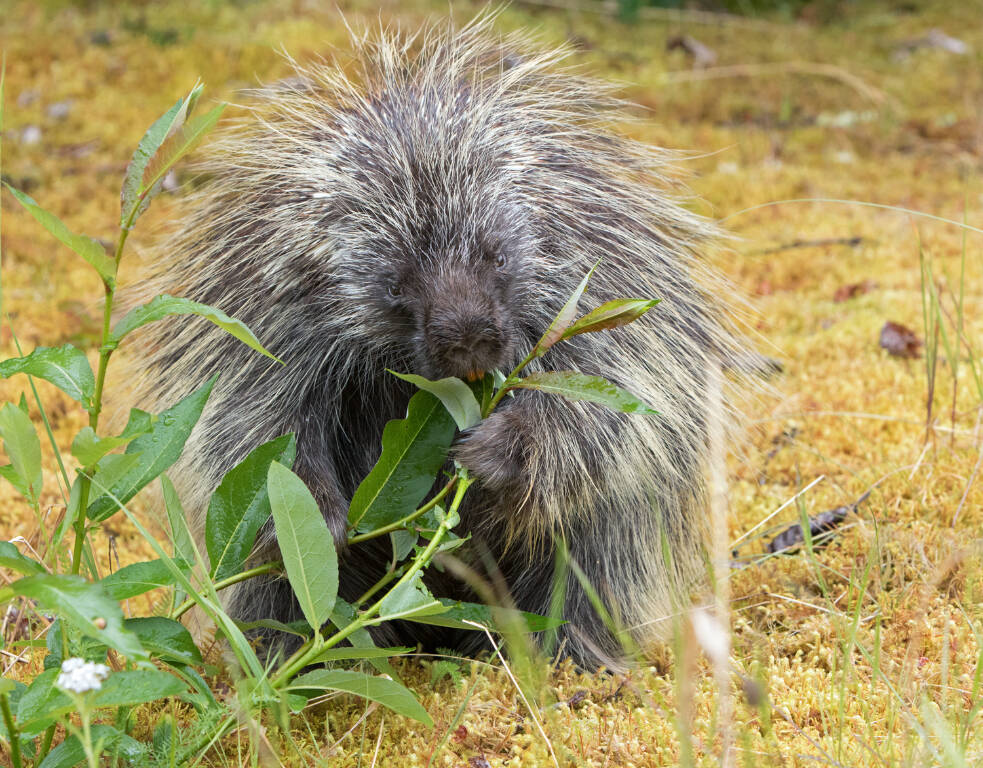
Many a nosy dog has discovered, to its sorrow, that porcupines have spines too; they are barbed and readily detached, so the nosy one often carries away a face full of spines. A cornered porcupine shows its back, with erected spines, to a predator, and thrashes the spiny tail, turning those spines into a defensive weapon. Some natural predators (such as fishers) learn how to avoid those defenses by attacking the porcupine’s vulnerable nose or belly. Porcupines sometimes fight each other, over food or mates, and reportedly the spines can be used both for defense and for attack.
Mammalian spines have evolved from modified hairs, made of a fibrous protein called keratin. Technically, a distinction is sometimes made between spines and quills, but in general usage, the two terms are swapped freely. Porcupine spines are hollow and somewhat flexible, but those of other spiny mammals can be semi-solid and rigid. Some African porcupine spines can be very long, between 12 and 20 inches.
While thinking about spiny mammals, I came to realize that they occur on every continent except Antarctica, not to mention several large island systems, in quite an amazing variety of species. The North American porcupine ranges over much of that continent and into northern South America. Central and South America have their own “tree porcupines,” which are smaller than the North American species and typically more arboreal. Some have prehensile tails, giving them a fifth appendage for clambering around in trees. There are 16 or 17 species (depending on the source).
The Old World porcupines of Eurasia and Africa are not very closely related to any of the New World species. There are about 11 species, some with extremely long spines. The largest ones can weigh 60 pounds, almost rivaling beavers and capybaras for the title of largest rodent. Although some of them can climb trees, most of them are quite terrestrial. Some of the more terrestrial species have tail spines of an unusual shape that rattle loudly when shaken. Those rattling sounds may be used both in courtship and as deterrents to predators.
Hedgehogs also live in Eurasia and Africa, with a now-extinct type in North America. Distantly related to shrews, there are about 17 species, most of them quite small. They can erect the spines that cover their backs and roll into a tight, spine-covered ball to defend themselves. Some are reported to use that prickly ball also on offense, ramming an intruder. Immature hedgehogs shed their spines and replace them with adult spines, but they are not readily detachable.
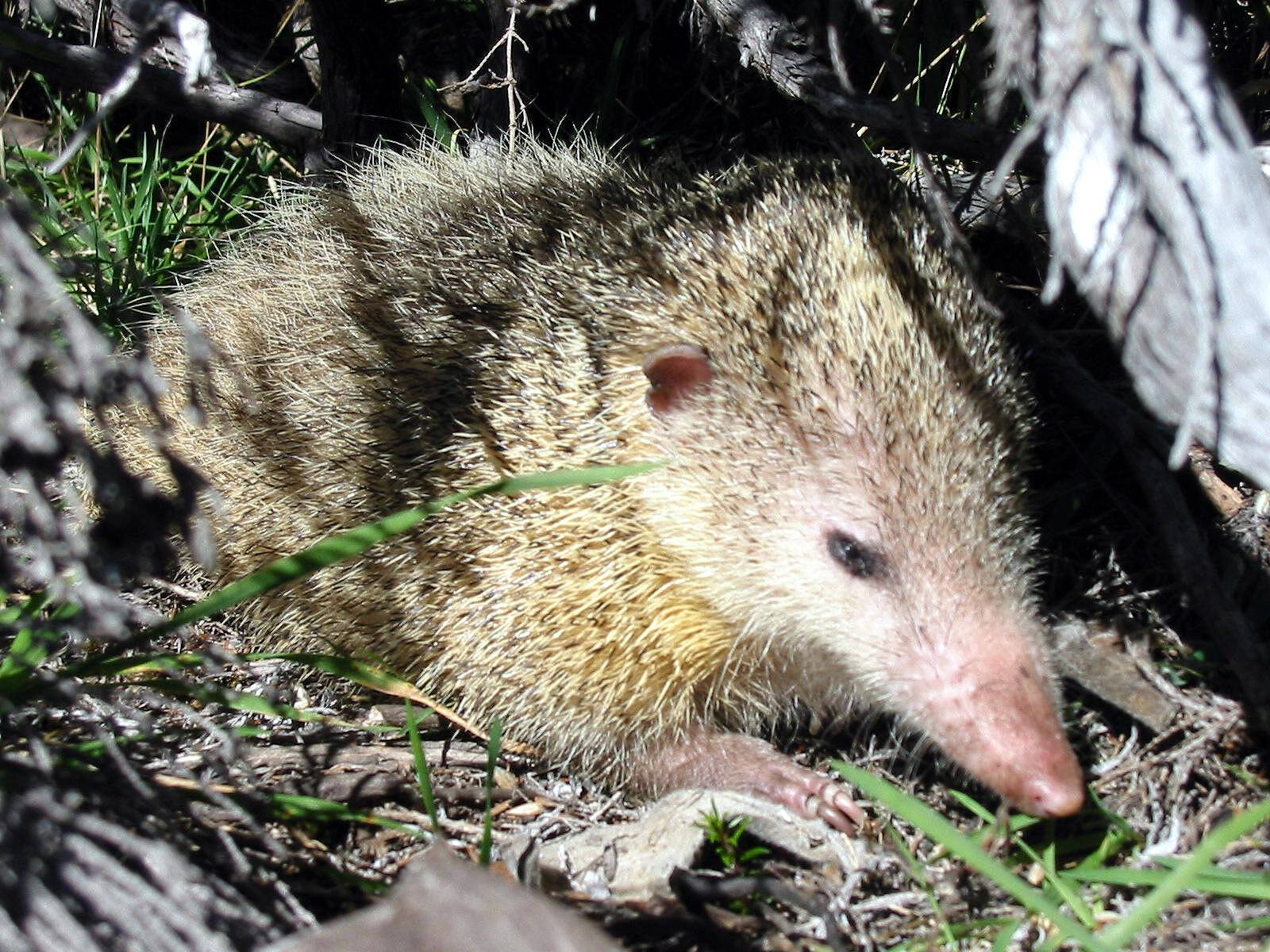
A tailless tenrec, one of many variations of the small spiny mammal. (Public domain photo via CC BY-SA 3.0)
The big island of Madagascar is home to an extraordinary group of small spiny mammals called tenrecs. Arriving from Africa millions of years ago, where a relative still lives, they probably rafted on floating vegetation. They have diversified into many ecological niches: some look like shrews, or tiny otters, or moles, and others look like hedgehogs. The more terrestrial species have spines, but most do not. A streaked tenrec is known for two specialized uses of its spines. When annoyed by another animal, it can head-butt the intruder with a spiny head, leaving barbed spines in the intruder’s nose. Their spines are also rubbed together to make an ultrasonic sound (this is called “stridulation,” as done by crickets, rubbing one body part against another). Tenrecs use stridulation for communication as family groups travel through the forest understory.
Australia didn’t get left out of the prickly-critter catalog. There are four species of echidna in Australia and New Guinea. Echidnas are egg-laying mammals (like the platypus; collectively called Monotremes), known only from this area (although there are fossils in South America). They are good diggers and can bury themselves well, leaving only a spiny back exposed to an intruder, and they can also roll into a prickly ball.
And then there are so-called spiny rats, which actually fall into two different rodent families. One large taxonomic family is neotropical, with around 80 surviving species (and many fossils too), most of which have stiff, sharp hairs or spines. They have radiated into many ecological niches, including arboreal, aquatic, burrowing, caves, and so forth. Another taxonomic group is more closely related to the usual mice and rats, and the several species inhabit Southeast Asia, New Guinea and Japan.
Two things emerge from this abbreviated catalog of spiny mammals. The first thing is that there has been a lot of convergent evolution, with similar adaptations (in this case, spiny-ness) arising independently in several different lineages. An extreme example is the Monotremes, which are only distantly related to the rest of the mammals. Similarly, spiny-ness arose in a lineage containing shrews (the tenrecs) and in rodents, which are not closely related to shrews. And then, spiny-ness occurs in several branches of the rodent group: within that group, porcupines and rats, for example, are not closely related, nor are the neotropical and Asian spiny rats.
The second thing is that some feature that exists in an animal can be put to novel uses, which has often happened in the course of evolution. Hairs were turned into spines. Spines are basically a means of defense, but they can become weapons (of both defense and aggression), as in the cases of species that roll up, exposing the spines, and roll that spiny ball at an attacker. The thrashing, spiny tail of a porcupine is used both defensively and aggressively. Another add-on use is communication. The modified spines of some Old World porcupines have shapes that enhance a rattling sound, used both amorously and aggressively. And tenrecs communicate with stridulations of their quills.
• Mary F. Willson is a retired professor of ecology. “On The Trails” appears every Wednesday in the Juneau Empire.
