
We have two species of forest hawks: the American goshawk and the much smaller sharp-shinned hawk. Both have short, broad, powerful wings and long tails, which let them dash through thick vegetation with agility.
They are, of course, mighty hunters, moving from one elevated observation post to another quite frequently, until they spot something tasty and worth pursuing, usually at high speed. As they close in on prospective prey, they extend their legs with claws ready to drive into the victim’s body. The success rate of such predation attempts varies greatly, depending on many factors, including the structure of the vegetation, the type of prey and its movements, the weather conditions, and so on; in addition, juvenile hawks are still learning to be savvy hunters and usually don’t do as well as more experienced adults.
Observers have reported success rates ranging from about 15% to about 80%. Our goshawks are big, with marked sexual dimorphism: some males weigh more than a kilogram and females weigh up to one-an-a-half kilograms. They can take prey weighing over twice their own body weight. I’ve seen several goshawks with captured mallards, which can weigh over a kilo. They also take hares (snowshoe hares weigh about 1.5 kilos), grouse, big woodpeckers, big songbirds such as robins, squirrels, as well as smaller prey.
The breeding range of this goshawk extends across much of the forested region of northern and western North America (former classifications put the American goshawk and the similar Eurasian form in the same species, called the northern goshawk). Some populations are semi-migratory, but don’t go far. Territories are exclusive areas, defended not only vs. other goshawks, but also other kinds of raptors. Territories are large, often over a hundred hectares, and occupied nests on neighboring territories are usually several kilometers apart. Pairs may stay together for more than one breeding season, but mate-changes are not uncommon.
The territory of a pair often holds several alternative nest sites and old nests that may be repaired and used again. The nests are usually well up (to about 20 meters) in big trees, often close to the trunk and also on infestations of dwarf mistletoe. Females do most of the construction work, selecting small branches and twigs for the basic structure, and adding snippets of green vegetation (often conifer twigs) during the time she is incubating eggs and brooding little chicks.
Courtship is mostly an aerial performance (I’d love to see that!) and pairs are typically monogamous. Pairs may stay together for more than one breeding season, but mate-changes are not uncommon. As the breeding season progresses, members of a pair copulate frequently, reportedly more often than most birds, both during courtship and during egg-laying. That high frequency might be one reason that chicks fathered by a male from outside the pair are said to be extremely rare (unlike many other birds). Females usually produce clutches of two to four eggs, laying one egg every other day or so. Incubation takes four to five weeks (the length varies among reports), almost entirely by the females.
Hatching is somewhat asynchronous, taking only two or three days, suggesting that effective incubation did not start with the first egg to be laid. Sibling aggression is not uncommon, typically with the larger, slightly older, and perhaps female chicks being aggressive to the smaller, younger ones.
Females do most of the brooding of young chicks. Males deliver food to incubating and brooding females on their nests; if the chicks have hatched, females tear off bits of delivered prey and give them to the chicks. Chicks stay in the nest about five weeks, then begin to hop out and explore around the nest. These fledglings are tended by both parents, and after a few more weeks, they usually disperse to other areas, sometimes visiting neighboring groups of fledglings. By this time fledglings are able to capture their own prey.
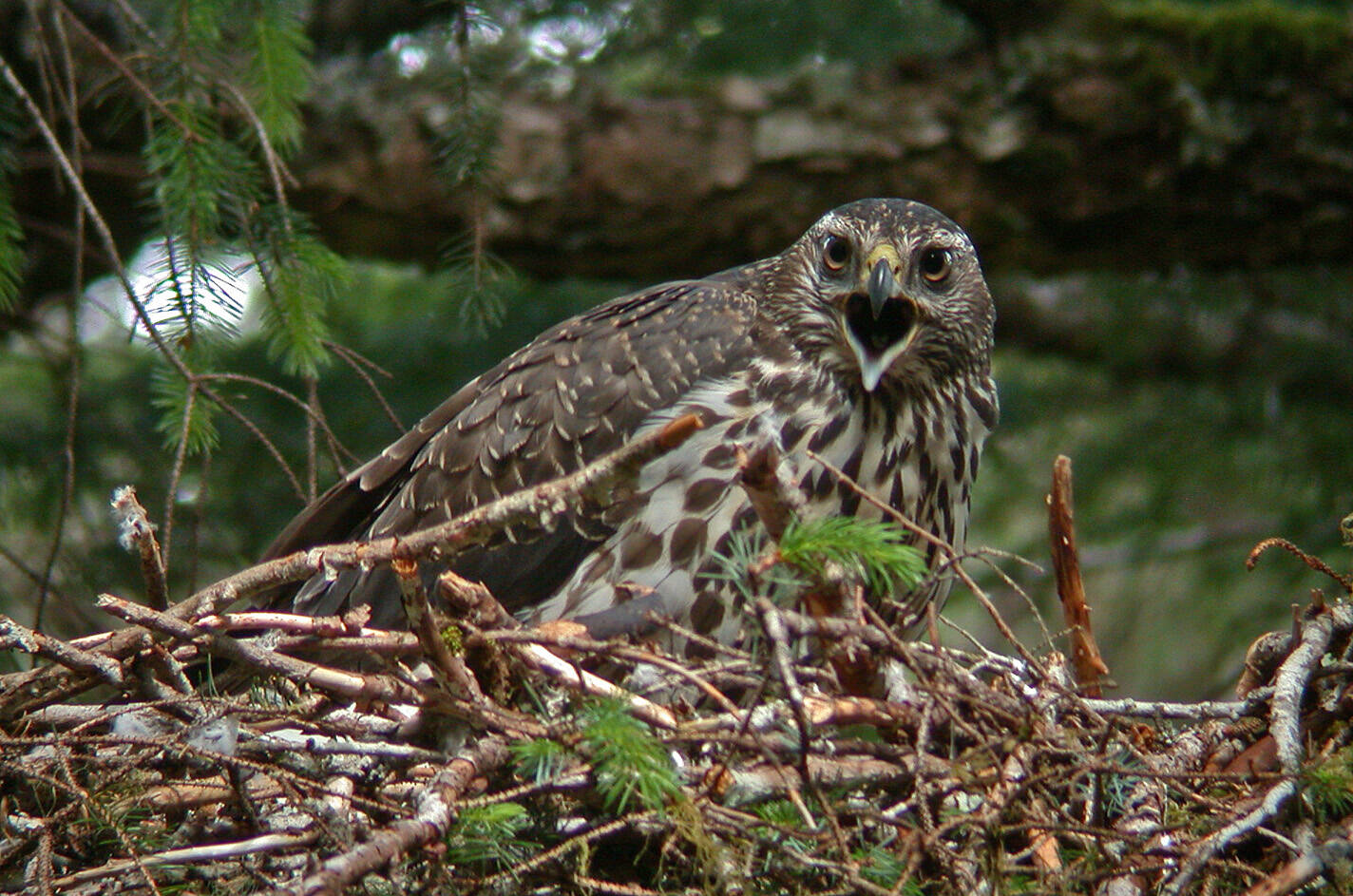
Nest success is usually quite good: over 75% of active nests produce fledglings, often two or three of them. Although one-year-old goshawks occasionally try to breed, most wait until they are two or three years old; the frequency of breeding by two-year-olds varies with location and conditions. A local photographer found a nest tended by a female in brown, so-called juvenile plumage (see photo) that was perhaps only a year old. That female did not approve of the observer, made hard, physical contact with closed talons, and drove the photographer away. Goshawk lifespan is poorly documented but is potentially at least eleven years.
Sharp-shinned hawks are significantly less well-studied than goshawks. They are much smaller — roughly a fifth of the body mass of a goshawk. Females are about twice as big as males. Their hunting techniques are similar but “sharpies” specialize on small birds (usually less than about 50 grams), with an occasional small mammal or large insect. They sometimes raid open-cup bird nests, taking the nestlings. Captured prey is often decapitated and the head is the first part eaten. Females can take bigger prey than males do, and in winter they may use continuous forests while males often use patchy forests and edges. Sharpies breed in forested areas of North America, Central America, Caribbean islands, and parts of South America. They are partially migratory, especially the northernmost populations. Like goshawks, they are very territorial in the breeding season and have aerial courtship displays. Nesting habits and parental care patterns are apparently quite similar to those of goshawks. Male chicks develop faster and leave the nest two to four days sooner than their female siblings. A study in Alaska reported an average of 3.5 fledglings per nest. Their lifespan is short, reportedly seldom more than about five years.
Forest hawks are very difficult to study in detail and few studies have adequately large sample sizes. There is plenty of information still to be confirmed and even discovered.
Thanks to Bob Armstrong for the goshawk photo.
• Mary F. Willson is a retired professor of ecology. “On The Trails” appears every Wednesday in the Juneau Empire.
An American goshawk female in brown “juvenile” plumage guards her nest. (Photo by Bob Armstrong)
