
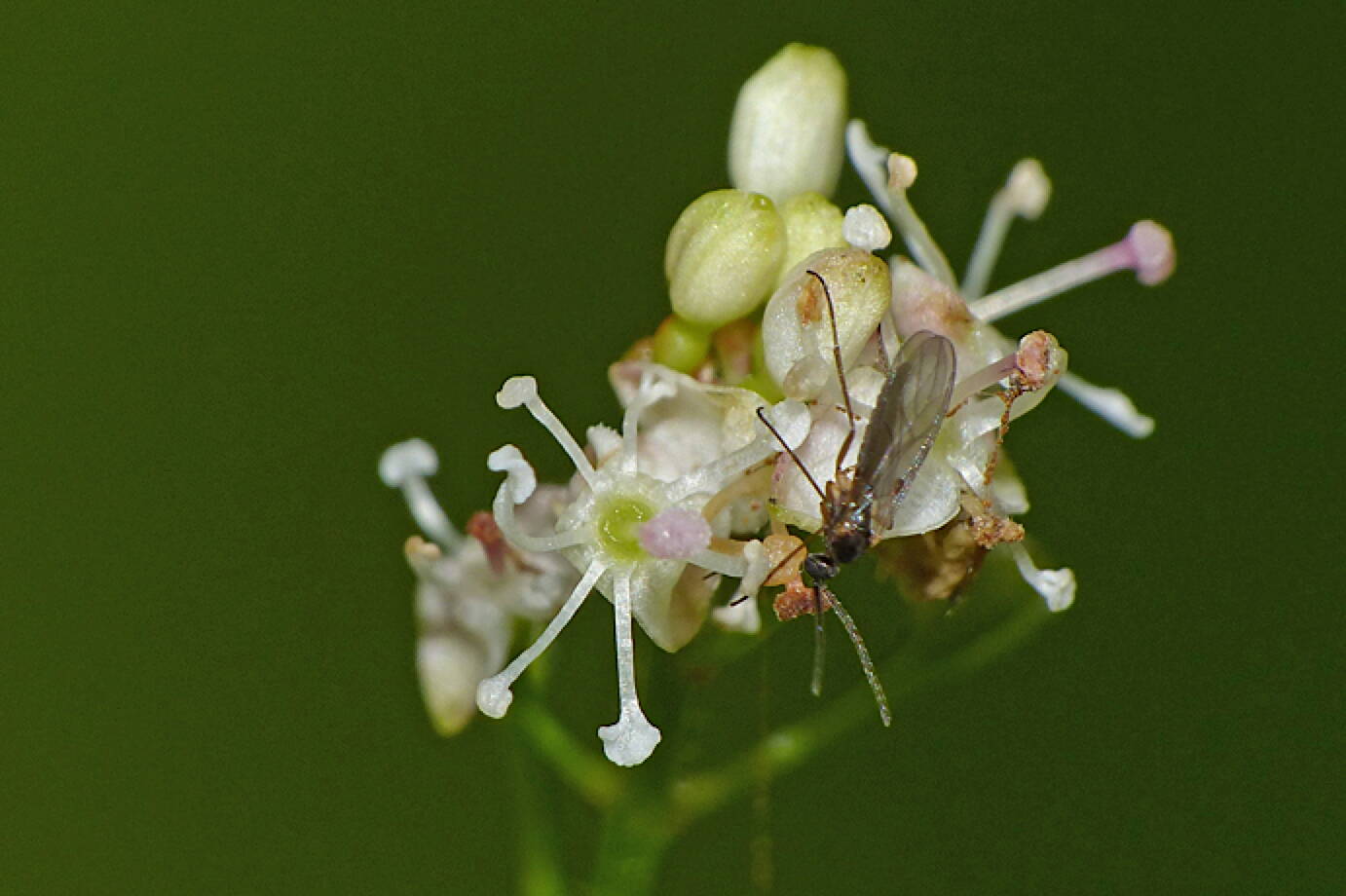
Enchanter’s nightshade is a tiny perennial plant we commonly see (and walk right past) alongside many of our trails.
Although it is said to grow as much as about two feet tall, almost all of those I notice are just a few inches above the ground. It often spreads by rhizomes; the terminal end of a rhizome expands to make a little tuber that overwinters, and the connection to the parent is lost. This asexual method of reproduction leads to small colonies of these plants, whose green leaves spread out and make a little carpet.
The flowers are tiny, less than two millimeters in size, with just two petals. In cold or other unpleasant weather conditions, the buds stay closed, and the flower self-pollinates: the anthers open and release pollen while they are closely touching the receptive stigma. In better weather, the flower opens and last a day or two.
There is nectar at the base of the style, which attracts mostly small syrphid flies; tiny halictid bees (known as sweat bees) may collect pollen and nectar also, at least in some areas. Several flowers are clumped at the top of a stem and often open at the same time, and a visiting fly may visit several flowers on the same plant or colony, leading to self-pollination. So it seems that cross-pollination is a chancy business, happening only when a fly moves to a different colony of plants, in which the individuals are genetically different. The very small one-seeded fruits are covered with short bristles that presumably help with dispersal, sticking to whatever walks or crawls by.
Enchanter’s nightshade is closely related to Fuchsia and belongs to the taxonomic family of evening primroses. The common name of enchanter’s nightshade is a mystery, since this plant is not related to the nightshades, which are in a different family. The scientific name of the species is Circaea alpina, although it is not at all common in alpine zones, at least in our area. So to that extent, the names are a muddle.
The genus Circaea contains over a dozen species distributed across the northern hemisphere, but mostly in Asia. That name comes from Circe, a mythological minor goddess who lived on an island in the Mediterranean Sea. She was an herbalist and a sorceress who was thought to use this plant in some way to turn men into wolves, pigs, lions and, once, a woodpecker. The classical Greek hero Odysseus encountered her on a voyage; his adventures are recounted in Homer’s epic poem “Odyssey.”
These plants have borne the name Circaea for over t200 years. Back then, and continuing into the 1900s, it was customary for scientists to include the study of Greek and Latin in preparing for a career. So they were often well-read in the classical literature and conversant with ancient myths from Greece and Rome. Thus we have many scientific names drawn from the classics. Here are a few examples for plants: Iris, goddess of the rainbow and messenger of the gods and our well-known garden and meadow flower; Calypso, goddess of silence who held Odysseus captive for several years and a popular little orchid here; Achilles, a famous Greek warrior and the namesake of yarrow (Achillea), which flowers profusely in our meadows. It often isn’t clear to me why the name-giver made some association between the classical work and the present-day flowering plant!
Thanks to Bob Armstrong for photo.
• Mary F. Willson is a retired professor of ecology. “On The Trails” appears every Wednesday in the Juneau Empire.
