
In the city’s first-ever case centering around police body cameras, a Juneau man was convicted Tuesday for assaulting a police officer during an incident this summer.
Domanic Quick, 23, was found guilty of two misdemeanor assault charges, interfering with an officer, disorderly conduct and criminal mischief. The jury deliberated for only about 50 minutes before reaching a decision.
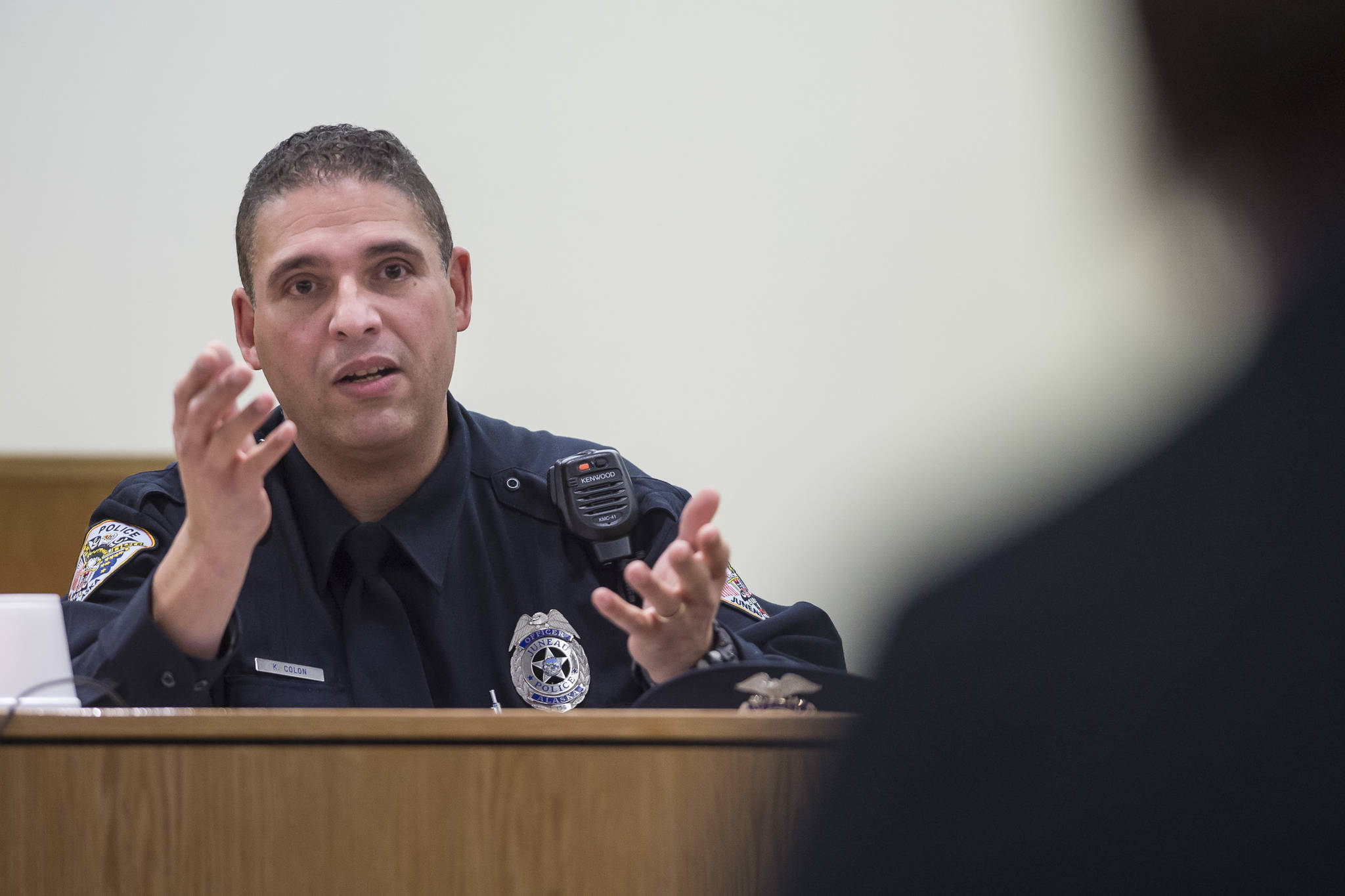
Quick’s defense was focused on the use of force that officers used to detain him. Quick was Tased multiple times, was pepper sprayed and was hit with a baton as Juneau Police Department officers Ken Colon and Don Ward detained him, the body camera footage showed.
Assistant Municipal Attorney Emily Wright said this is the first body camera trial that the City and Borough of Juneau has prosecuted. It isn’t the first trial to involve JPD body camera footage, but is the first one the CBJ prosecuted. JPD received funding for body cameras in late 2016. JPD Lt. Krag Campbell said a few officers began wearing them in January of this year, and by May, all uniformed officers were wearing them.
Grace Lee, the city contract public defender, said Quick wanted to go to trial mainly to make sure people saw the body camera footage.
“He felt it was important for people to see this video,” Lee said. “He felt that he was treated poorly and he didn’t want to kind of hide it. Now that officers can be accountable through their body cams, he wanted to make sure that information was out there for public consumption.”
The ‘melee’
The charges stemmed from a June 7 incident during which two officers responded to a call saying Quick had stolen someone’s keys, according to testimony from the officers. Colon’s body camera fell off about two minutes into the incident, but Ward’s stayed on and gave a close-up view of the struggle.
Colon and Ward arrived within minutes of each other and began talking with Quick, the body camera footage showed in court. Over the next 20 minutes, Colon and Ward tried to detain Quick in order to conduct an investigation into where they keys were, they both testified.
“All we wanted to do was conduct our investigation and determine what happened. If nothing occurred, you’re free to leave after that, but he refused to stay, so we had to take control of the situation,” Colon said under direct examination in court. “A lot of times we place cuffs on an uncooperative individual as a temporary detainment so we can continue our investigation.”
Quick was upset that he was being detained, the officers said and the video showed, and the officers resorted to using force to get Quick on the ground and in handcuffs. Ward used his Taser on Quick multiple times and Colon pepper-sprayed Quick, they both testified. After neither of those resulted in Quick allowing them to handcuff him, Ward hit Quick in the thigh three times with his baton, the camera footage showed.
After that, the officers were able to handcuff him. Colon and Ward both ended up getting scraped up during the incident, which Colon referred to as “the melee.” The cuts on Colon’s hand were the cause for the first assault charge, according to the complaint. Threatening statements to Ward constituted the second assault charge, according to the complaint.
The officers’ response
In her opening statement, Lee said she believes the scuffle wouldn’t have been so intense if the officers had acted more appropriately. She said she believed the video showed that Quick only began acting aggressive as the officers approached him.
“Throughout the trial, in the evidence presented, I believe that you as the jury will be able to see the full picture,” Lee said. “You will be able to see that these charges only come about as a justification for the officers’ poorly thought-out actions against a young man who was not a true threat.”
Quick, who wore a black collared shirt with white and blue stripes, declined to testify. The defense did not call any witnesses. Wright called three: the two officers and Capital City Fire/Rescue Paramedic Jesse Eschave, who treated Quick after the incident.
Ward, who wore a brown suit and a red Christmas tie as he testified, said it’s the first time in 26 years of police work in Tennessee and Alaska that he has used his Taser.
“Everything about this says, ‘Somebody can get hurt here. He’s actively resisting,’” Ward said under direct examination when asked why he used his Taser.
This incident was the first time in nearly 13 years with JPD that Colon has used his pepper spray, he said under direct examination Tuesday.
Both officers said the situation was more tense because they were the only two officers available at that time. During this call, most JPD officers were at the end of the road trying to talk down an armed man who was suicidal, both Colon and Ward said.
Campbell said JPD always reviews uses of force by officers. The officers are required to fill out a report explaining why the use of force was necessary, and the report is reviewed by the shift supervisor, the division supervisor, the deputy chief and the chief, Campbell said.
“We reviewed this incident and determined that the use of force was reasonable and within policy,” Campbell said.
• Contact reporter Alex McCarthy at 523-2271 or amccarthy@juneauempire.com. Follow him on Twitter at @akmccarthy.

Domanic Quick, 23, appears in Juneau District Court on Tuesday, Dec. 18, 2018, for his trial on two counts of assault on a police officer, resisting arrest, disorderly conduct and criminal mischief. (Michael Penn | Juneau Empire)
