
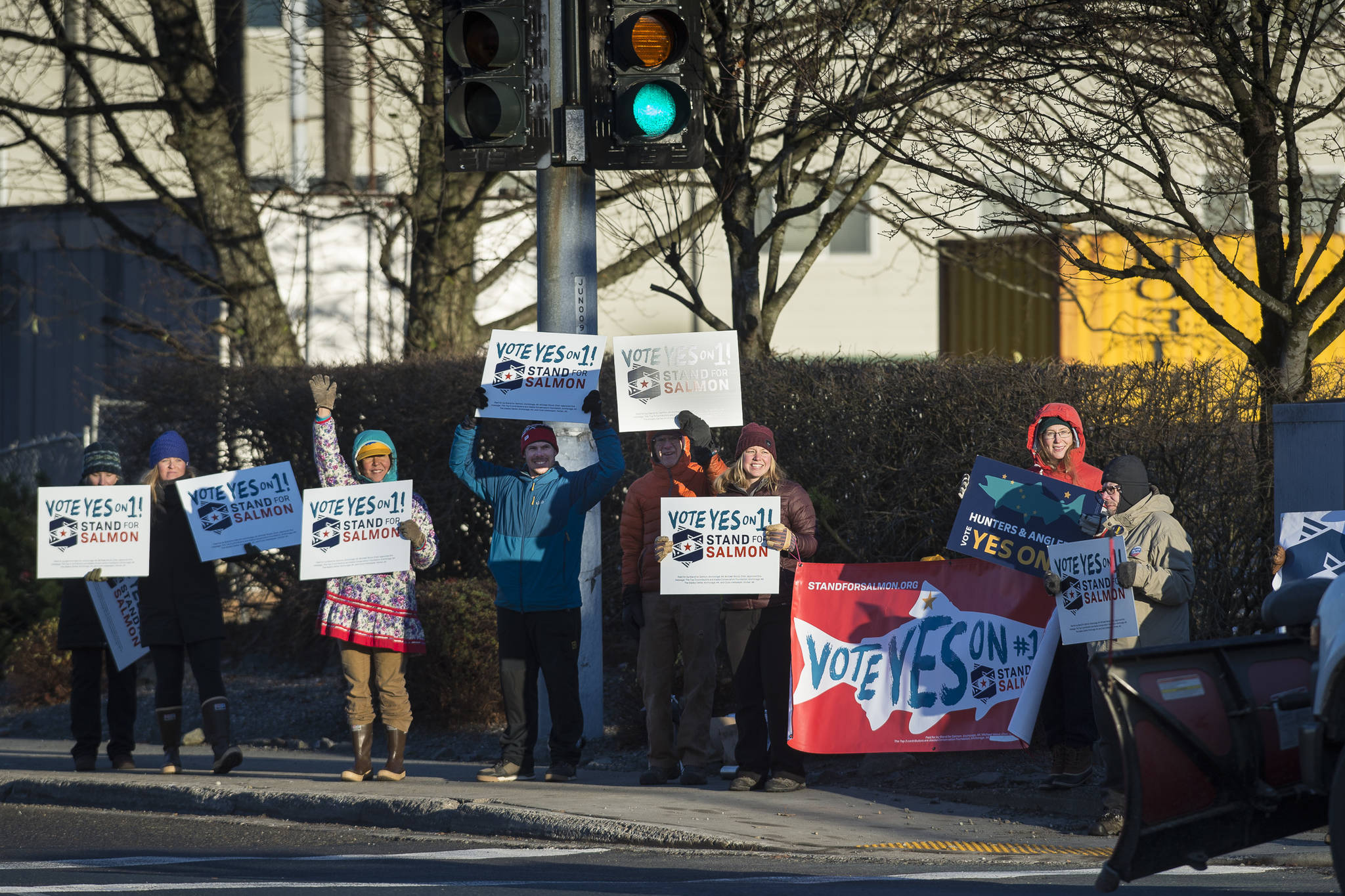
A ballot measure aimed at protecting salmon habitat received a resounding defeat in the statewide general election Tuesday.
With 98 percent of precincts reporting as of Wednesday afternoon, Ballot Measure 1, commonly known as Stand for Salmon, held only 35.2 percent of Alaska’s vote, with 61.6 percent voting against.
In a state where everyone loves salmon, why did voters reject Ballot Measure 1 by such a large margin?
Measure co-sponsor Mike Wood, a Mat-Su carpenter and set net fisherman, was in good spirits when reached by phone Wednesday. The measure started a conversation, Wood said. Alaskans now talk about updating fish habitat permitting law. The existence of that discourse means that, though the measure fell, it “fell forward,” Wood said.
“Salmon now have a seat at the table, instead of just being on the platter,” as Wood put it.
Money played a big factor in the loss, Wood said.
The coffers behind the principal group supporting the measure, Yes for Salmon — Yes on 1, paled in comparison to that of industry-led opposition group Stand for Alaska — Vote No on One. Measure opponents raised $12 million in cash and in-kind contributions, according to the latest report from the Alaska Public Offices Commission. About half of that money came from a group of six oil and mining companies, which donated $1 million each. Stand for Salmon proponents had only $1.7 million to work with, according to the last APOC report before the election.
[Ballot Measure 1 spending tops a state-level record]
That money paid for a spate of TV advertising that kept the opposition’s argument fresh in voters’ minds, Wood said. That argument? The measure would cripple Alaska’s economy. Calming those fears proved too tough for measure proponents.
“Oil, gas and mining — everyone laughs that we grabbed the tiger by the tail, but in the end, we jumped on a T-Rex. … It’s some big money,” Wood said. “Even if we spent $12 million, they would have spent $100 million.”
The uphill funding climb only accounted for so much of the wide margin of victory. Stand for Salmon lost the messaging battle, Wood said. The eight-page measure written in legalese bored and confused voters, leaving it vulnerable to harsher readings put forth by its opposition.
“It was frickin’ boring, and it was eight pages of boring that nobody could ever really wrap their head around,” Wood said.
Stand for Alaska campaign manager Kati Capozzi credited the measure’s defeat to a group of 550 Alaska businesses, Native corporations and labor unions which lined up against the measure. Business leaders across the state, including Juneau’s Chamber of Commerce, helped spread the vote no message. Oil and mining companies dispatched executives to speak against the measure. Ten of 13 Alaska Native regional corporations called for a no vote.
“Ballot Measure 1 was a radical overhaul of our salmon habitat protections. Voters today showed they believe our current regulations have served to protect our habitat and allow for responsible development,” Capozzi said.
Where Wood called the measure boring, Stand for Salmon campaign director Ryan Schryver said the initiative process may have been “the wrong tool.” Voters have to do their own homework on initiatives, and it’s a tall task to ask voters to learn the nitty-gritty of Alaska statute.
Making a decision on whether or not to legalize marijuauna, as Alaskans did by ballot initiative in 2014, is easier than deciding whether or not Alaska statute properly protects salmon habitat.
“I think the specifics of the initiative made it open to a lot of distortion and misinformation,” Schryver said.
Though the defeat was resounding, a few pockets around the state voted for the measure in a majority. Six of 40 house districts voted in favor. House District 33, which includes downtown Juneau, Gustavus, Haines and Skagway, voted yes 56.3 percent to 40.3 percent. House Districts 18, 19 and 20, the Democratic stronghold of Anchorage, voted by a slight majority for the measure. Two Bristol Bay districts, 31 and 37, near the proposed site of Pebble Mine, voted in favor by double digits, according to the Alaska Division of Elections.
Any update to fish habitat permitting law would be subject to a political landscape that shifted Republican on Tuesday. Governor-elect Mike Dunleavy was against Ballot Measure 1, but Wood is confident Stand for Salmon generated enough political capital that Dunleavy will at least give any new habitat laws a hearing.
Schryver said Stand for Salmon will keep working as an organization to update salmon habitat laws in Alaska.
Next time, Wood said he would consider taking a smaller “bite” into Alaska law. Making a sweeping change to permitting law would have the greatest effect, Wood said, but a piecemeal approach might be more realistic.
“We were trying to be too goody two-shoes and do it right,” Wood said, adding, “The thing is, is it’s the right thing to do because it’s the law, and we needed a solid foundation to work with.”
• Contact reporter Kevin Gullufsen at kgullufsen@juneauempire.com. Follow him on Twitter at @KevinGullufsen.
