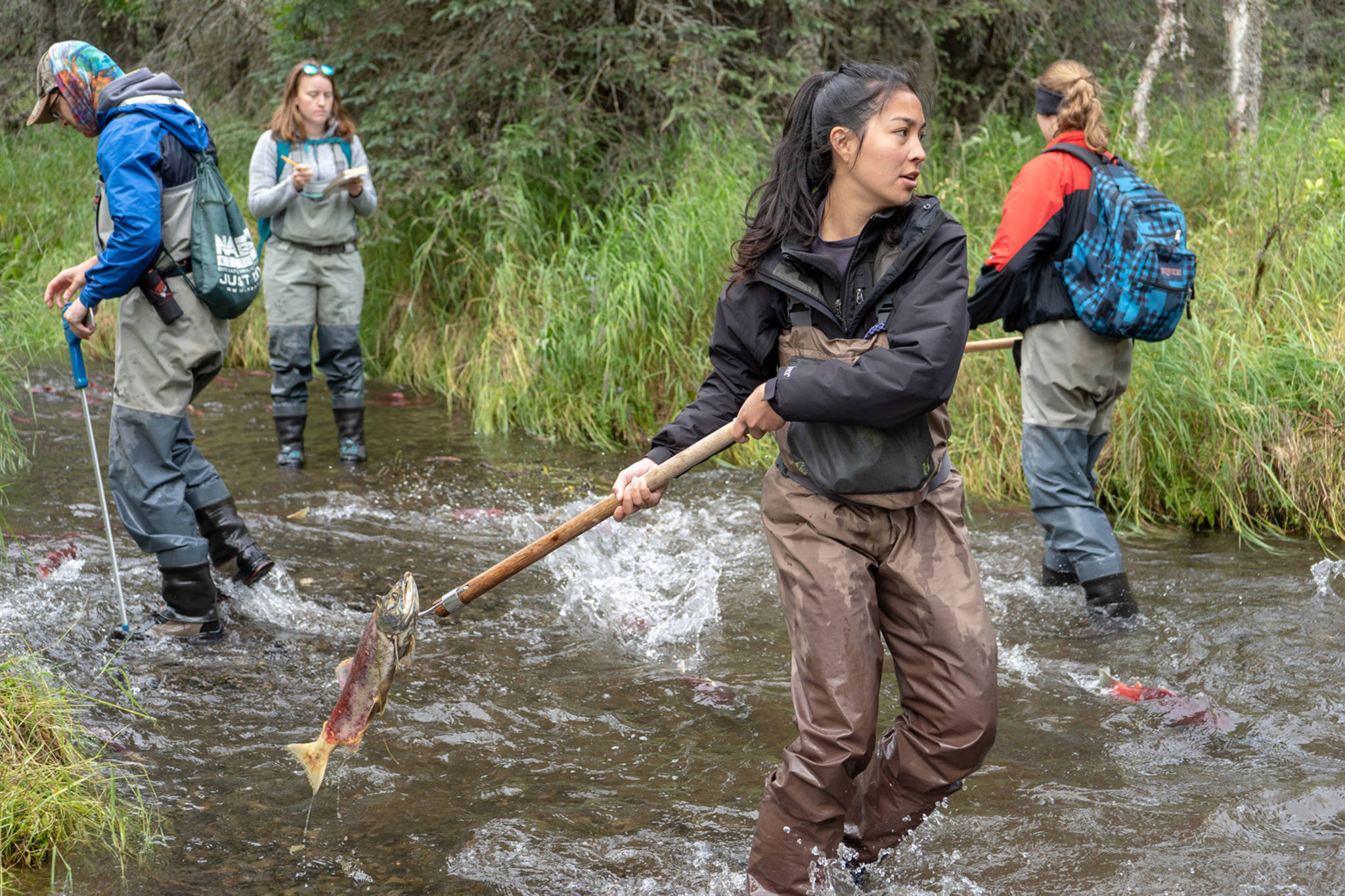
Andrea Odell, an undergraduate student in the University of Washington School of Aquatic and Fishery Sciences, tosses dead sockeye salmon onto the bank of Hansen Creek in southwest Alaska in August 2018 while other researchers record data and look for salmon in the stream. (Courtesy Photo | Dan DiNicola via University of Washington)

Andrea Odell, an undergraduate student in the University of Washington School of Aquatic and Fishery Sciences, tosses dead sockeye salmon onto the bank of Hansen Creek in southwest Alaska in August 2018 while other researchers record data and look for salmon in the stream. (Courtesy Photo | Dan DiNicola via University of Washington)

Researchers threw salmon carcasses on one side of a creek for 20 years. Here’s what happened.

How fast does a spruce tree grow? It depends on how many salmon die there, researchers show

With its network of tree-choked salmon streams, the Tongass National Forest has earned its moniker as the salmon forest.

It’s long been known that salmon fertilize forest growth. The fish contain marine nutrients like nitrogen. When salmon spawn and die in riparian areas, their carcasses feed the soil underneath, providing trees with nutrients otherwise unavailable.

Knowing that is one thing: it’s something most Alaskans grow up understanding. Measuring just how much salmon carcasses spur growth is another.

A long-running University of Washington salmon study in southwest Alaska has done just that. In a paper published Oct. 23 in the peer-reviewed journal “Ecology,” UW researcher Tom Quinn and colleagues have documented the growth of trees on one side of a river in southwest Alaska over the other.

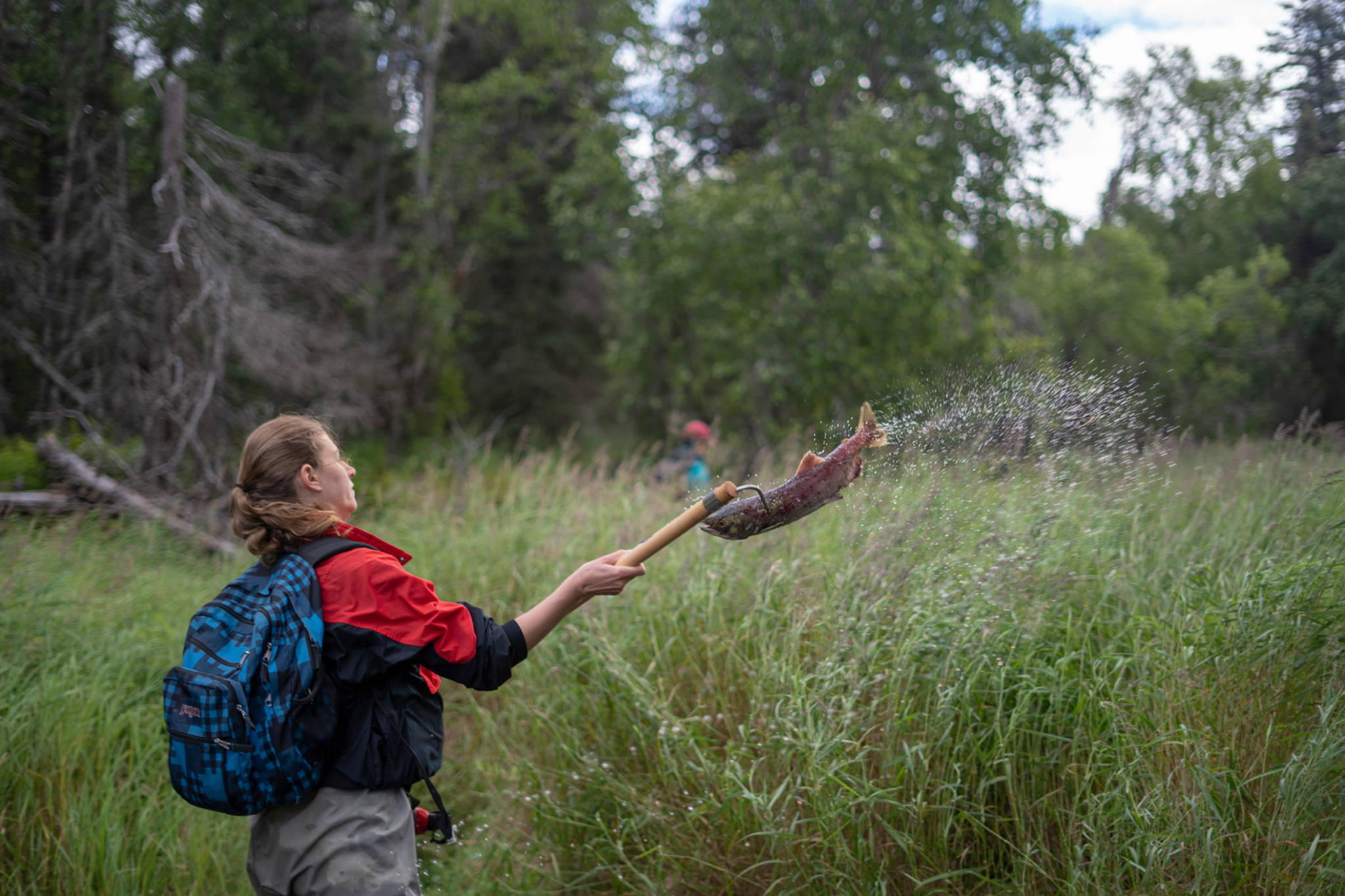
The difference? Over 20 years of a fish count study, researchers flung sockeye salmon carcasses to only one side of Hansen Creek in the Bristol Bay region. It started out as an incidental decision — to avoid double counting fish, researchers decided to huck them onto the creek bank.

Quinn saw an opportunity for further research, electing to use only one side of the bank to gauge a possible effect.

“Tossing the carcasses to the left side started out just as a convenience to keep from counting the same fish twice. I thought at some point in the future, it would be kind of cool to see it if had an effect,” Quinn told UW media.

The paper, titled “A multi-decade experiment shows that fertilization by salmon carcasses enhanced tree growth in the riparian zone,” details how white spruce trees on one side of the creek grew faster than the non-fertilized side. Samples of 84 white spruce trees showed marine-derived nitrogen was incorporated into the new growth of trees on the enhanced bank.

The researchers threw 217,055 individual salmon, estimated to be over 600,000 pounds of fish, onto a 1.24-mile section of Hansen Creek over a 20 year period.

The effect was two-fold: trees on one side of the bank didn’t receive their customary dose of salmon feed, while trees on the other side received a second serving. The trees on the fertilized side weren’t noticeably taller, even though they grew faster. Trees on the salmon-enriched side started out shorter, which could explain the difference.

Quinn and his team took deep slices out of tree corps from white spruce on both sides of the stream. They examined growth of the tree rings during the 20-year period (1997-2016) as well as a 20-year period prior to the study (1977-1996), with growth measured in the earlier period serving as a control.
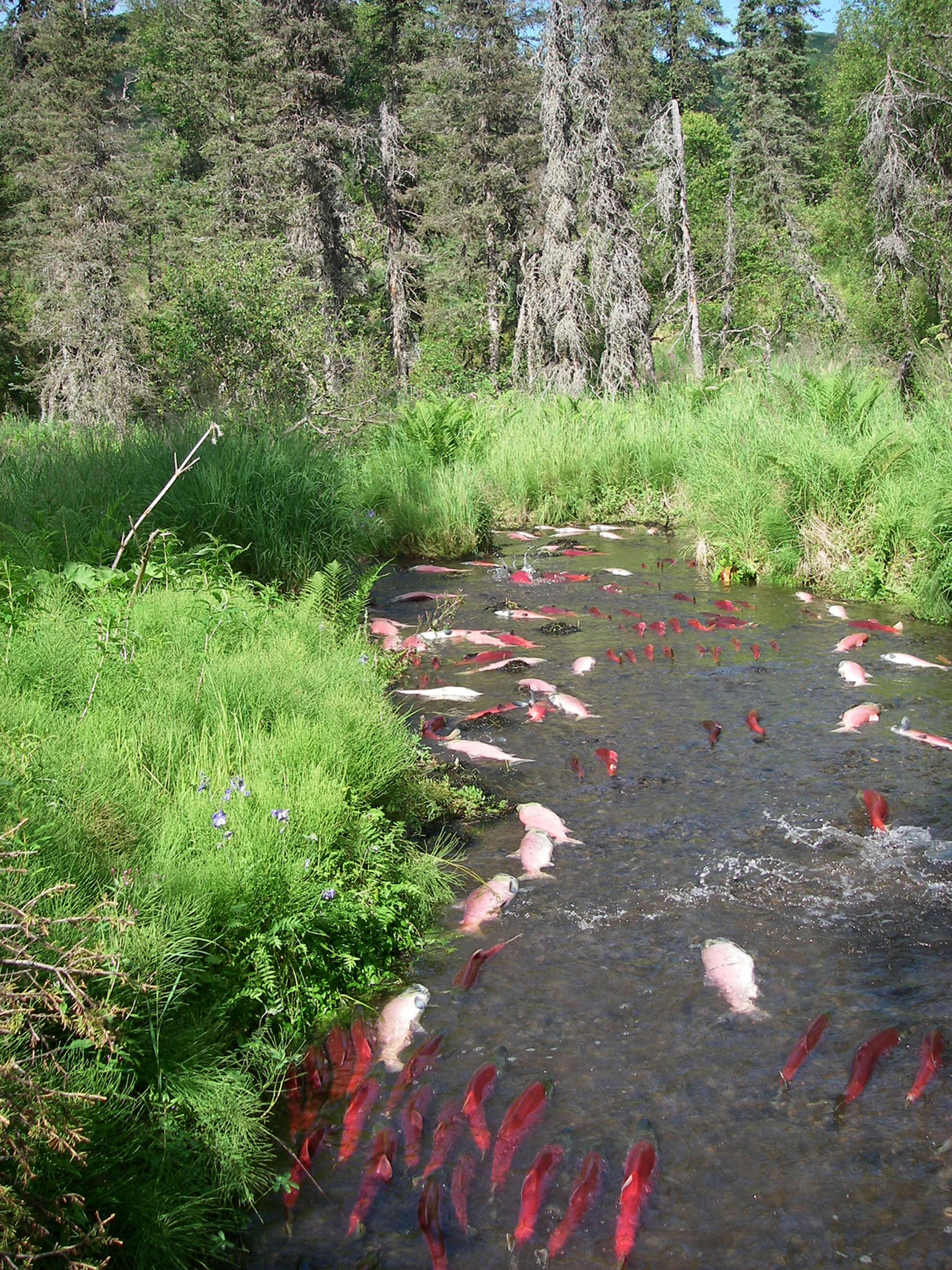
Both live sockeye salmon and fish carcasses are seen in Hansen Creek in 2014. (Courtesy Photo | Tom Quinn via University of Washington)
Both live sockeye salmon and fish carcasses are seen in Hansen Creek in 2014. (Courtesy Photo | Tom Quinn via University of Washington)

Kyla Bivens, an undergraduate student in the University of Washington School of Aquatic and Fishery Sciences, uses a hooked pole to throw a dead sockeye salmon onto the bank of Hansen Creek in southwest Alaska in August 2018. (Courtesy Photo | Dan DiNicola via University of Washington)
Kyla Bivens, an undergraduate student in the University of Washington School of Aquatic and Fishery Sciences, uses a hooked pole to throw a dead sockeye salmon onto the bank of Hansen Creek in southwest Alaska in August 2018. (Courtesy Photo | Dan DiNicola via University of Washington)

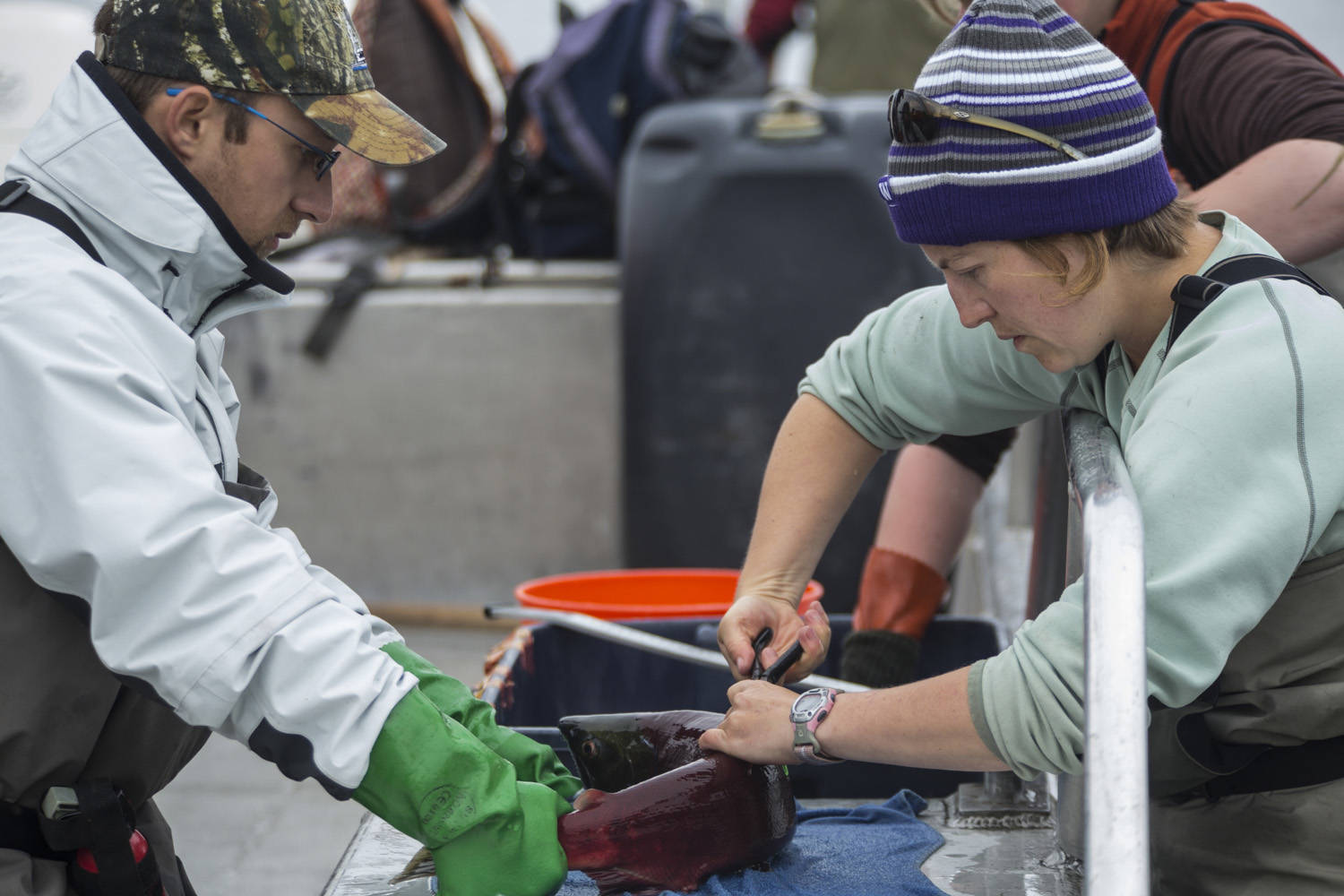
University of Washington researchers Martini Arostegui, left, and Jackie Carter tag sockeye salmon in 2015. (Courtesy Photo | Dennis Wise via University of Washington)

University of Washington researchers Martini Arostegui, left, and Jackie Carter tag sockeye salmon in 2015. (Courtesy Photo | Dennis Wise via University of Washington)

More in Home2

Win Gruening (courtesy)
OPINION: Eaglecrest’s opportunity to achieve financial independence, if the city allows it

It’s a well-known saying that “timing is everything.” Certainly, this applies to… Continue reading

A tsunami is not expected after a 4.4-magnitude earthquake northwest of Anchorage Wednesday, Feb. 4, 2026. (U.S. Geological Survey)
No tsunami expected after 4.4-magnitude earthquake in Alaska

U.S. Geological Survey says 179 people reported feeling the earthquake.

The Spruce Root team gathers for a retreat in Sitka. Spruce Root, is an Indigenous institution that provides all Southeast Alaskans with access to business development resources. (Photo by Lione Clare)
Woven Peoples and Places: Wealth lives in our communities

Sustainable Southeast Partnership reflects on a values-aligned approach to financial wellness.

Cars drive aboard the Alaska Marine Highway System ferry Hubbard on June 25, 2023, in Haines. (Photo by James Brooks)
Alaska’s ferry system could run out of funding this summer due to ‘federal chaos problem’

A shift in state funding could help, but a big gap likely remains unless a key federal grant is issued.

Photo by James Brooks/Alaska Beacon
U.S. Sen. Dan Sullivan stands with acting Coast Guard Commandant Adm. Kevin Lunday during the after the commissioning ceremony for the Coast Guard icebreaker Storis on Sunday, Aug. 10, 2025, in Juneau, Alaska.
Coast Guard’s new Juneau base may not be complete until 2029, commandant says

Top Coast Guard officer says he is considering whether to base four new icebreakers in Alaska.

At the Elvey Building, home of UAF’s Geophysical Institute, Carl Benson, far right, and Val Scullion of the GI business office attend a 2014 retirement party with Glenn Shaw. Photo by Ned Rozell
Alaska Science Forum: Carl Benson embodied the far North

Carl Benson’s last winter on Earth featured 32 consecutive days during which… Continue reading

calendar
Weekly events guide: Juneau community calendar for Feb. 2 – Feb. 8

Visit Juneau Arts and Humanities Council at JAHC.org for more details on this week’s happenings.

Van Abbott is a long-time resident of Alaska and California. He has held financial management positions in government and private organizations, and is now a full-time opinion writer. He served in the late nineteen-sixties in the Peace Corps as a teacher. (Contributed)
When lying becomes the only qualification

How truth lost its place in the Trump administration.

Jamie Kelter Davis/The New York Times
Masked federal agents arrive to help immigration agents detain immigrants and control protesters in Chicago, June 4, 2025. With the passage of President Trump’s domestic policy law, the Department of Homeland Security is poised to hire thousands of new Immigration and Customs Enforcement (ICE) agents, and double detention space.
OPINION: $85 billion and no answers

How ICE’s expansion threatens law, liberty, and accountability.

Most Read