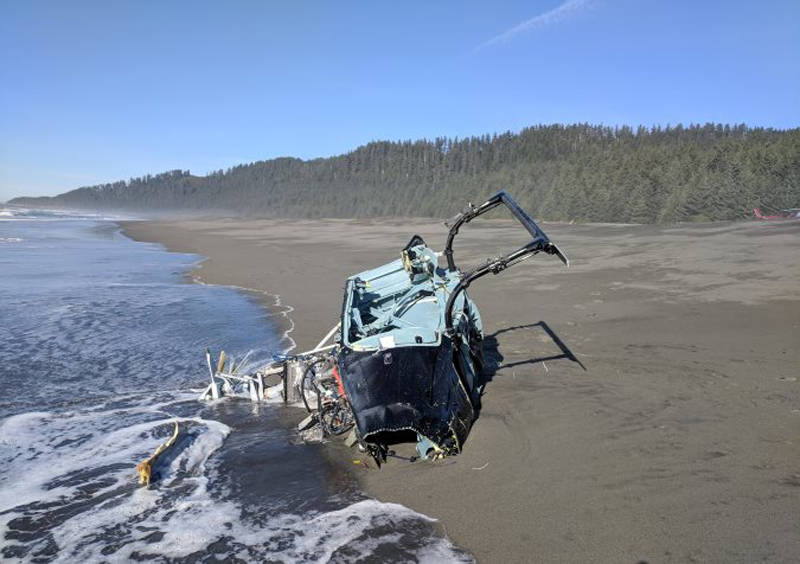
The wreckage of a crashed Airbus AS350-B3e is seen near Lituya Bay in early October in a photo provided by the National Transportation Safety Board. (Courtesy photo)

The wreckage of a crashed Airbus AS350-B3e is seen near Lituya Bay in early October in a photo provided by the National Transportation Safety Board. (Courtesy photo)

Pilot ‘rolled back throttle’ in fatal helicopter crash

14-year-old sole survivor shares memory of crash with federal investigators

The sole survivor of a fatal helicopter crash has given federal investigators their first insight into the event that killed three people Sept. 28.

In a preliminary report issued Wednesday, investigator Joshua Lindberg wrote that the 14-year-old passenger said the pilot “reached down and rolled the throttle off” before the accident and that the helicopter entered a free fall from about 500 feet up. The passenger said the pilot increased throttle before the accident, but that the helicopter still hit the beach near Lituya Bay. The passenger remembers the impact and water splashing into the wreck, but he then fell unconscious.

It was not clear which of the helicopter’s two pilots adjusted the throttle.

The passenger doesn’t know what the pilot’s actions mean, Lindberg said, and “at this point, neither do we.”

According to information initially provided to the U.S. Coast Guard and the National Park Service (then subsequently confirmed by the NTSB), the crashed helicopter was an Airbus AS350-B3e en route from the factory in Grand Prairie Texas to Anchorage. It had taken off from Juneau and was headed to Yakutat as part of its ferry flight when it crashed on a beach in Glacier Bay National Park.

Fifty-three-year-old Palmer resident David King, 42-year-old Anchorage resident Joshua Pepperd and 11-year-old Andrew Pepperd were killed in the crash. Fourteen-year-old Aiden Pepperd was found injured but alive by the U.S. Coast Guard after the accident.

While Alaska has the highest aviation accident rate in the country, according to Federal Aviation Administration statistics, this crash is somewhat unusual in that it involves a new aircraft with two pilots aboard, Lindberg said. For insurance purposes, King had been hired as a safety pilot to accompany the flight.

According to the NTSB report, which was based on GPS recordings, the helicopter left Juneau and traveled over Glacier Bay at 3,000-4,000 feet before following the coastline about 500 to 700 feet above the ground. The last GPS reading had the helicopter at 500 feet.

Investigators arrived at the wreckage two days after the accident, but the tide had washed away some of the debris, Lindberg said. While part of the instrument panel was among the pieces washed away, the NTSB did recover the engine data recorder, engine control unit and a camera that monitored the instruments and the pilot’s actions.

All of the recorders were taken to Washington, D.C. for analysis.

Lindberg said finding the cause of the crash will take time. How much time depends on the course of the investigation, but a ballpark figure is 12 to 18 months.

“The reason that those take so long is that there’s a lot of information to process,” he said. “There’s a lot that goes into an accident like this.”


• Contact reporter James Brooks at jbrooks@juneauempire.com or 523-2258.


More in Home2

A sign reading, "Help Save These Historic Homes" is posted in front of a residence on Telephone Hill on Friday Nov. 21, 2025. (Mari Kanagy / Juneau Empire)
OPINION: The Telephone Hill cost is staggering

The Assembly approved $5.5 million to raze Telephone Hill as part of… Continue reading

Jeff Lund/contributed
The author would rather fish for steelhead, but he’ll watch the Super Bowl.
I Went to the Woods: Super Bowl spectacle

At some point on Sunday, dopey characters, hopelessly addicted to Doritos, will… Continue reading

Win Gruening (courtesy)
OPINION: Eaglecrest’s opportunity to achieve financial independence, if the city allows it

It’s a well-known saying that “timing is everything.” Certainly, this applies to… Continue reading

A tsunami is not expected after a 4.4-magnitude earthquake northwest of Anchorage Wednesday, Feb. 4, 2026. (U.S. Geological Survey)
No tsunami expected after 4.4-magnitude earthquake in Alaska

U.S. Geological Survey says 179 people reported feeling the earthquake.

Gov. Mike Dunleavy gestures during his State of the State address on Jan. 22, 2026. (Photo by Corinne Smith/Alaska Beacon)
OPINION: It’s time to end Alaska’s fiscal experiment

For decades, Alaska has operated under a fiscal and budgeting system unlike… Continue reading

The Spruce Root team gathers for a retreat in Sitka. Spruce Root, is an Indigenous institution that provides all Southeast Alaskans with access to business development resources. (Photo by Lione Clare)
Woven Peoples and Places: Wealth lives in our communities

Sustainable Southeast Partnership reflects on a values-aligned approach to financial wellness.

Cars drive aboard the Alaska Marine Highway System ferry Hubbard on June 25, 2023, in Haines. (Photo by James Brooks)
Alaska’s ferry system could run out of funding this summer due to ‘federal chaos problem’

A shift in state funding could help, but a big gap likely remains unless a key federal grant is issued.

Photo by James Brooks/Alaska Beacon
U.S. Sen. Dan Sullivan stands with acting Coast Guard Commandant Adm. Kevin Lunday during the after the commissioning ceremony for the Coast Guard icebreaker Storis on Sunday, Aug. 10, 2025, in Juneau, Alaska.
Coast Guard’s new Juneau base may not be complete until 2029, commandant says

Top Coast Guard officer says he is considering whether to base four new icebreakers in Alaska.

At the Elvey Building, home of UAF’s Geophysical Institute, Carl Benson, far right, and Val Scullion of the GI business office attend a 2014 retirement party with Glenn Shaw. Photo by Ned Rozell
Alaska Science Forum: Carl Benson embodied the far North

Carl Benson’s last winter on Earth featured 32 consecutive days during which… Continue reading

Most Read