
A large creature is being assembled behind the scenes at the Alaska State Library, Archives and Museum, and by spring it will be alive.
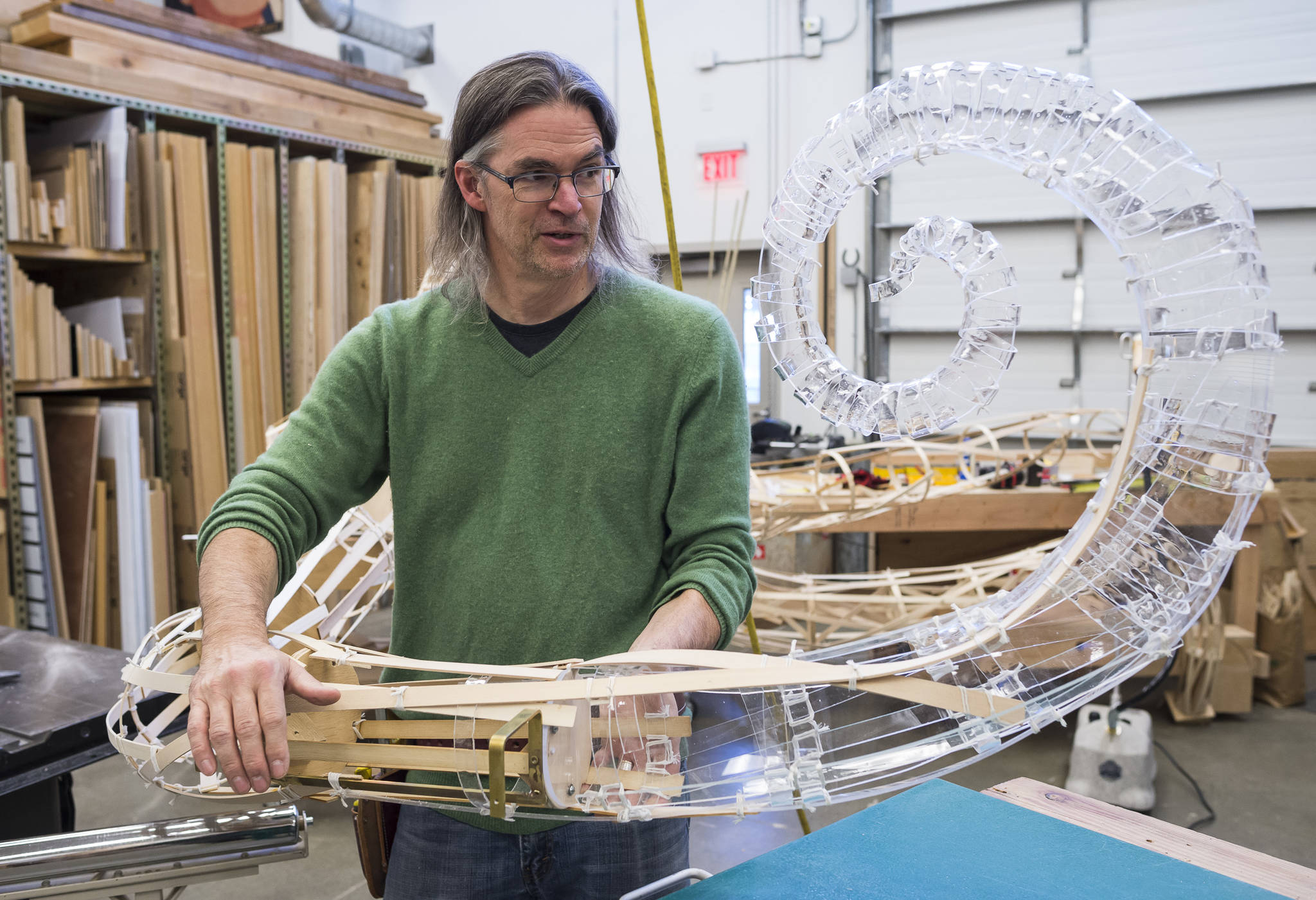
In the museum’s carpentry shop, 14-foot-long arms frozen in both come-hither curls and searching extensions hang on the wall waiting to be fastened to the skeletal frame at the center of the room.
Despite its piecemeal nature and large size, the animal being put together isn’t anything as dreadful as Frankenstein’s monster. It’s an enlarged depiction of a North Pacific giant octopus destined for the museum’s Discovery Room.
“It will be much more exploratory than threatening, hopefully,” said Aaron Elmore, exhibits specialist.
Elmore, who is taking the lead on constructing the octopus, said the idea for the octopus art piece has been gestating ever since a scale model of the ship Discovery has been a permanent exhibit at the museum.
He has spent hours steaming scrap wood to form the cylindrical segments that make up the yet-unnamed octopus’ arms and the crisscrossing bows that form the visceral mass that laymen might call the head.
Sherry Tamone, professor of marine biology at University of Alaska Southeast, is one of two biology consultants helping to ensure the project is a relatively accurate representation of the large, reddish molluscs native to the North Pacific, including Southeast Alaska.
Tamone said what people call the head of the octopus is actually a mass that includes reproductive and digestive organs and more.
“The brain is really just between the eyes,” Tamone said.
Tamone’s expertise helped reach an important conclusion about the in-progress octopus: it’s a girl.
She said male octopuses have a specialized furrowed arm without tentacles that is used for spawning purposes.
The current plan calls for no such specialized arm, but each arm will still be unique.
“We want to tie it to the room as much as possible,” Elmore said. “Each part of the octopus comes in contact with different parts of the room. It will change shape and color.”
This mirrors the real-life ability of the octopus to change its color, shape and texture.
One arm will reach toward the mast of the ship in the Discovery Room, another will prod the Eye Spy exhibit, and other limbs will reach out and probe and adapt to different surfaces, including glass and the Eye Spy.
More than one way to skin an octopus
While the general size, shape and concept of the octopus have been decided, a lot of other aspects of the project remain undetermined.
Before the octopus is installed in late spring, the goal is for it to be an interactive art piece that can double as a tool to educate youths about pollution, but ideas are still being generated for how to accomplish that goal.
“We still have some hurdles to navigate,” said Tanna Peters, artist and consultant for the project.” What the actual skin is is still in revision, but we’re hoping the kids cam help us decorate.”
Peters and other organizers said the hope is children will have an opportunity to have a hands-on impact on the project’s final appearance, which would increase a sense of community ownership.
It is also hoped the octopus can be made of all recycled material, but how that will be collected and what materials will be needed are undecided.
“We don’t know,” Peters said. “Maybe there will be an all-call.”
The octopus is also not yet named, and that may be a decision made by a public vote or suggestions to be solicited at a later date.
Another potential avenue for personal touches will be the thousands of suckers that will line the octopus’ arms, Elmore said.
The exact form those will take is also not finalized, but it could allow an element of the fantastic to creep into what is currently a reasonably realistic frame of an extra-large octopus.
“We want it to be true to life … but it’s also a piece of art,” Peters said.
• Contact arts and culture reporter Ben Hohenstatt at 523-2243 or bhohenstatt@juneauempire.com. Follow him on Twitter at @capweekly.

Alaska State Libraries, Archives and Museums Operation Manager Lisa Golisek-Nankerv, right, helps Museum Exhibit Specialist Aaron Elmore move one of the eight legs to a giant octopus he is building for the Museum’s children’s room on Monday, Sept. 17, 2018. (Michael Penn | Capital City Weekly)
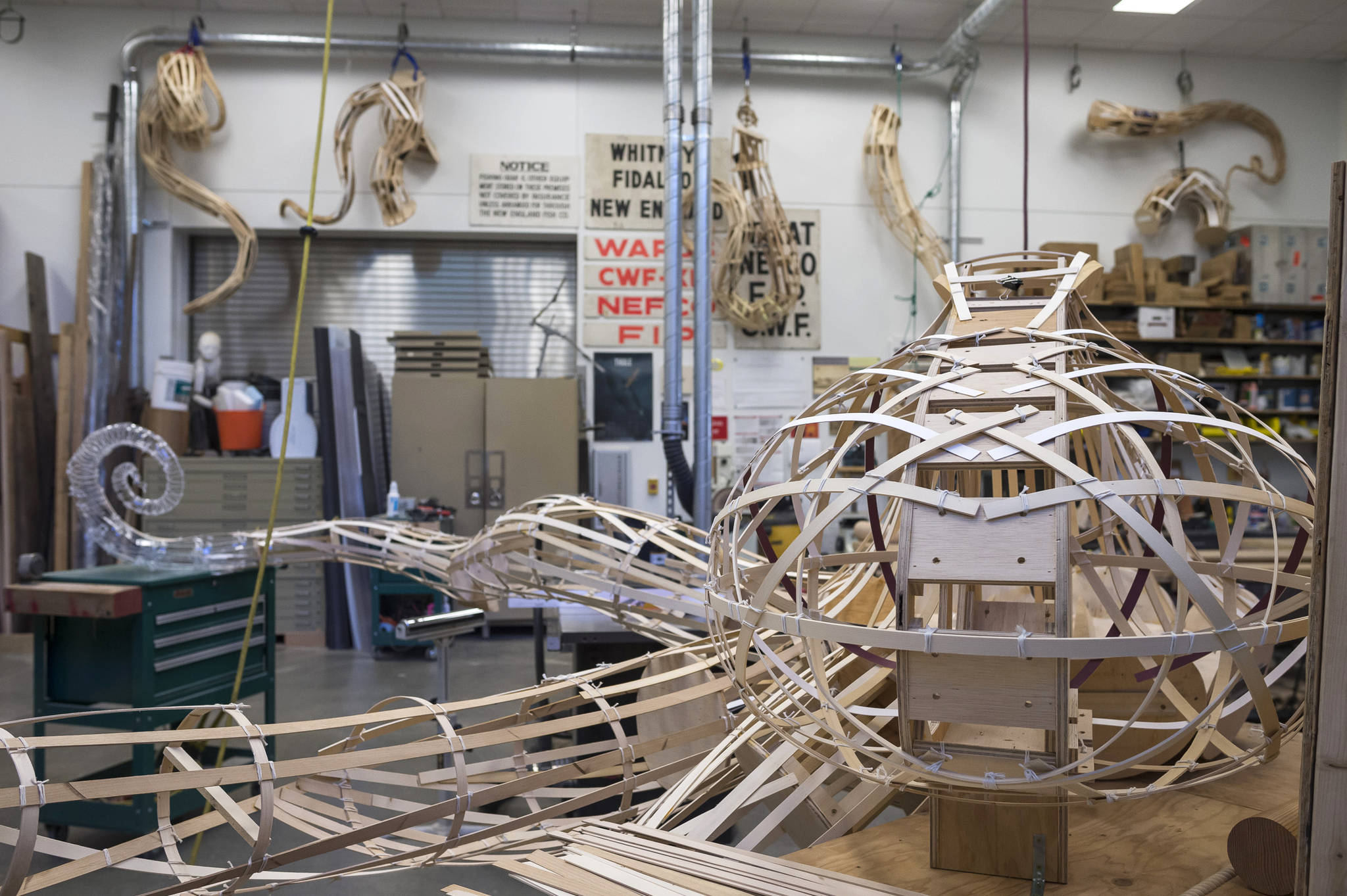
The frame of a giant octopus and its eight legs decorate a carpenter’s shop at the Alaska State Libraries, Archives and Museums on Monday, Sept. 17, 2018. Exhibit Specialist Aaron Elmore is building the creature for the Museum’s children’s room. (Michael Penn | Capital City Weekly)

Exhibit Specialist Aaron Elmore steams a wooden piece as he builds one of the eight legs for a giant octopus for the Alaska State Museum’s children’s room on Monday, Sept. 17, 2018. (Michael Penn | Capital City Weekly)
