
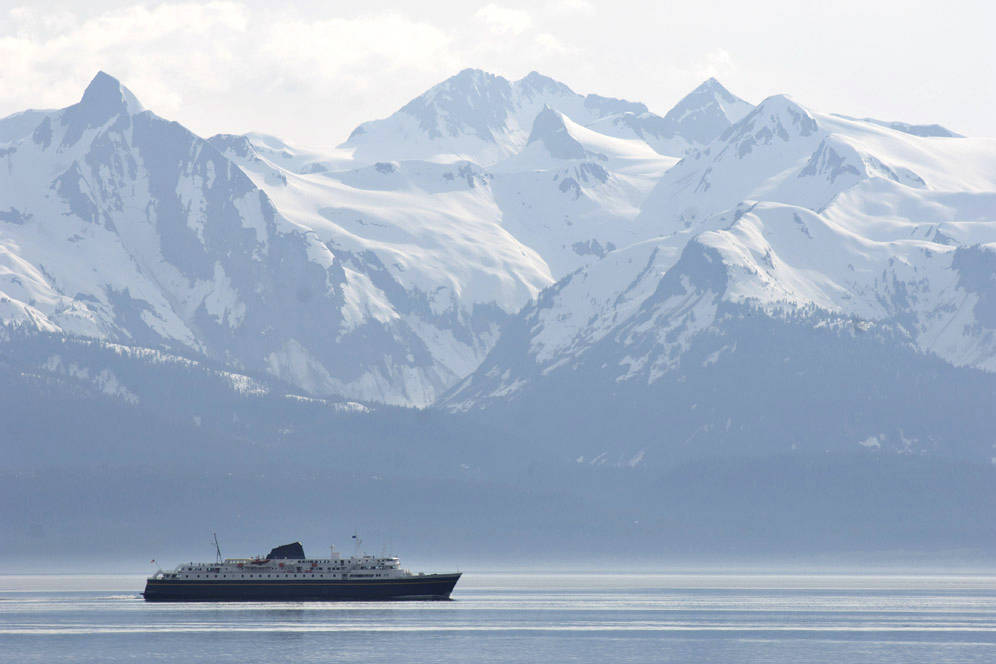
In this May 2008 photo, the Alaska Marine Highway ferry Malaspina heads up Lynn Canal toward Haines and Skagway, Alaska, from Juneau, Alaska. (Michael Penn | Juneau Empire File)

In this May 2008 photo, the Alaska Marine Highway ferry Malaspina heads up Lynn Canal toward Haines and Skagway, Alaska, from Juneau, Alaska. (Michael Penn | Juneau Empire File)

New Alaska ferries need $30M in work before entering service

Ferries Tazlina and Hubbard to be used on longer routes than originally planned.

ANCHORAGE — An additional $30 million in public money is needed to install crew quarters on Alaska’s two new ferries, the Alaska Marine Highway System said.

Adding crew quarters will allow the ferries Tazlina and Hubbard to be used on longer routes than originally planned, the Anchorage Daily News reported this week.

The new ferries were designed for specific roles, but cuts to ferry service means the ships will need to enter general service. With the state’s budget constraints, two older ferries will likely be taken offline as the two new vessels begin operations, leaving a hole in the system’s routes.

[Fast ferry Fairweather faces foggy future]

“People can be frustrated about the expenditure of money and the change of plans, but the reality is that our plans changed for us,” said Shirley Marquardt, director of the system. “We’re reacting in the best way we can.”

Coast Guard regulations limit ferry crews to 12-hour workdays. A roundtrip from Juneau to Haines and Skagway would likely take one of the new ferries 14 hours, according to the system’s projections.

“We have two boats that the department says don’t meet their concept of service delivery and we can’t use them. That to me is the mind-boggling, mind-blowing issue at hand,” said Robert Venables, chairman of the Alaska Marine Transportation Advisory Board.

In addition to the cost of crew quarters, tens of millions of dollars will also be needed to construct support facilities for the vessels, the advisory board revealed at its meeting last week.

New facilities to accommodate the ferries will be needed in Chenega Bay, Talitlek, Pelican, Cordova and Whittier, according to board documents. The cost for all five is estimated to be $25 million, said Capt. John Falvey, general manager of the system.

Money to install crew quarters would come from the Marine Highway System fund, Marquardt said. The work could begin this summer if the state Legislature authorizes the expense.

Gov. Mike Dunleavy’s administration has not yet responded to the newspaper’s questions about whether or not it supports the proposal.


• This is an Associated Press report.


More in Home2

Win Gruening (courtesy)
OPINION: Eaglecrest’s opportunity to achieve financial independence, if the city allows it

It’s a well-known saying that “timing is everything.” Certainly, this applies to… Continue reading

A tsunami is not expected after a 4.4-magnitude earthquake northwest of Anchorage Wednesday, Feb. 4, 2026. (U.S. Geological Survey)
No tsunami expected after 4.4-magnitude earthquake in Alaska

U.S. Geological Survey says 179 people reported feeling the earthquake.

The Spruce Root team gathers for a retreat in Sitka. Spruce Root, is an Indigenous institution that provides all Southeast Alaskans with access to business development resources. (Photo by Lione Clare)
Woven Peoples and Places: Wealth lives in our communities

Sustainable Southeast Partnership reflects on a values-aligned approach to financial wellness.

Cars drive aboard the Alaska Marine Highway System ferry Hubbard on June 25, 2023, in Haines. (Photo by James Brooks)
Alaska’s ferry system could run out of funding this summer due to ‘federal chaos problem’

A shift in state funding could help, but a big gap likely remains unless a key federal grant is issued.

Photo by James Brooks/Alaska Beacon
U.S. Sen. Dan Sullivan stands with acting Coast Guard Commandant Adm. Kevin Lunday during the after the commissioning ceremony for the Coast Guard icebreaker Storis on Sunday, Aug. 10, 2025, in Juneau, Alaska.
Coast Guard’s new Juneau base may not be complete until 2029, commandant says

Top Coast Guard officer says he is considering whether to base four new icebreakers in Alaska.

At the Elvey Building, home of UAF’s Geophysical Institute, Carl Benson, far right, and Val Scullion of the GI business office attend a 2014 retirement party with Glenn Shaw. Photo by Ned Rozell
Alaska Science Forum: Carl Benson embodied the far North

Carl Benson’s last winter on Earth featured 32 consecutive days during which… Continue reading

calendar
Weekly events guide: Juneau community calendar for Feb. 2 – Feb. 8

Visit Juneau Arts and Humanities Council at JAHC.org for more details on this week’s happenings.

Van Abbott is a long-time resident of Alaska and California. He has held financial management positions in government and private organizations, and is now a full-time opinion writer. He served in the late nineteen-sixties in the Peace Corps as a teacher. (Contributed)
When lying becomes the only qualification

How truth lost its place in the Trump administration.

Jamie Kelter Davis/The New York Times
Masked federal agents arrive to help immigration agents detain immigrants and control protesters in Chicago, June 4, 2025. With the passage of President Trump’s domestic policy law, the Department of Homeland Security is poised to hire thousands of new Immigration and Customs Enforcement (ICE) agents, and double detention space.
OPINION: $85 billion and no answers

How ICE’s expansion threatens law, liberty, and accountability.

Most Read