
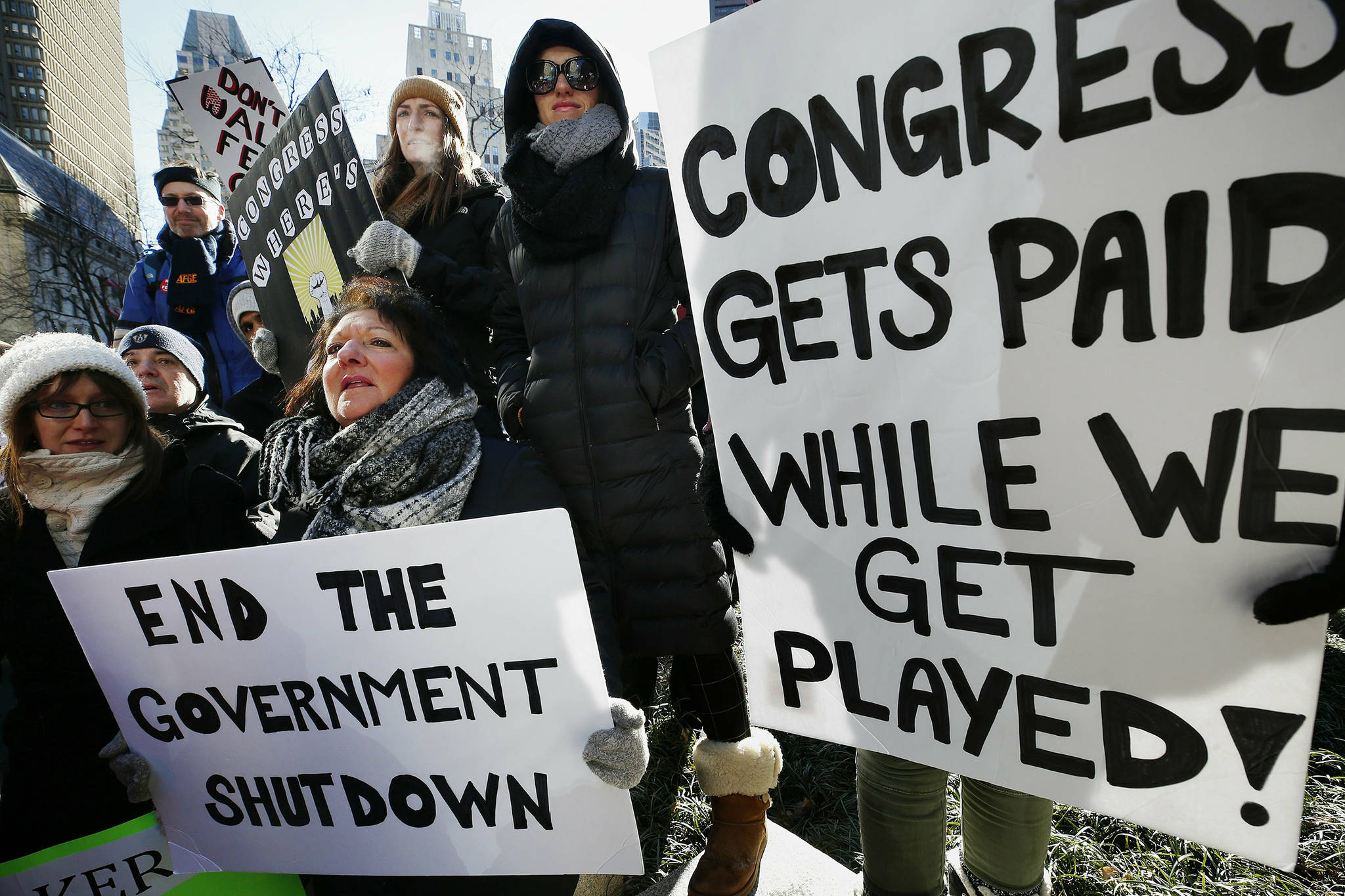
There have been almost 10 times more unemployment filings from federal workers in Alaska than normal since the federal shutdown began.
The Alaska Department of Labor & Workforce Development received 382 benefit claims from federal workers in Alaska over the last three weeks, Division Director Patsy Westcott said. In contrast, there were only about 40 claims for federal workers in Alaska for the whole month of November.
“That’s pretty significant,” she said.
The maximum unemployment payout benefit in Alaska is $370 per week, and Wescott said most federal employees would qualify for that amount. She did not have data of how many of the 382 new filings were from Juneau.
Juneau Economic Development Council has been working on collecting estimates for local data. Executive Director Brian Holst said the JEDC estimates there are about 670 federal workers in Juneau, accounting for 4.1 percent of the total workforce in town. The Coast Guard active duty employees are all working, along with all of the Transportation Security Administration employees at the airport and the U.S. Postal Service workers.
“Most of our gaps are the Forest Service workers,” Holst said. Of about 165 Forest Service workers, only about 20 to 30 are working, he said.
Some are being paid through fees collected at Mendenhall Glacier Visitor Center, but that won’t last forever, Holst said. The Postal Service is also able to pay employees through stamp revenues, he said.
“If this happens another two weeks, it will really start to impact the local economy,” Holst said. “I think it’s a bit muted right now.”
He attributed some of the “muted” impacts to the fact that Congress passed a bill last week confirming retroactive pay for furloughed federal workers. This makes those economic impacts harder to gauge because workers might still be spending normally, just buying things on credit cards because they’ve been assured that the lost wages will come back to them, he said.
JEDC estimates that $2.3 million in Juneau workers’ wages were not paid out in last week’s pay period.
“It would be an exaggeration to say that number equals the spending lost,” Holst said. But as time progresses, people will slow down their spending to a closer amount equal to lost wages. He also said there’s a multiplier effect on places like grocery stores and restaurants, such as the ones reported by the Empire last week.
[‘It’s ridiculous’: Furloughed Juneau residents frustrated at federal shutdown]
Workers who filed for unemployment right when the shutdown began have already started receiving weekly payouts, Westcott said. To apply, she said furloughed workers need some kind of wage proof, such as pay stubs, to help speed up the process.
“Federal agencies don’t automatically report worker wages to the state,” she said. “We have to request those. But with the shutdown there’s no one there to send us those reports.”
But Alaska’s unemployment “trust fund is healthy,” Westcott said.
[Some Coast Guard employees furloughed, others working without pay during shutdown]
“We definitely have the funds to pay benefits to these workers, so there’s no concern there,” Westcott said.
If workers are paid retroactively once a federal budget passes, workers who received unemployment benefits will be required to pay back any benefits they received during the shutdown from that retroactive pay.
Ideally, Westcott said, workers would pay that money back as soon as they receive retroactive pay.
“Once we establish an over-payment, if the benefits aren’t paid back timely, then we will pursue a levy like a Permanent Fund Dividend payout,” she said. “So it’s in workers’ best interest to pay it back when they get their retroactive pay.”
• Contact reporter Mollie Barnes at mbarnes@juneauempire.com or 523-2228.
