
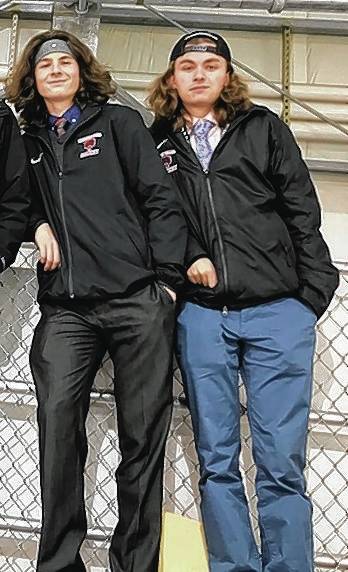
Long before there was the man bun, there was “hockey flow,” or the extraordinarily long men’s hair common in ice hockey circles.
As one hockey blog explains the phrase: “The most important aspect of flow is that it spills out of the back of a hockey helmet. Flow has been a part of hockey culture for decades and the tradition is still widely practiced in the hockey community today.”
One look at the 2017-18 Juneau-Douglas High School hockey team picture supports this assertion.
Three players in the third row alone — juniors Greyson Liebelt, Cameron Smith and Bill Bosse — have dark brown locks that reach all the way down to their shoulder pads and then some.
Smith and Bosse’s hair in the 2016-17 program makes it to the bottom of their ears. As freshmen, the hair didn’t even make it that far on them — both sport neatly-cropped hairdos that blend in with those of the rest of the team.
Fellow JDHS hockey juniors Blake Bixby, Cully Currigan, Logan Ginter, Tyler Weldon and Wolf Dostal have followed a similar trend. All similarly have shaggy hair framing their gazes into the camera. Several underclassmen have taken to the trend as well.
JDHS assistant coach Matt Boline, who joined the JDHS coaching staff in 2008, said its only been in the last couple years that hockey flow has proliferated. He says it’s a positive sign for high school hockey in Juneau.
“I think it’s huge because since hockey came in Juneau we’ve always been a bunch of kids that like to play hockey,” Boline said. “Now, the commitment to the flow has cemented the (notion) Juneau kids are hockey players now. It’s not just because of the flow, but it certainly helps.”
Boline, who grew up in a small town in central Minnesota, said it the phenomenon was simply referred to as “hockey hair” in his homestate.
“I didn’t even know what a mullet was until after I had left Minnesota, I just thought it was called hockey hair,” Boline said.
Like a mullet, a Minnesotan’s hockey hair is short in the front to keep it from masking one’s sight, but long in the back to “flow” brilliantly out of the back of a helmet when skating at high speeds.
That was one of the problems Bosse ran into last year with his flow: it got in the way of his eyes. Bosse’s mom, Tiffany Davis, recalls her son having to move his head around while playing to clear the hair out of the way. Now, around a foot in length, it’s only off the ice that he still runs into that problem.
While it’s a commonly accepted look inside the locker room, not everyone is used to seeing him with such long hair.
“When a lot of people look at you, they’re like, ‘Whoa, you got long hair,’” Bosse said. “It’s like, ‘Yeah, I do.’”
Bosse’s teammate Liebelt said he was inspired to grow his hair two years ago as a freshman on the team. His older brother, Ryan, was a junior on the team at the time and had plenty-long hair.
“Plus, it’s just a hockey tradition, really,” Liebelt said. “I’ve just had long hair since freshman year.”
Liebelt spent last season playing club hockey in Whitehorse, Yukon. He was surprised to find the trend wasn’t more prevalent in the motherland of hockey.
“Not a lot of the players had long hair, they all kept it cut, they all kept it trimmed,” Liebelt said. “It’s was honestly weird I was the only kid with flow of their team.”
All good flows must come to an end though.
For the JDHS hockey team, that may come as soon as the first weekend of February. That’s when the team will be playing in the Mid Alaska Conference championships in Fairbanks. The plan for those with an adequate length of hair — about half of the team — to sculpt mullets from their manes of hair.
Until then, hockey parents and fans alike can enjoy the hair while it lasts. The Crimson Bears’ hair will be in action Jan. 4-5 against Monroe Catholic at Treadwell Arena. The final home series of the season comes two weeks later, when JDHS plays North Pole in two nonconference tilts.
“I just love these guys — all of them,” Davis said. “All of them are just great kids, so if they wanted to grow their hair out, fine with me, it’s just something else to laugh at them about.”
• Contact sports reporter Nolin Ainsworth at 523-2272 or nolin.ainsworth@juneauempire.com.
