
A very low tide in early August enticed me and a couple of friends out to see what we could see in the intertidal zone. Accompanied by a horde of nasty little biting flies that liked to settle at the edges of my cap, we chose to go to Indian Point, where we’d had good luck in the past. This late in the season, however, things might be different.
On rocky beaches, many of the critters hide under the rocks, where they have some protection from desiccation and predators. We are careful when we turn over rocks in search of critters, tipping or lifting them gently and always restoring them to their original position.
Each of the first two flat rocks I gently tipped up exposed a prickleback, which augured well. These were likely to be cockscomb pricklebacks, known to occur here. They breed in late winter and early spring, commonly sorting themselves out by size: big males with big females, and small males with small females. After mating, the female incubates her clutch of eggs for about a month; clutch sizes are bigger in bigger females. Although this was a good start, I was surprised that these two were the only intertidal fish we found; there were no crescent gunnels.
Under other rocks, we found several tiny hermit crabs in their periwinkle shells. Very dirty shells, they were, covered with debris and silt. On the underside of several rocks were small sea stars, some with five arms and some with six. Pretty little lined chitons clung there too, but only on two of the overturned rocks.
Small green sea urchins found shelter under some rocks, and one had settled in an empty whelk shell, but they were also scattered all about on the rocky beach. Someone spotted a long, thin strand of bright orange; this was a sea urchin gut, attached to the feeding apparatus called Aristotle’s lantern. That urchin had been a lunch for a foraging bird.
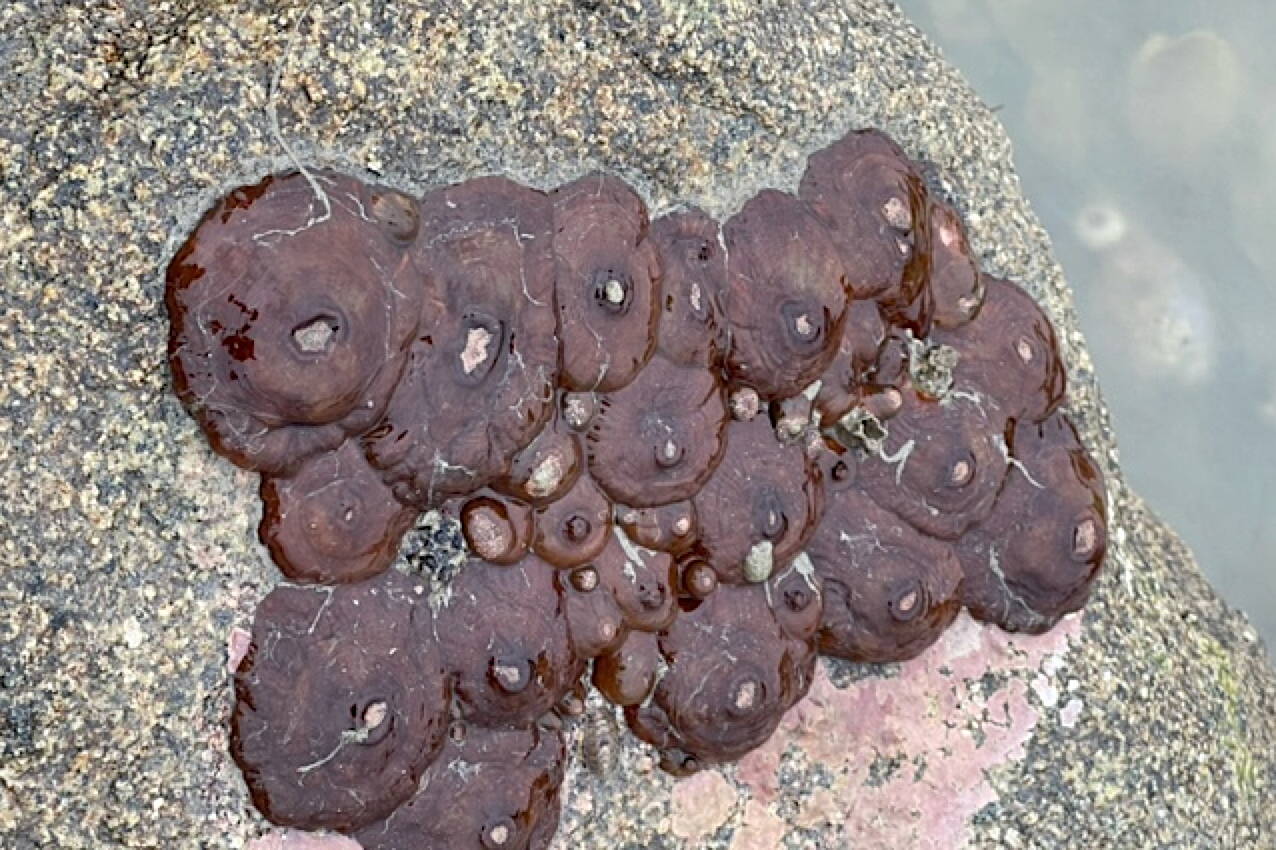
There were some buried anemones, detectable by a ring in the silt between rocks. Christmas anemones were common, widely scattered among the rocks. Not far from the edge of the low-tide line, we found numerous large, dark anemones, which we didn’t remember seeing on other trips; perhaps the very low tide on this day revealed them. They were probably plumose anemones, a species that can vary in color. When it is molested, it can shoot out defensive threads with lots of stinging cells. The feeding tentacles bear stinging cells too; these anemones selectively feed mostly on various small invertebrates and sometimes herring eggs. Reproduction can be asexual, by longitudinal fission or fragmenting in particular ways, or sexual, both sexes spawning gametes into the water. Larvae can be carried for long distances on ocean currents. Adults disperse by sliding around on their basal discs or by detaching from the rocks and drifting on currents. They form clones, and individuals at the edges of clones can produce special catch tentacles, which are used aggressively against non-clonal individuals of the same sex that approach the clone.
Small, white sea cucumbers and black tar-spot cucumbers littered the rocks in uncountable numbers, but we saw none of the large cucumbers seen on other trips. There were some beautiful, big purple sea stars, some tan ones (all with five arms), and some that looked rather sickly. An exposed reef harbored some of the usual chitons (such as Katherina), and there were scattered limpets clinging to the rocks.
Extensive mussel beds were typically crusted with barnacles. On those barnacles we could find occasional little snails of two kinds, one with a more extended (less rounded) conical shell than the other, but we did not identify them. A few mussel beds were shiny and new-looking, consisting of thousands of small, rather young individuals that had not yet acquired the inevitable barnacles.
A few crows fossicked about in the loose stones, finding who knows what. They and other scavengers had already demolished many of the dead salmon that were washed up on the beach.
That was it, for this trip. The diversity was lower than on previous trips, but it was, after all, late in the season. We missed seeing more kinds of sea stars, the big red hermit crab, ribbon worms, and others. Many factors may contribute to the perceived lower diversity, including (in addition to the season) over-harvesting of some species (e.g. gumboots), ungentle treatment by small kids, destructive explorations by people that rip up rocks and toss them wherever, warming waters, and so on.
Thanks to Stori Oates at NOAA for the probable name of that dark anemone.
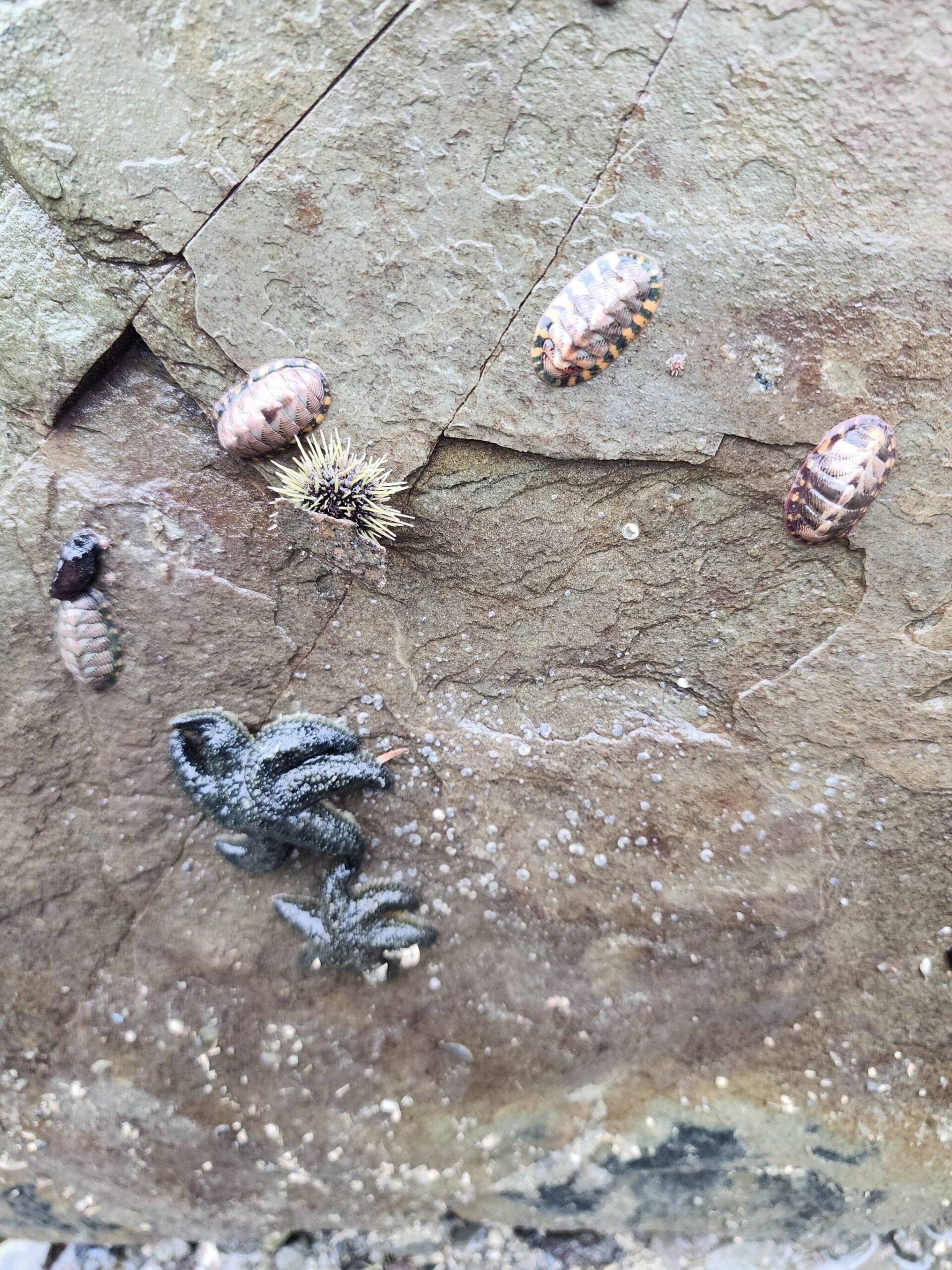
Photo by Pam Bergeson A flat rock shelters some small six-armed sea stars, lined chitons and a bleached-looking sea urchin.
