
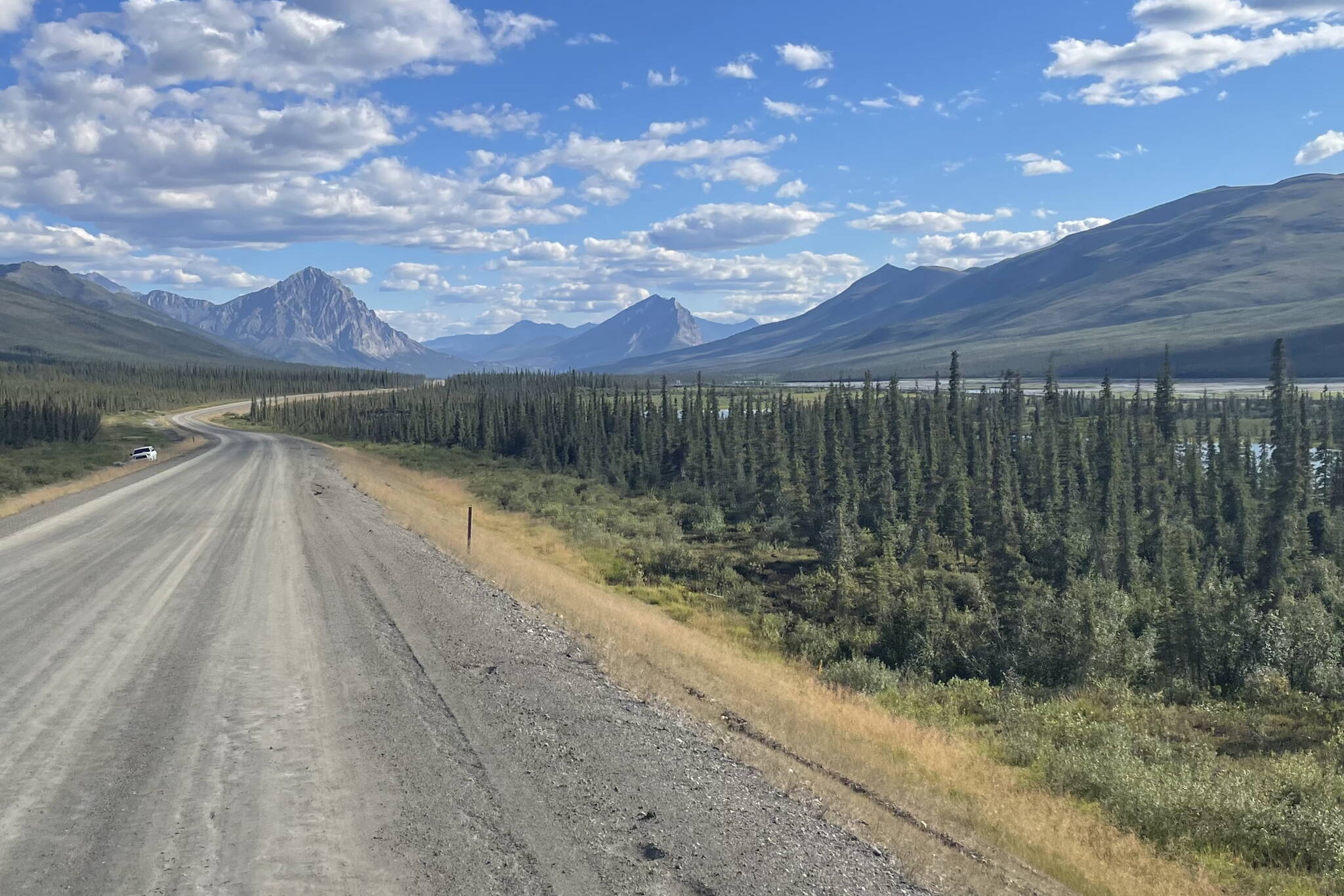
The Dalton Highway, built in 1974 to construct the Trans-Alaska Pipeline, allows the public to access the Brooks Range and North Slope like the author did in 2022. (Photo by Jeff Lund)

The Dalton Highway, built in 1974 to construct the Trans-Alaska Pipeline, allows the public to access the Brooks Range and North Slope like the author did in 2022. (Photo by Jeff Lund)

I Went to the Woods: The theater is over, let the work begin

The election is over. It’s time to catch our collective breath and re-enter reality.

The far right and the far left are mirrors of each other and both represent threats to democracy. But that’s not to say every Trump or Harris voter fits into the narrowly defined definition of either. It’s the civic responsibility of the middle to encourage civil discourse and engage meaningfully to address the issues going forward. Disagree, get frustrated, be incredulous about how someone could have voted that way, but don’t burn it down. Don’t claim fellow Alaskans are unAlaskan or unAmerican because social media told you so.

If I believe in freedom, that means it extends to people who don’t think how I do. The better I am at articulating my point, the more likely I am to convince someone to change his or her mind.

Many people probably voted less for the candidate and more for the side that was more in-line with a palatable future. It was a bitter, bleak choice for many, made even worse because we no longer live in a world in which everyone gets their evening news from one of three or four nightly newscasts. Now an algorithm curates our own newsfeed that is individualized. We’re not seeing the same content. We’re not arriving at work on Monday talking about what we saw on the news, we’re sharing what we saw on our news.

For news organizations, this incentivizes entertainment and catastrophizing over truth to compete with manipulative influencers who treat us like lab mice who can’t help but tap the lever while they cash the checks.

This is a huge problem for Alaskans because it creates this idea that you are for Alaska or against it. That’s not true.

By voting down Ballot Measure 1 in 2018, Alaskans didn’t stand against salmon as much as voters stood for Alaskan industry and, in the eyes of many, against increased regulation that may or may not have significantly improved future salmon runs.

Political slogan research creates a narrow vision of complex issues. It perpetuates the idea that something like the Roadless Rule prevents development in the Tongass National Forest when the truth is 57 projects ranging from hydroelectric projects to mining have been permitted. There are Alaskans who are for the Roadless Rule and Alaskans who are against. Both represent legitimate Alaskan perspectives. Knowing more doesn’t betray your position.

There are Alaskans who are vehemently against Pebble Mine but might be OK with the road to Ambler as long as it is opened to the public, citing the Dalton Highway as an example of a footprint in pristine land that ends up providing the opportunity for residents to maximize the benefit of Alaskan land as stated in the constitution.

Both angles put Alaskans first; it’s just a matter of which Alaskans. The ones who want to protect the habitat for future generations of anglers and hunters pursuing future generations of fish and wildlife, or the Alaskans who will benefit from the jobs.

The trawling industry has set itself up on both sides of the issue, helping rural communities gain financially from the pillaging of the ocean resources. It’s as complicated as it is insidious.

I don’t feel bad for politicians, but I do feel for those who choose to serve Alaska as elected officials and have to combat outspoken people with propaganda-fed opinions. I respect the people who know the fewer partisan attention-seekers we have in Juneau and in Washington D.C., the better, so they enter the fray knowing what a soul-crushing experience it will likely be.

With the election over, let’s put the signs away and beat bad ideas with good ones.

• Jeff Lund is a freelance writer based in Ketchikan. His book, “A Miserable Paradise: Life in Southeast Alaska,” is available in local bookstores and at Amazon.com. “I Went to the Woods” appears twice per month in the Sports & Outdoors section of the Juneau Empire.

More in Sports

Senior Juneau-Douglas High School: Yadaa.at Kalé hockey players were recognized at the Treadwell Arena on Friday, Jan. 23, 2026 before the Crimson Bears faced the Homer High School Mariners. Head coach Matt Boline and assistant coaches Mike Bovitz, Luke Adams, Jason Kohlase and Dave Kovach honored 11 seniors. (Chloe Anderson / Juneau Empire)
JDHS celebrates hockey team’s senior night with sweeping victory over Homer

The Crimson Bears saw an 8-2 victory over the Mariners Friday night.

Photo by Ned Rozell
Golds and greens of aspens and birches adorn a hillside above the Angel Creek drainage east of Fairbanks.
Alaska Science Forum: The season of senescence is upon us

Trees and other plants are simply shedding what no longer suits them

Things you won’t find camping in Southeast Alaska. (Jeff Lund/Juneau Empire)
I Went to the Woods: Sodium and serenity

The terrain of interior Alaska is captivating in a way that Southeast isn’t

An albacore tuna is hooked on a bait pole on Oct. 9, 2012, in waters off Oregon. Tuna are normally found along the U.S. West Coast but occasionally stray into Alaska waters if temperatures are high enough. Sport anglers catch them with gear similar to that used to hook salmon. (Photo provided by the National Oceanic and Atmospheric Administration/West Coast Fisheries Management and Marine Life Protection)
Brief tuna bounty in Southeast Alaska spurs excitement about new fishing opportunity

Waters off Sitka were warm enough to lure fish from the south, and local anglers took advantage of conditions to harvest species that make rare appearances in Alaska

Isaac Updike breaks the tape at the Portland Track Festival. (Photo by Amanda Gehrich/pdxtrack)
Updike concludes historic season in steeplechase heats at World Championships

Representing Team USA, the 33-year-old from Ketchikan raced commendably in his second world championships

A whale breaches near Point Retreat on July 19. (Chloe Anderson/Juneau Empire)
Weekly Wonder: The whys of whale breaching

Why whales do the things they do remain largely a mystery to us land-bound mammals

Renee Boozer, Carlos Boozer Jr. and Carlos Boozer Sr. attend the enshrinement ceremony at the Naismith Basketball Hall of Fame in Sprinfield, Massachusetts, on Saturday, Sept. 6, 2025. As a member of the 2008 U.S. men's Olympic team, Boozer Jr. is a member of the 2025 class. (Photo provided by Carlos Boozer Sr.)
Boozer Jr. inducted into Naismith Hall of Fame with ‘Redeem Team’

Boozer Jr. is a 1999 graduate of Juneau-Douglas: Yadaa.at Kale

Photo by Martin Truffer
The 18,008-foot Mount St. Elias rises above Malaspina Glacier and Sitkagi Lagoon (water body center left) in 2021.
Alaska Science Forum: The long fade of Alaska’s largest glacier

SITKAGI BLUFFS — While paddling a glacial lake complete with icebergs and… Continue reading

Photo by Jeff Lund/Juneau Empire
The point of fishing is to catch fish, but there are other things to see and do while out on a trip.
I Went to the Woods: Fish of the summer

I was amped to be out on the polished ocean and was game for the necessary work of jigging

A female brown bear and her cub are pictured near Pack Creek on Admiralty Island on July 19, 2024. (Chloe Anderson for the Juneau Empire)
Bears: Beloved fuzzy Juneau residents — Part 2

Humor me for a moment and picture yourself next to a brown bear

Isaac Updike of Ketchikan finished 16th at the World Championships track and field meet in Budapest, Hungary, on Tuesday. (Alaska Sports Report)
Ketchikan steeplechaser makes Team USA for worlds

Worlds are from Sept. 13 to 21, with steeplechase prelims starting on the first day

Old growth habitat is as impressive as it is spectacular. (Photo by Jeff Lund/Juneau Empire)
I Went to the Woods: The right investments

Engaged participation in restoration and meaningful investment in recreation can make the future of Southeast special