
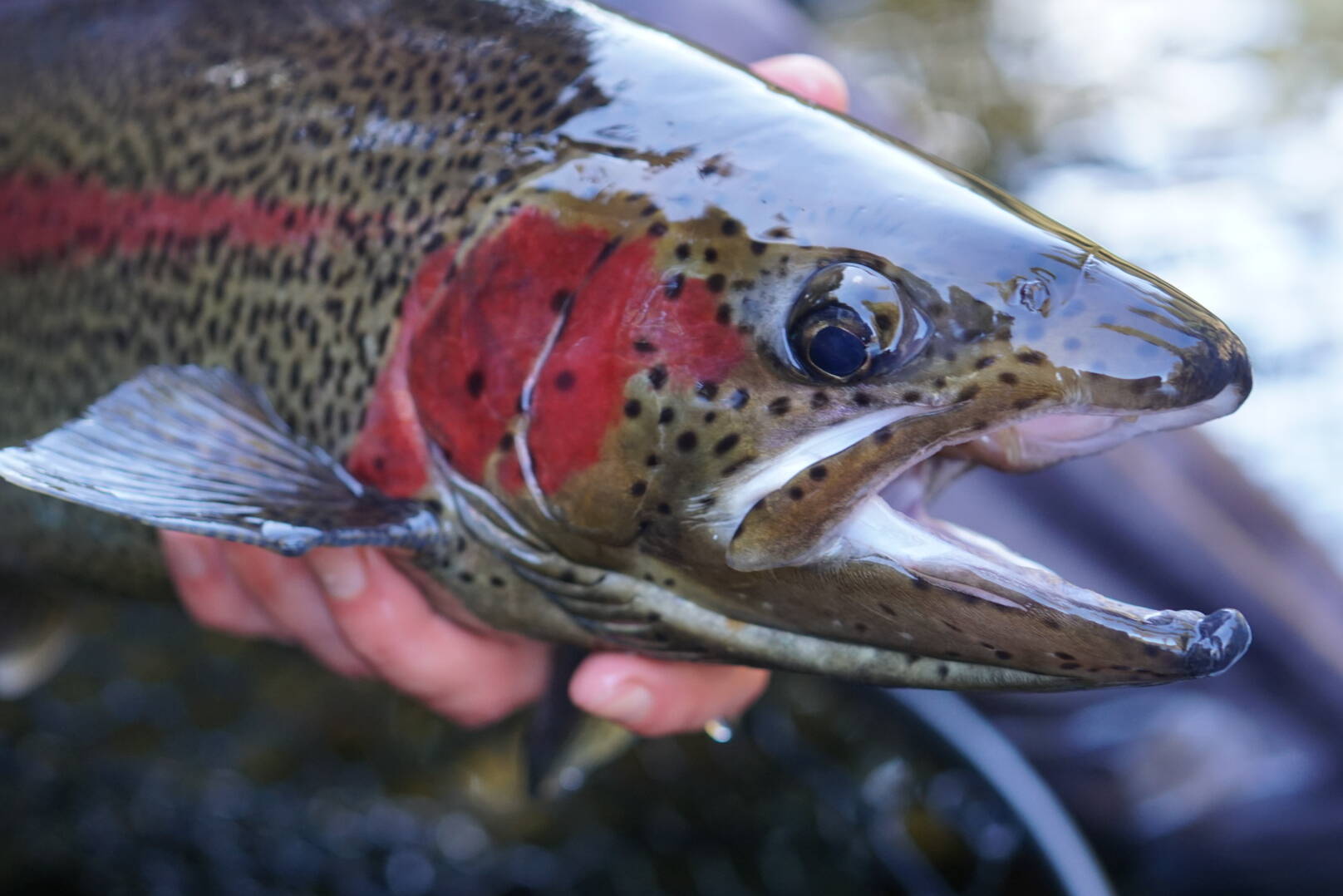
Compromise isn’t always possible, but when it is Alaskans benefit greatly when posturing is replaced with good-faith negotiations that yield results that help Alaskans. (Photo by Jeff Lund)

Compromise isn’t always possible, but when it is Alaskans benefit greatly when posturing is replaced with good-faith negotiations that yield results that help Alaskans. (Photo by Jeff Lund)

I Went to the Woods: The future of fish

The Forest Service cabin was a sauna so I went outside, stood at the edge of the lake and listened. We had hauled in some dry firewood in case the supply had been exhausted over the winter, but were happy to find a few rounds in the shed. I chopped with delight, remembering the skill I had honed as a kid growing up in a house with an inefficient wood-burning stove. The fire roared and the cool lair called.

We’re at the time of year when daylight lingers after dinner and I was happy to lose track of time because my impatience typically makes inactivity boring.

A few grouse hooted from atop spruce trees across the lake. Fast water making its way down rocky chutes was hidden in the forest somewhere. The lake was still except for a few cruising ducks and trout and/or salmon occasionally breaking the surface.

I thought about what it meant that this was still a lake. Not a reservoir. Reservoirs are typically ugly and make for poor beach access or boat launching. When people come to Alaska they want pristine habitat, not the same drowned forest they could get at home.

I get it. Most of the cheap, clean energy I use and water I drink comes from subalpine lakes that are dammed and I am grateful. But not this one. This one has a long history of use, but there is no dam. This lake has kept its original value by providing a link to lakes and tributaries upriver, and enough habitat to provide a robust environment for fish, anglers and people seeking solitude such as my wife and me. Opportunities to access a Forest Service cabin are major contributors to the quality of life that many Alaskans hold so dear.

I grew up thinking that anti-logging people liked owls more than humans and didn’t care if my friends were poor because their parents lost their jobs.

My parents were teachers on Prince of Wales Island, but a lot of my friends came from logging families and I absorbed the attitudes of people attempting to save their jobs and continuing to live where they wanted.

I’m not a kid anymore and understand that resource policy is complicated. Along with many others, I sit in a not-so-precarious spot in what I’d like to call the middle. It’s not precarious because life doesn’t have simple answers and sometimes there really can’t be an exact middle ground. You can’t compromise on the existence of something like Pebble Mine. There is one, or there isn’t. The middle is more an average-middle created by hopping back and forth across lines drawn by people hoping to cast you as friend or enemy. One or the other. Loyal or not.

Pebble Mine has more lives than a cat named Lazarus, but that comparison doesn’t really work because benevolence brought Lazarus back to life. Pebble seems more like a ravenous, habituated town bear attracted to fresh cookies in the kitchen. It just wants the cookies, but you know letting it in would completely wreck the house.

As projects and proposals birthed in varying visions of Alaska’s future are debated around the state, partisanship poisons the water. In the interest of vilification, some groups fail, or refuse, to distinguish key differences between an organization like Trout Unlimited, which champions responsible, sustainable use and works to protect spawning habitat, from environmental activists who throw tomato soup at priceless paintings.

As Alaskans we need to take advantage of opportunities in which compromise is possible and multiple user groups can benefit rather than take stands to impress Lower 48 interests that benefit personal careers or agendas.

• Jeff Lund is a freelance writer based in Ketchikan. His book, “A Miserable Paradise: Life in Southeast Alaska,” is available in local bookstores and at Amazon.com. “I Went to the Woods” appears twice per month in the Sports & Outdoors section of the Juneau Empire.

More in Sports

Senior Juneau-Douglas High School: Yadaa.at Kalé hockey players were recognized at the Treadwell Arena on Friday, Jan. 23, 2026 before the Crimson Bears faced the Homer High School Mariners. Head coach Matt Boline and assistant coaches Mike Bovitz, Luke Adams, Jason Kohlase and Dave Kovach honored 11 seniors. (Chloe Anderson / Juneau Empire)
JDHS celebrates hockey team’s senior night with sweeping victory over Homer

The Crimson Bears saw an 8-2 victory over the Mariners Friday night.

Photo by Ned Rozell
Golds and greens of aspens and birches adorn a hillside above the Angel Creek drainage east of Fairbanks.
Alaska Science Forum: The season of senescence is upon us

Trees and other plants are simply shedding what no longer suits them

Things you won’t find camping in Southeast Alaska. (Jeff Lund/Juneau Empire)
I Went to the Woods: Sodium and serenity

The terrain of interior Alaska is captivating in a way that Southeast isn’t

An albacore tuna is hooked on a bait pole on Oct. 9, 2012, in waters off Oregon. Tuna are normally found along the U.S. West Coast but occasionally stray into Alaska waters if temperatures are high enough. Sport anglers catch them with gear similar to that used to hook salmon. (Photo provided by the National Oceanic and Atmospheric Administration/West Coast Fisheries Management and Marine Life Protection)
Brief tuna bounty in Southeast Alaska spurs excitement about new fishing opportunity

Waters off Sitka were warm enough to lure fish from the south, and local anglers took advantage of conditions to harvest species that make rare appearances in Alaska

Isaac Updike breaks the tape at the Portland Track Festival. (Photo by Amanda Gehrich/pdxtrack)
Updike concludes historic season in steeplechase heats at World Championships

Representing Team USA, the 33-year-old from Ketchikan raced commendably in his second world championships

A whale breaches near Point Retreat on July 19. (Chloe Anderson/Juneau Empire)
Weekly Wonder: The whys of whale breaching

Why whales do the things they do remain largely a mystery to us land-bound mammals

Renee Boozer, Carlos Boozer Jr. and Carlos Boozer Sr. attend the enshrinement ceremony at the Naismith Basketball Hall of Fame in Sprinfield, Massachusetts, on Saturday, Sept. 6, 2025. As a member of the 2008 U.S. men's Olympic team, Boozer Jr. is a member of the 2025 class. (Photo provided by Carlos Boozer Sr.)
Boozer Jr. inducted into Naismith Hall of Fame with ‘Redeem Team’

Boozer Jr. is a 1999 graduate of Juneau-Douglas: Yadaa.at Kale

Photo by Martin Truffer
The 18,008-foot Mount St. Elias rises above Malaspina Glacier and Sitkagi Lagoon (water body center left) in 2021.
Alaska Science Forum: The long fade of Alaska’s largest glacier

SITKAGI BLUFFS — While paddling a glacial lake complete with icebergs and… Continue reading

Photo by Jeff Lund/Juneau Empire
The point of fishing is to catch fish, but there are other things to see and do while out on a trip.
I Went to the Woods: Fish of the summer

I was amped to be out on the polished ocean and was game for the necessary work of jigging

A female brown bear and her cub are pictured near Pack Creek on Admiralty Island on July 19, 2024. (Chloe Anderson for the Juneau Empire)
Bears: Beloved fuzzy Juneau residents — Part 2

Humor me for a moment and picture yourself next to a brown bear

Isaac Updike of Ketchikan finished 16th at the World Championships track and field meet in Budapest, Hungary, on Tuesday. (Alaska Sports Report)
Ketchikan steeplechaser makes Team USA for worlds

Worlds are from Sept. 13 to 21, with steeplechase prelims starting on the first day

Old growth habitat is as impressive as it is spectacular. (Photo by Jeff Lund/Juneau Empire)
I Went to the Woods: The right investments

Engaged participation in restoration and meaningful investment in recreation can make the future of Southeast special