
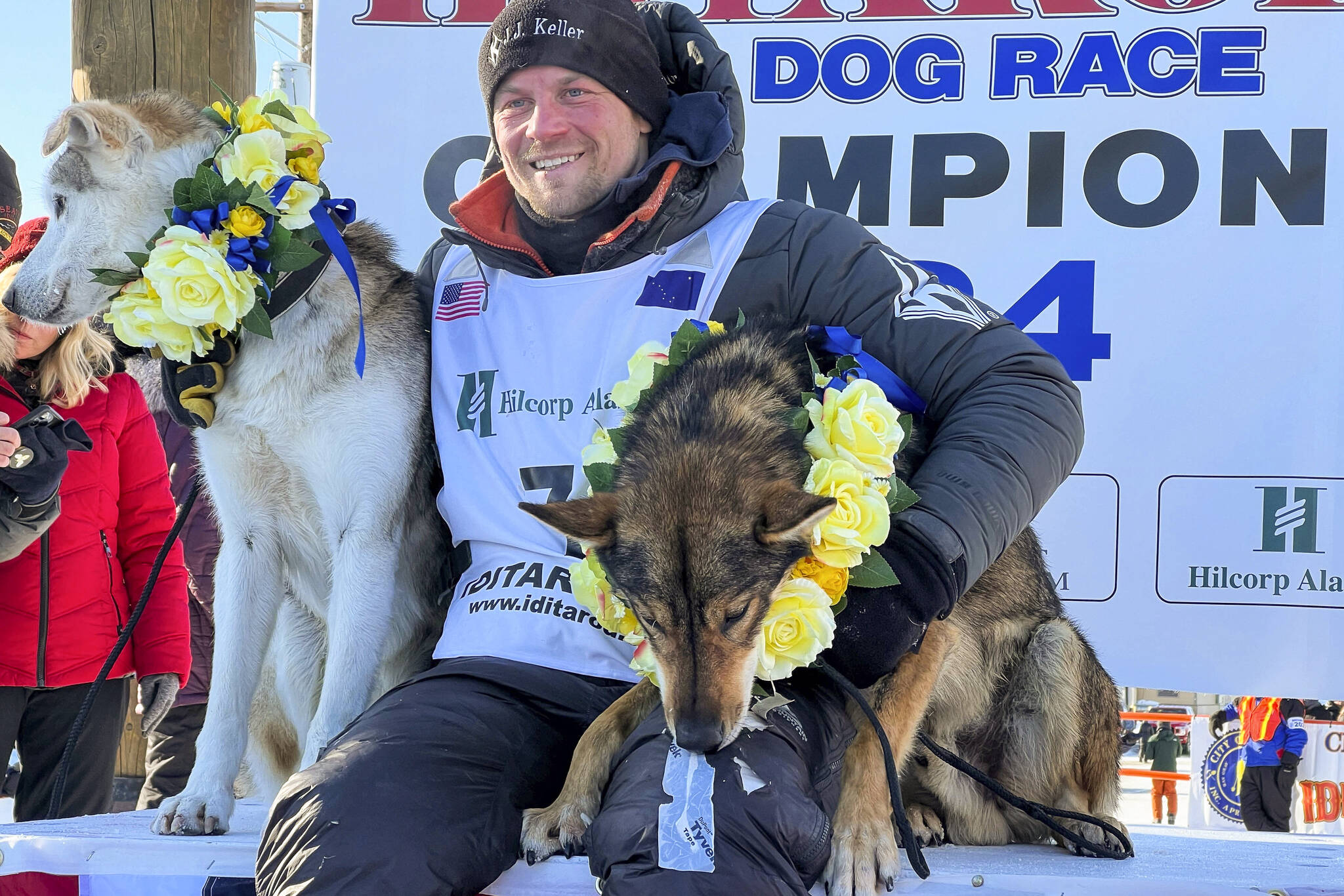
Dallas Seavey’s path to an Iditarod championship was like none he’s faced before, including killing a moose and overcoming a time penalty that had him in 10th place at one point to win a record-breaking sixth championship in the world’s most famous sled dog race.
Seavey drove his team a half-block off the Bering Sea ice onto the frozen streets of Nome to cross under the famed burled arch finish line, a triumphant moment in a race marred by the death of three sled dogs, including two on Sunday, and serious injury to another.
The deaths prompted one animal rights organization to renew its call for the end of the storied endurance race in which a team of dogs pulls a sled across 1,000 miles (1,609-kilometers) of Alaska wilderness.
“This one was supposed to be hard,” Seavey told the crowd. “It had to be special, it had to be more than just a normal Iditarod, and for me, it was.”
As he neared the finish line, he jumped off his sled and ran with his dogs, pumping his fists. After he reached the finish line, he hugged each dog on the team.
“There wasn’t a core group of super, super athletes, but what these guys had with a lot of heart, and it was a team and they worked together the whole way down the trail,” he said. “When you look back at 1,000 miles of what these dogs just covered, the challenges they faced, you can’t swallow that in one bite, but we can have one good step at a time. And if you can keep doing that, it leads to something.”
Seavey’s winning time was 9 days, 2 hours and 16 minutes.
Seavey, 37, becomes the winningest musher in the 51-year history of the Iditarod Trail Sled Dog Race, which takes the teams over two mountain ranges, across the Yukon River and along the frozen edges of the Bering Sea just south of the Arctic Circle. He won just over $55,000 for the victory.
Such a momentous win started out rough for Seavey after his team got tangled up with a moose on the trail just hours after the Iditarod started.
Seavey’s dog Faloo was injured before Seavey shot and killed the moose with a handgun. Race rules require any big game animal killed in defense of life or property to be gutted before the musher moves on.
Seavey told officials he gutted the moose the best he could. However, he was ultimately given a two-hour time penalty because he only spent 10 minutes gutting the moose, officials said.
The time penalty did not cost Seavey the race, and he left the second-to-last checkpoint Tuesday morning with a healthy three-hour lead over his nearest competitor.
Seavey’s name is found throughout the Iditarod record book. In 2005, he became the youngest musher to run in the race, and in 2012, its youngest champion.
Seavey also won Iditarod championships in 2014, 2015, 2016 and 2021. He had previously been tied with now-retired musher Rick Swenson with five titles apiece. Swenson won the Iditarod in 1977, 1979, 1981, 1982 and 1991.
Seavey’s family history is deeply entwined with the Iditarod. His grandfather, Dan Seavey, helped organize and ran the first Iditarod in 1973, and his father, Mitch Seavey, is a three-time champion.
Dallas Seavey almost took a different path in the sports world. He was the first Alaskan to win a USA national wrestling championship when he took the 125-pound Gregco-Roman title in 2003 and trained for a year at the U.S. Olympic Training Center before concussions led him to back to mushing.
Besides the moose encounter and time penalty, the race had other controversial issues this year.
After going five years without a dog dying during the race, two on separate teams collapsed and died Sunday, and another died Tuesday. Efforts to resuscitate all three dogs were unsuccessful.
Mushers Issac Teaford, of Salt Lake City, and Hunter Keefe, of Knik, both voluntarily scratched or they would have risked being removed by the race marshal because dogs in their care died during the race, per Iditarod rules. The third dog, a 3-year-old male named Henry on rookie Calvin Daugherty’s team, collapsed on the trail about 10 miles (16 kilometers) before reaching the checkpoint in the village of Shaktoolik. A necropsy is planned, and Daugherty also scratched.
People for the Ethical Treatment of Animals, the loudest critic of the Iditarod, called for officials to end the race.
“The Iditarod is the shame of Alaska,” PETA Executive Vice President Tracy Reiman said in a statement. “How many more dogs need to die before this stops? Dogs’ lives are worth more than this.” The Iditarod did not immediately respond to a request for comment.
Before the race even started, officials disqualified Eddie Burke Jr., the race’s rookie of the year last year, as well as 2022 champion Brent Sass as allegations of violence against women embroiled the Iditarod.
Race officials disqualified Burke on Feb. 19. But the state of Alaska then dropped charges alleging he choked his then-girlfriend in 2022, and the Iditarod Trail Committee reinstated him. He ultimately withdrew because he had leased his dogs to other mushers when he was disqualified and couldn’t reassemble his team in time for the race.
The committee also disqualified Sass without explanation, other than pointing to a rule governing personal and professional conduct, and race officials refused to discuss it during a media briefing ahead of the race.
Sass said in a Facebook post he was “beyond disappointed” and that the “anonymous accusations” made against him were “completely false.” No criminal cases against Sass appear in online Alaska court records.
The race started March 2 for 38 mushers with a ceremonial run in Anchorage. The competitive start was held the following day 75 miles (120 kilometers) north of Anchorage. Since then, seven mushers have withdrawn.