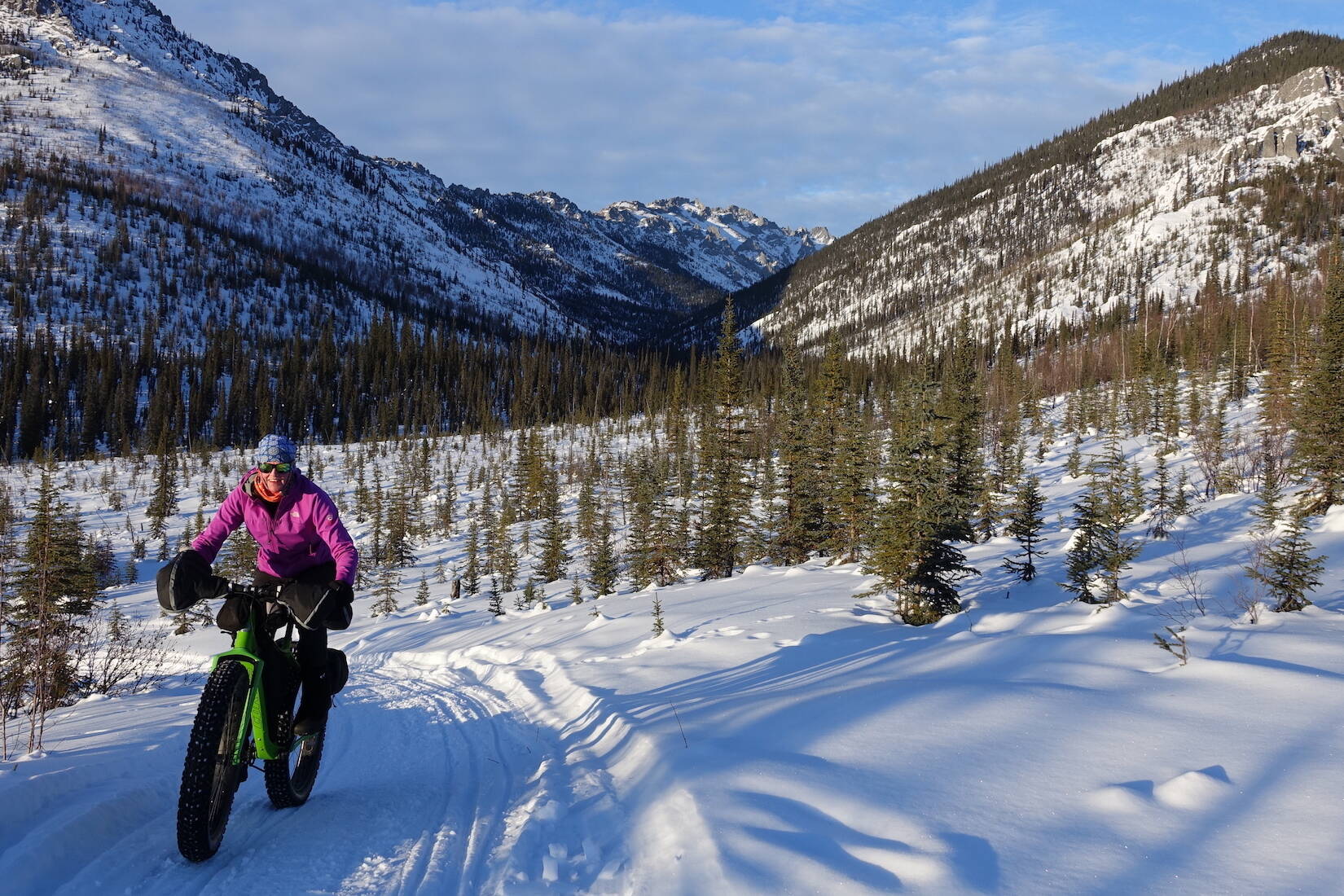
Hydrologist Heather Best rides her fat bike in the White Mountains National Recreation Area north of Fairbanks. (Photo by Ned Rozell)

Hydrologist Heather Best rides her fat bike in the White Mountains National Recreation Area north of Fairbanks. (Photo by Ned Rozell)

Alaska Science Forum: Wet overflow a winter hazard in Alaska

While following a snowmachine trail recently, my dog and I came to a low spot that looked like a swimming pool filled with ice water. The air temperature was about 5 degrees F.

Rather than plunge in, my dog and I followed the faint bike-and-boot tracks of friends who had snuck across an ice bridge on the upstream edge of the pool. We continued on, leaving another stretch of “overflow” behind us.

Getting wet at subzero temperatures is one of the few potential hazards in an Alaska winter free of bears and mosquitoes. It’s also one that seems against the laws of physics; how does water remain unfrozen when the temperature of the air is way below the freezing mark?

For an answer, I asked Heather Best, a hydrologist for the U.S. Geological Survey in Fairbanks. She is also a winter biker with many thousands of miles under her tires. And she had — just ahead of me — crossed that same water hazard along with her husband Jeff Oatley.

Alaskans and other northerners recognize fresh water covering a trail (sometimes solid, often wet) as aufeis, or overflow. Aufeis, pronounced off-ice, is a German word meaning “ice on top.”

Aufeis happens because underground springs pump water toward the surface no matter how cold the air above. On some northern waterways, fields of surface ice slowly build all winter; this can leave behind slabs 10 feet thick and acres wide. They don’t melt until late summer.

Dog mushers, snowmachiners and other trail users often encounter smaller patches of aufeis recharged from below. Those overflow patches often happen when a stream channel has frozen beneath the snow surface, plugging up a passage and forcing water to the surface.

While Best claims not to be an expert on overflow, she has pondered its causes many times as she has rolled and skied over it.

She said the surface water that my dog and I pondered was probably there because a pool of water “slowly seeped through the snowpack and built up at the trail crossing.”

Retaining all its air-trapping properties, the undisturbed snow around a visible patch of aufeis often hides the presence of liquid water beneath. People often soak their boots when stepping in snow while trying to walk around glare ice or obvious wet spots.

Since the formation of aufeis is a gravity-driven system, wet and icy sections of trail vary all the time. The gradual nature of freezing also sometimes causes an aufeis sheet to tilt in a treacherous fashion after water reaches a trail of compacted snow, which acts like a dam.

“Any water seeping into the trail dam freezes there,” Best said. “Eventually the water reaches the elevation of the top of the trail and tries to flow across, only to freeze.

“This continues to happen vertically and laterally, which is why we find these sloping ice fields.”

Best had a tip for negotiating those canted fields of trail ice.

“If we step on the uphill side there will be water-saturated snow, but we can often sneak by on the downhill side where it is still mostly dry,” she said.

Best said that hazard we faced at Wickersham Creek in the White Mountains National Recreation Area had probably already wandered a bit.

“I would expect this overflow area to freeze over and force the process to start again and probably at a slightly different spot along the trail.”

• Since the late 1970s, the University of Alaska Fairbanks’ Geophysical Institute has provided this column free in cooperation with the UAF research community. Ned Rozell ned.rozell@alaska.edu is a science writer for the Geophysical Institute.
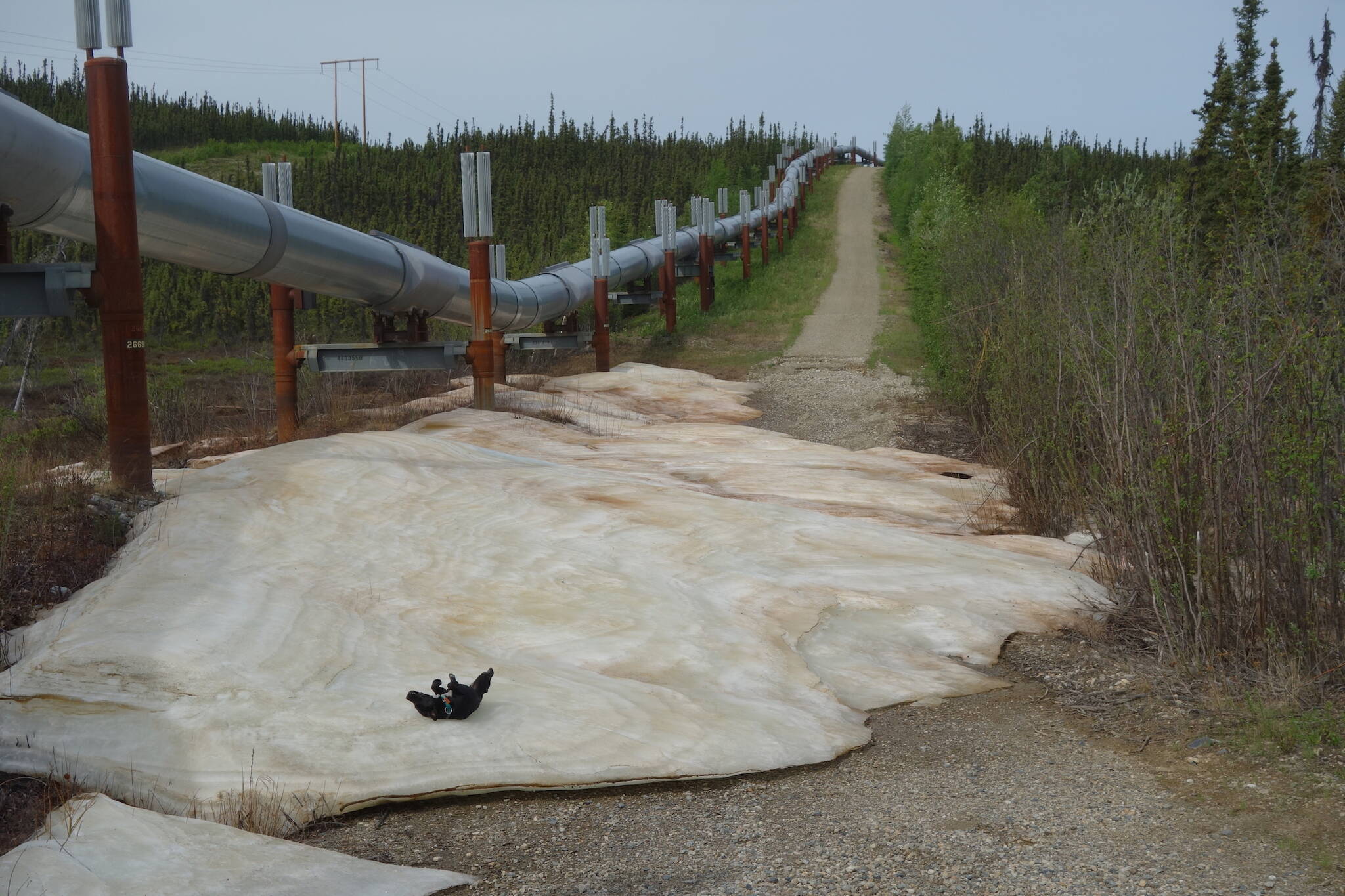
Cora the dog enjoys a patch of aufeis that formed over the winter near the trans-Alaska pipeline and had lasted well into June. (Photo by Ned Rozell)
Cora the dog enjoys a patch of aufeis that formed over the winter near the trans-Alaska pipeline and had lasted well into June. (Photo by Ned Rozell)

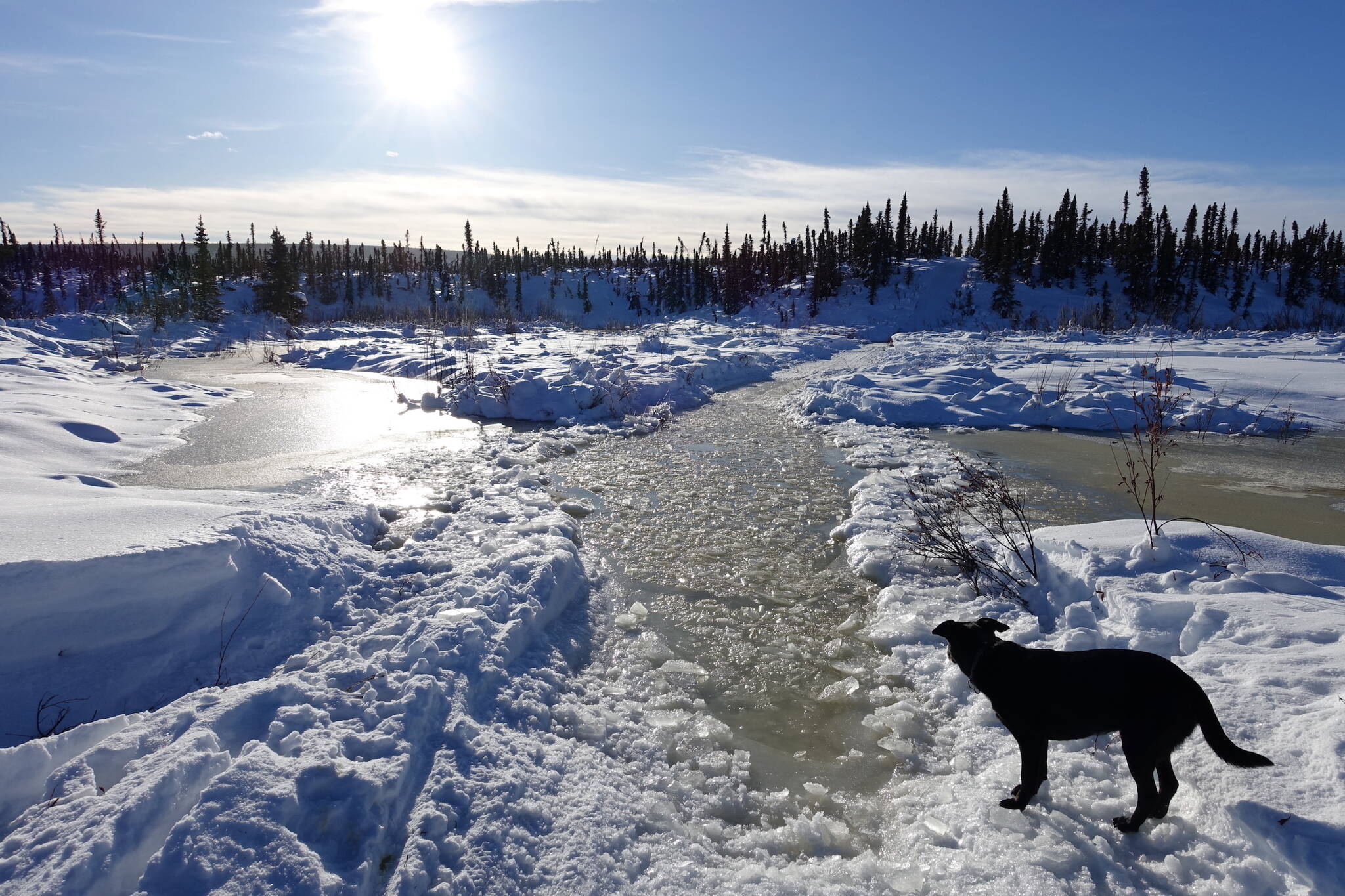
Cora the dog seems to contemplate a winter trail filled with cold water during a recent trip to the White Mountains National Recreation Area north of Fairbanks. (Photo by Ned Rozell)

Cora the dog seems to contemplate a winter trail filled with cold water during a recent trip to the White Mountains National Recreation Area north of Fairbanks. (Photo by Ned Rozell)

More in Sports

The Juneau-Douglas High School: Yadaa.at Kalé Crimson Bears won fourth place during the Division II Hockey State championships in Palmer last weekend. Photo courtesy of Rapi Sotoa
Juneau takes home fourth place during high school state hockey tournament

The Crimson Bears also received the Sportsmanship Award last weekend.

Senior Juneau-Douglas High School: Yadaa.at Kalé hockey players were recognized at the Treadwell Arena on Friday, Jan. 23, 2026 before the Crimson Bears faced the Homer High School Mariners. Head coach Matt Boline and assistant coaches Mike Bovitz, Luke Adams, Jason Kohlase and Dave Kovach honored 11 seniors. (Chloe Anderson / Juneau Empire)
JDHS celebrates hockey team’s senior night with sweeping victory over Homer

The Crimson Bears saw an 8-2 victory over the Mariners Friday night.

Photo by Ned Rozell
Golds and greens of aspens and birches adorn a hillside above the Angel Creek drainage east of Fairbanks.
Alaska Science Forum: The season of senescence is upon us

Trees and other plants are simply shedding what no longer suits them

Things you won’t find camping in Southeast Alaska. (Jeff Lund/Juneau Empire)
I Went to the Woods: Sodium and serenity

The terrain of interior Alaska is captivating in a way that Southeast isn’t

An albacore tuna is hooked on a bait pole on Oct. 9, 2012, in waters off Oregon. Tuna are normally found along the U.S. West Coast but occasionally stray into Alaska waters if temperatures are high enough. Sport anglers catch them with gear similar to that used to hook salmon. (Photo provided by the National Oceanic and Atmospheric Administration/West Coast Fisheries Management and Marine Life Protection)
Brief tuna bounty in Southeast Alaska spurs excitement about new fishing opportunity

Waters off Sitka were warm enough to lure fish from the south, and local anglers took advantage of conditions to harvest species that make rare appearances in Alaska

Isaac Updike breaks the tape at the Portland Track Festival. (Photo by Amanda Gehrich/pdxtrack)
Updike concludes historic season in steeplechase heats at World Championships

Representing Team USA, the 33-year-old from Ketchikan raced commendably in his second world championships

A whale breaches near Point Retreat on July 19. (Chloe Anderson/Juneau Empire)
Weekly Wonder: The whys of whale breaching

Why whales do the things they do remain largely a mystery to us land-bound mammals

Renee Boozer, Carlos Boozer Jr. and Carlos Boozer Sr. attend the enshrinement ceremony at the Naismith Basketball Hall of Fame in Sprinfield, Massachusetts, on Saturday, Sept. 6, 2025. As a member of the 2008 U.S. men's Olympic team, Boozer Jr. is a member of the 2025 class. (Photo provided by Carlos Boozer Sr.)
Boozer Jr. inducted into Naismith Hall of Fame with ‘Redeem Team’

Boozer Jr. is a 1999 graduate of Juneau-Douglas: Yadaa.at Kale

Photo by Martin Truffer
The 18,008-foot Mount St. Elias rises above Malaspina Glacier and Sitkagi Lagoon (water body center left) in 2021.
Alaska Science Forum: The long fade of Alaska’s largest glacier

SITKAGI BLUFFS — While paddling a glacial lake complete with icebergs and… Continue reading

Photo by Jeff Lund/Juneau Empire
The point of fishing is to catch fish, but there are other things to see and do while out on a trip.
I Went to the Woods: Fish of the summer

I was amped to be out on the polished ocean and was game for the necessary work of jigging

A female brown bear and her cub are pictured near Pack Creek on Admiralty Island on July 19, 2024. (Chloe Anderson for the Juneau Empire)
Bears: Beloved fuzzy Juneau residents — Part 2

Humor me for a moment and picture yourself next to a brown bear

Isaac Updike of Ketchikan finished 16th at the World Championships track and field meet in Budapest, Hungary, on Tuesday. (Alaska Sports Report)
Ketchikan steeplechaser makes Team USA for worlds

Worlds are from Sept. 13 to 21, with steeplechase prelims starting on the first day