
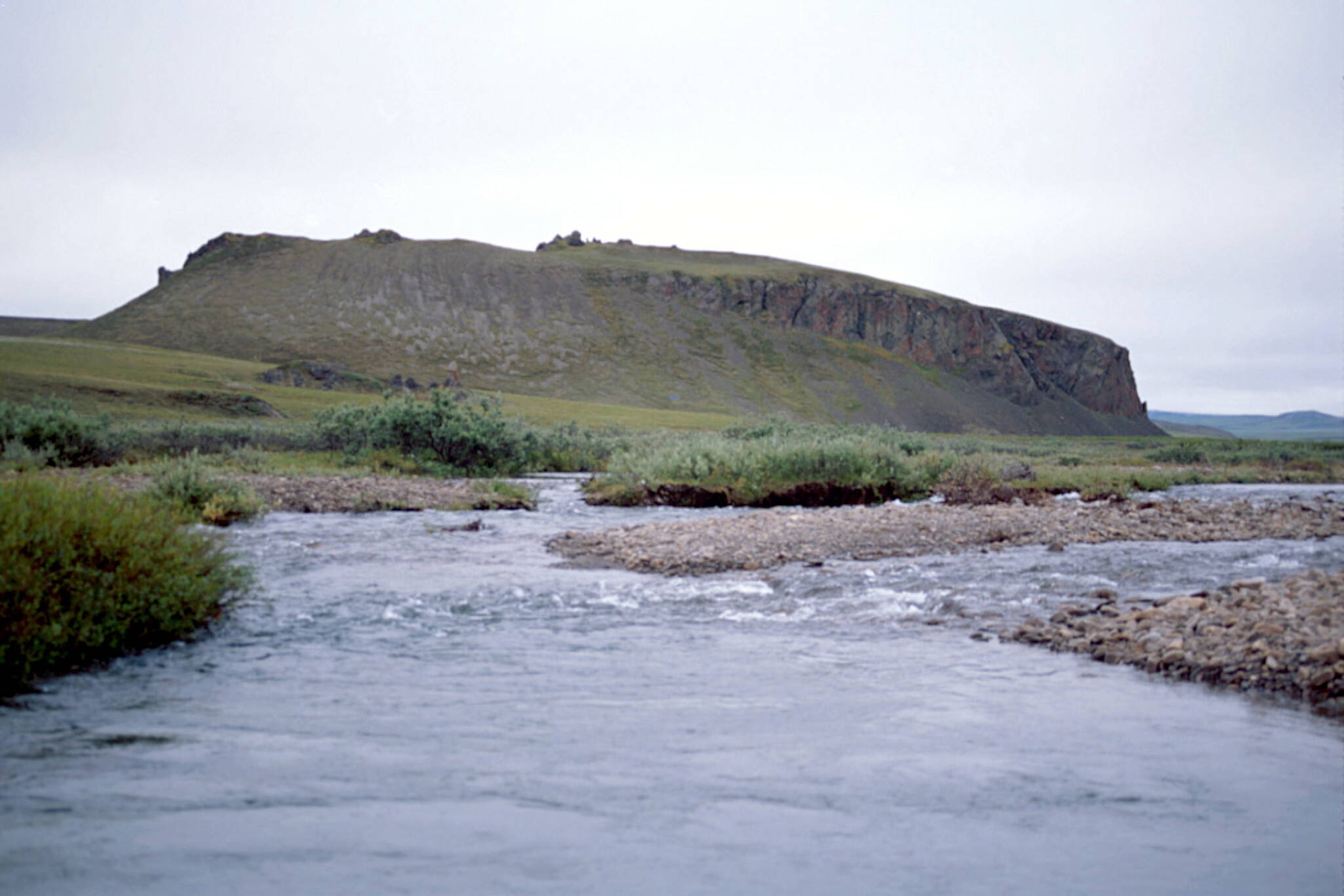
A creek runs beside the Mesa Site in northern Alaska. (Photo by Dan Gullickson)

A creek runs beside the Mesa Site in northern Alaska. (Photo by Dan Gullickson)

Alaska Science Forum: Pondering the mystery of the Mesa people

Now as quiet as wind whispering through grass, a plateau rising from the flats of northern Alaska was for thousands of years a lookout for ancient Alaskans. Those people later vanished, perhaps moving on to populate the Americas. A scientist is using what little they left behind to find out more about those hunters of long ago.

That scientist is Stormy Fields. She works in the Alaska Stable Isotope Facility at the University of Alaska Fairbanks. There, she vaporizes specks of blood, feather, muscle tissue, bone and other organic material. The emitted smoke helps scientists determine — among many other things — where a mammoth wandered across the Alaska landscape thousands of years ago.

Fields, also a master’s-degree student, recently saw an additional opportunity to use the lab’s tools on burned material a scientist gathered in gallon-size bags from the Mesa Site more than 20 years ago. Her goal is to see if the hunters there — steppe bison specialists — were also eating fish.

What is the Mesa Site?

In 1978, now-retired Bureau of Land Management archaeologists Mike Kunz and Dale Slaughter explored a hill that rises 180 feet above the foothills of the west/central Brooks Range. What Kunz named the Mesa Site was one of the few stony outcrops in the area. Oil developers wanted to use the rock for construction of a nearby airstrip.

On top of the Mesa, the archaeologists found ancient projectile points, stone tools and blackened areas the size of their open hands that they recognized as the remnants of ancient campfires. They found 40 of those dark circles.

During the next few decades, Kunz and many others returned to the Mesa Site. They discovered that the stone points with which the Mesa people tipped their weapons were strikingly similar to those that Native Americans of the U.S. Great Plains used to kill bison.

In a paper he wrote on the Mesa Site, Kunz noted that the hunters there abandoned that excellent lookout about 9,700 years ago. For the next 2,000 years, there were probably few or no people present on Alaska’s North Slope.

Why? Kunz and UAF’s Dan Mann think that rapid climate change at the end of the last ice age transformed northern Alaska.

The encroachment of the ocean from sea-level rise and the slow flooding of the Bering Land Bridge caused an increase in precipitation around the North Slope.

What was once an Arctic prairie with grasses that fed mammoths, horses and bison transitioned to a place influenced by wetter and warmer conditions. That meant the increase of cottongrass and other tussock tundra plants — favored by few mammals — and mosquitoes, favored by none.

The departed people of the Mesa might have then helped to populate the Americas, as Kunz wrote: “As early as 14,500 years (ago), arctic immigrants…could have worked their way south along the coast to a point in temperate North America.”

In the fireplace residue Kunz donated to the UA Museum of the North, Fields sees an easy resource she can process. The Mesa Site has yielded no useful bones for scientists to identify particular animals. But with the capabilities of UAF’s isotope lab, the grit could reveal remains of bison, muskoxen or caribou, as well as the presence or absence of fish that ancient people may have cooked.

Scientists recently determined that the ancient people of Alaska south of the Arctic Circle were eating salmon at about the same time.

“I am curious to know if the megafauna specialists that were hunting on the North Slope were expanding their diet to include fish like the people of the Interior were,” Fields said. “Whatever results we get will be exciting.”

• Since the late 1970s, the University of Alaska Fairbanks’ Geophysical Institute has provided this column free in cooperation with the UAF research community. Ned Rozell ned.rozell@alaska.edu is a science writer for the Geophysical Institute.
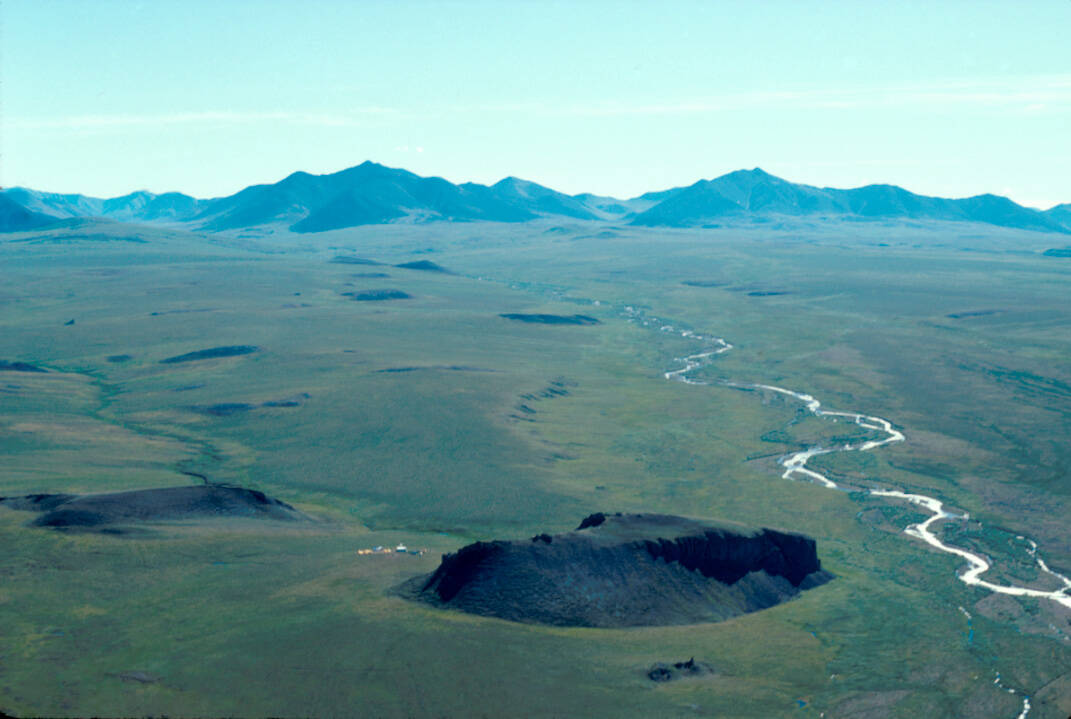
The Mesa Site rises just north of the Brooks Range in northern Alaska. (Photo by Mike Kunz)

The Mesa Site rises just north of the Brooks Range in northern Alaska. (Photo by Mike Kunz)

More in Sports

Senior Juneau-Douglas High School: Yadaa.at Kalé hockey players were recognized at the Treadwell Arena on Friday, Jan. 23, 2026 before the Crimson Bears faced the Homer High School Mariners. Head coach Matt Boline and assistant coaches Mike Bovitz, Luke Adams, Jason Kohlase and Dave Kovach honored 11 seniors. (Chloe Anderson / Juneau Empire)
JDHS celebrates hockey team’s senior night with sweeping victory over Homer

The Crimson Bears saw an 8-2 victory over the Mariners Friday night.

Photo by Ned Rozell
Golds and greens of aspens and birches adorn a hillside above the Angel Creek drainage east of Fairbanks.
Alaska Science Forum: The season of senescence is upon us

Trees and other plants are simply shedding what no longer suits them

Things you won’t find camping in Southeast Alaska. (Jeff Lund/Juneau Empire)
I Went to the Woods: Sodium and serenity

The terrain of interior Alaska is captivating in a way that Southeast isn’t

An albacore tuna is hooked on a bait pole on Oct. 9, 2012, in waters off Oregon. Tuna are normally found along the U.S. West Coast but occasionally stray into Alaska waters if temperatures are high enough. Sport anglers catch them with gear similar to that used to hook salmon. (Photo provided by the National Oceanic and Atmospheric Administration/West Coast Fisheries Management and Marine Life Protection)
Brief tuna bounty in Southeast Alaska spurs excitement about new fishing opportunity

Waters off Sitka were warm enough to lure fish from the south, and local anglers took advantage of conditions to harvest species that make rare appearances in Alaska

Isaac Updike breaks the tape at the Portland Track Festival. (Photo by Amanda Gehrich/pdxtrack)
Updike concludes historic season in steeplechase heats at World Championships

Representing Team USA, the 33-year-old from Ketchikan raced commendably in his second world championships

A whale breaches near Point Retreat on July 19. (Chloe Anderson/Juneau Empire)
Weekly Wonder: The whys of whale breaching

Why whales do the things they do remain largely a mystery to us land-bound mammals

Renee Boozer, Carlos Boozer Jr. and Carlos Boozer Sr. attend the enshrinement ceremony at the Naismith Basketball Hall of Fame in Sprinfield, Massachusetts, on Saturday, Sept. 6, 2025. As a member of the 2008 U.S. men's Olympic team, Boozer Jr. is a member of the 2025 class. (Photo provided by Carlos Boozer Sr.)
Boozer Jr. inducted into Naismith Hall of Fame with ‘Redeem Team’

Boozer Jr. is a 1999 graduate of Juneau-Douglas: Yadaa.at Kale

Photo by Martin Truffer
The 18,008-foot Mount St. Elias rises above Malaspina Glacier and Sitkagi Lagoon (water body center left) in 2021.
Alaska Science Forum: The long fade of Alaska’s largest glacier

SITKAGI BLUFFS — While paddling a glacial lake complete with icebergs and… Continue reading

Photo by Jeff Lund/Juneau Empire
The point of fishing is to catch fish, but there are other things to see and do while out on a trip.
I Went to the Woods: Fish of the summer

I was amped to be out on the polished ocean and was game for the necessary work of jigging

A female brown bear and her cub are pictured near Pack Creek on Admiralty Island on July 19, 2024. (Chloe Anderson for the Juneau Empire)
Bears: Beloved fuzzy Juneau residents — Part 2

Humor me for a moment and picture yourself next to a brown bear

Isaac Updike of Ketchikan finished 16th at the World Championships track and field meet in Budapest, Hungary, on Tuesday. (Alaska Sports Report)
Ketchikan steeplechaser makes Team USA for worlds

Worlds are from Sept. 13 to 21, with steeplechase prelims starting on the first day

Old growth habitat is as impressive as it is spectacular. (Photo by Jeff Lund/Juneau Empire)
I Went to the Woods: The right investments

Engaged participation in restoration and meaningful investment in recreation can make the future of Southeast special