

“You guys are the result of thousands of years of selection,” Fran Kohl said. “You haven’t scratched the surface of what you can do with those bodies and brains.”
Our biologist friend gave that much-needed pep talk as she shuttled me, Bruno Grunau and Forest Wagner to Eagle Summit, an alpine high point rising above the boreal forest north of Fairbanks.
We three friends riding together in a pickup had committed to join together for the AlaskAcross, a 50-mile jaunt on foot from Eagle Summit to the Chena Hot Springs Resort.
AlaskAcross is like a shorter version of the Wilderness Classic summer race, where competitors carry all their provisions and follow what they think is the fastest route from A to B.
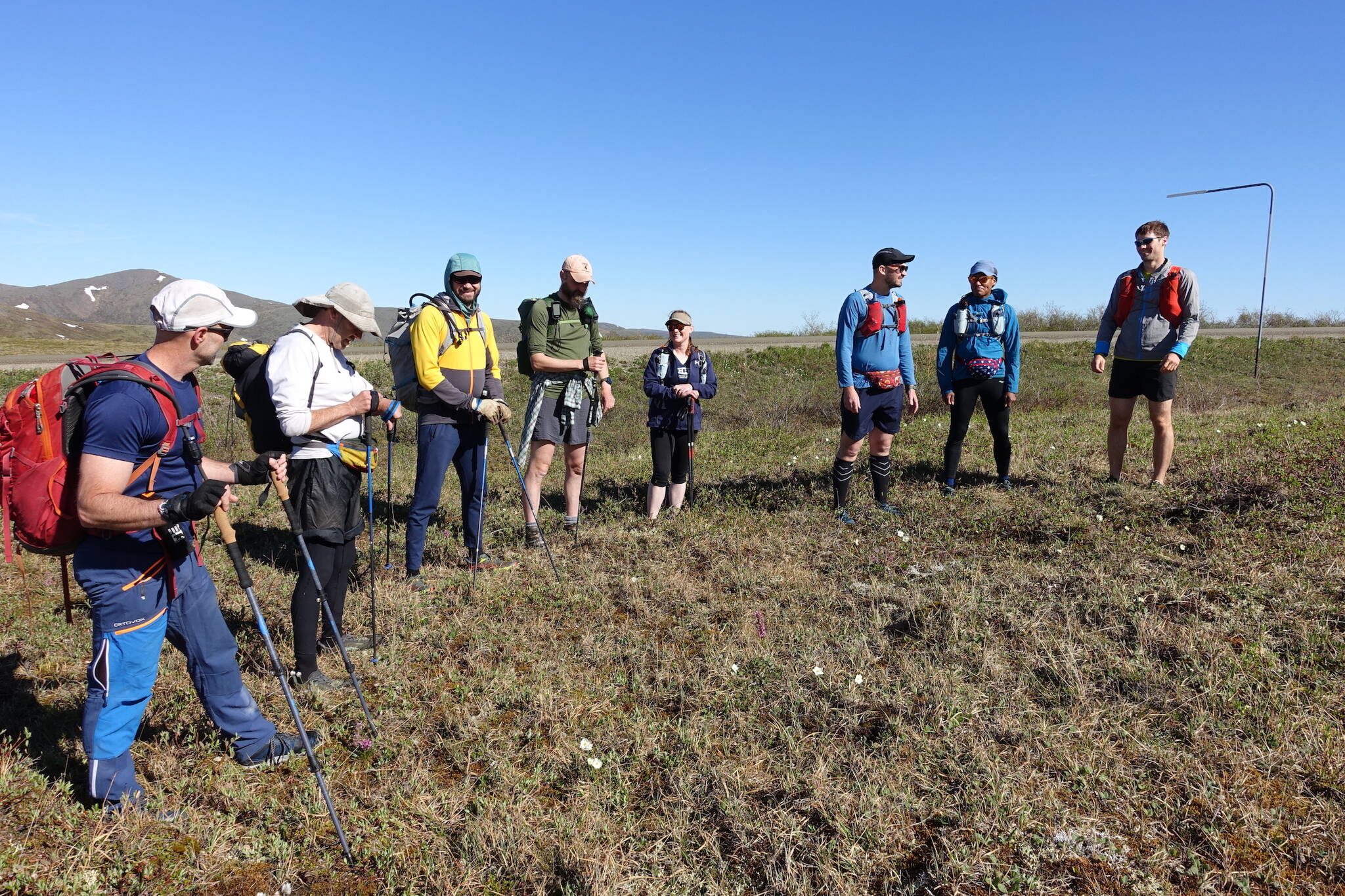
Competitors in the AlaskAcross 2024 race prepare to depart from Eagle Summit at 10 a.m. on June 8, 2024. From left are Bruno Grunau, Mark Ross, Forest Wagner, Mike Fisher, Sarah Hurkett, Clinton Brown, Tracie Curry and Curtis Henry. (Photo by Ned Rozell)
That recent Saturday morning, nine people showed up in the Eagle Summit parking lot, a trailhead for the Pinnell Mountain Trail. Most of them were familiar faces.
After walking us across the highway, biologist Mark Ross asked us to keep a lookout for the rare gray-headed chickadee and get a photo of it if we encountered one.
Someone said go.
Everyone hiked away toward Mastodon Dome wearing daypacks stuffed with enough food to get them to Chena Hot Springs.
Forest, Bruno and I took our place at the back, a standing we would never relinquish. We were all happy with that; our mutual goal was lots of time moving across the country together.
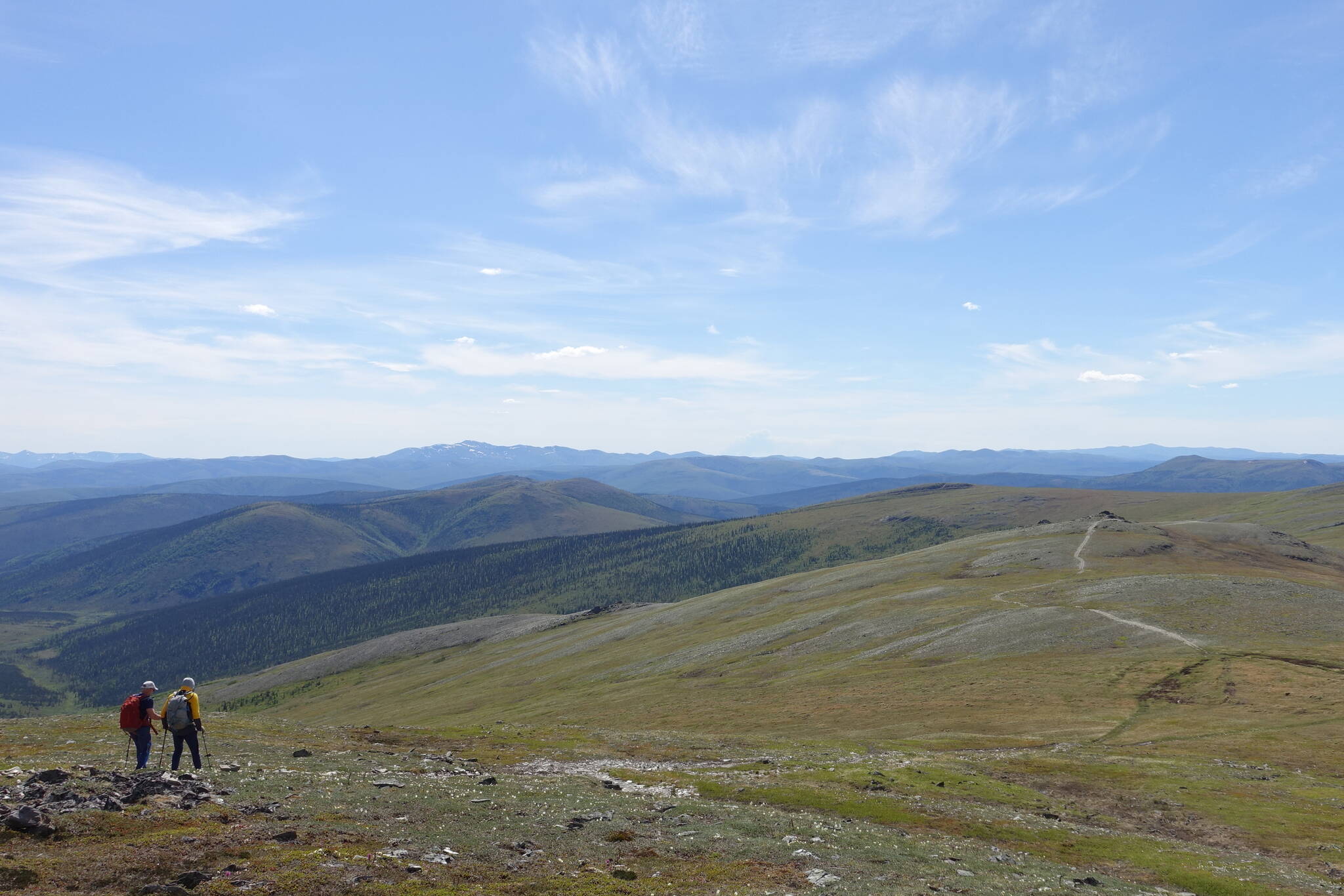
Bruno Grunau and Forest Wagner hike a trail through the alpine in Interior Alaska during the AlaskAcross 2024 50-mile race. (Photo by Ned Rozell)
AlaskAcross is a “just-add-water” adventure, one in which someone else has provided a plan and invited other people whose tracks are fun to follow and interpret. All you have to do is navigate, eat and drink enough to prevent falling over, and stay on your feet long enough to finish.
My partners are both longtime friends who had never met one another. It tickled me to hear Forest and Bruno chatting. I let my mind drift off with their current subject, and loved seeing my boys gettin’ on like that.
While we had seen other racers begin to trot on a four-wheeler trail burned through the alpine at the start, Forest, Bruno and I clicked along with trekking poles, never exceeding 4 miles per hour.
That plodding pace was necessary for me, mature enough to be my friends’ uncle. I was also the most in need of hearing Fran Kohl remind us that we had dusty tools in our boxes waiting to be used.
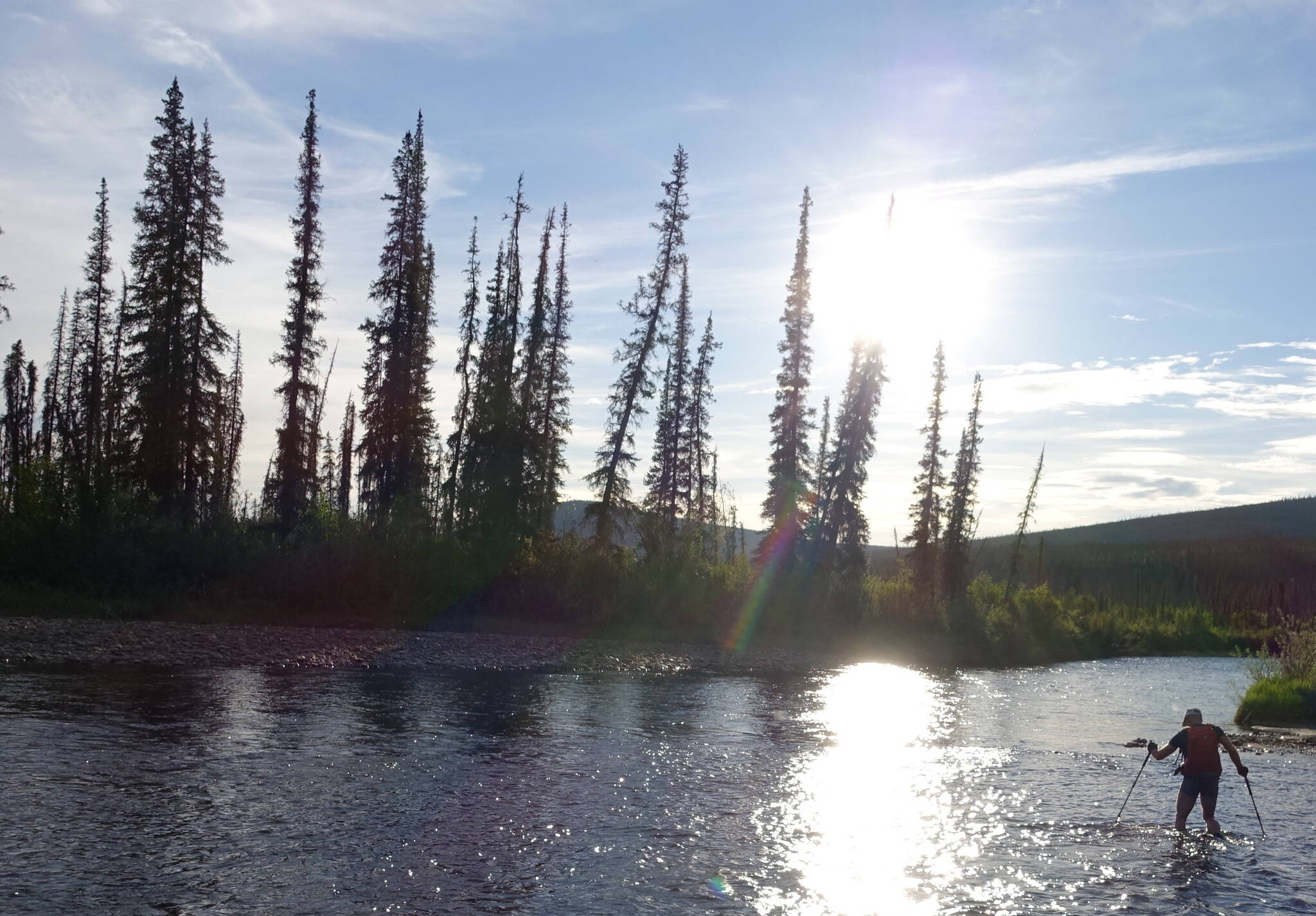
Bruno Grunau crosses the Ikheenjik River (formerly known as Birch Creek), the major water obstacle during the AlaskAcross 2024 race from Eagle Summit to Chena Hot Springs resort. (Photo by Ned Rozell)
One of these was the ability to resist the body’s urge to sleep, something I try to do once a year around summer solstice.
We were carrying no sleeping bags or tents, committed to pushing through the twilight of high summer. When that time came, we watched the sun dip behind hills to the northwest at 12:27 a.m. while sitting under a rock shelter on a ridgetop, our wet sneakers kicked off our wrinkled feet.
With a stove and a tiny canister of fuel, we boiled water and enjoyed a coffee there. We were out there together as friends, in quiet country shared with hawk owls, golden plovers, gray-cheeked thrushes and ptarmigan. It was hard to imagine a time six month earlier, when the same spot was devoid of beating hearts, cloaked in darkness, and featured a frigid wind that would damage flesh in seconds.
The coffee filled us with euphoria.
Then came the next ten hours.
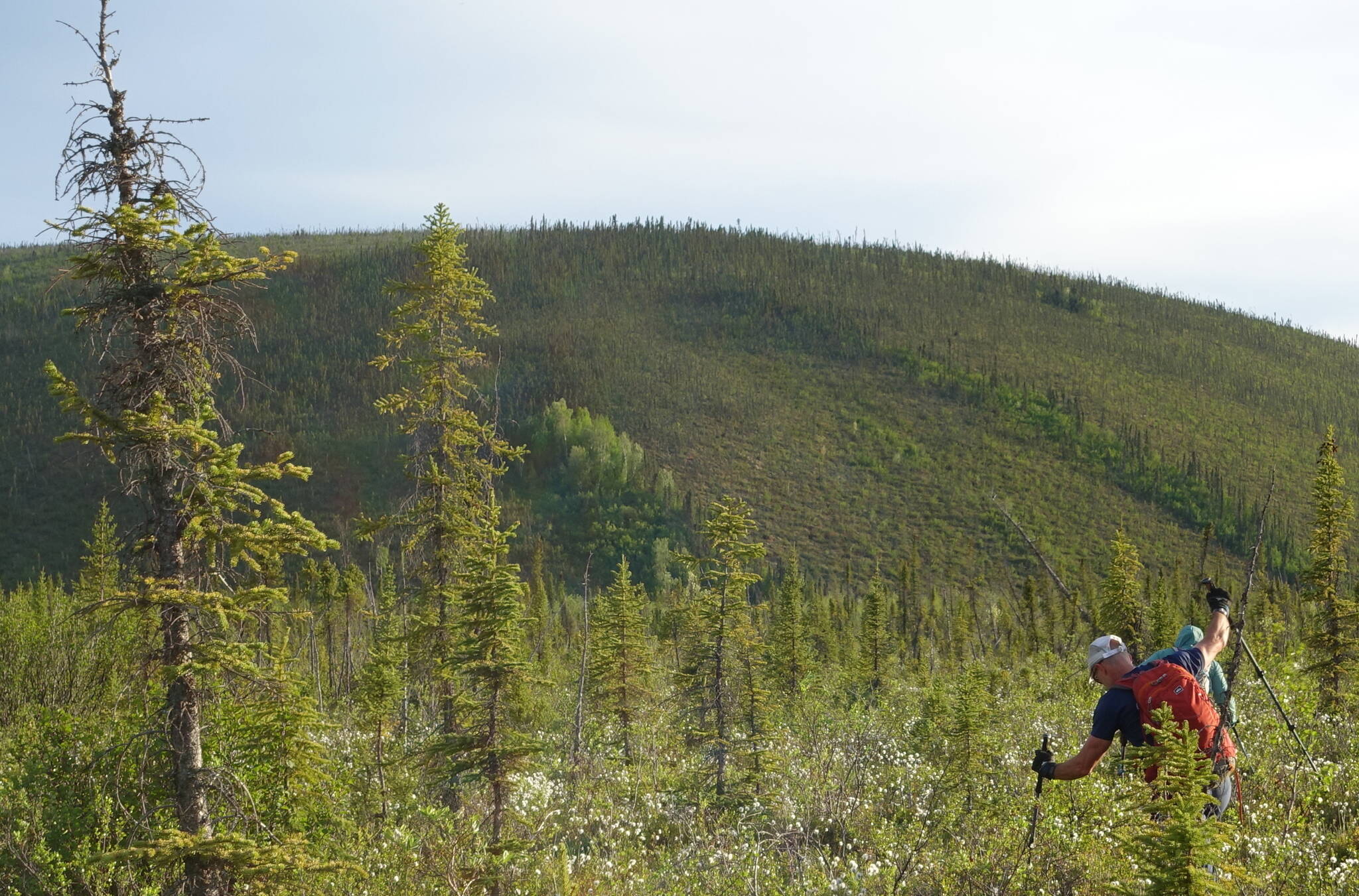
Bruno Grunau and Forest Wagner negotiate trail-less country during the AlaskAcross 2024 race from Eagle Summit to Chena Hot Springs resort. (Photo by Ned Rozell)
The caffeine wore off at the same time our chosen route required us to navigate the green parts of the map. Those were correlated with thick dwarf birch shrubs, tempered white claws of spruce branches that had burned 20 years earlier and a slight tailwind that allowed our mosquito entourages unfettered access to our faces.
Trying to shine through thick wildfire smoke, the sun was then a ball the color of a Creamsicle.
That was also the time — from the 3:09 a.m. sunrise until about 7 a.m. — that our bodies were pleading with us to drop and curl around a tussock.
The mosquitoes made that option less enticing. Most important, we had our shared pact of keeping our feet moving until we had reached the arch at the entrance of Chena Hot Springs Resort.
That finish was far away when we found a section of trail used for the Yukon Quest sled dog race. During that race, held every February, the path is a smooth white highway packed hard a foot above hibernating mosquitoes.
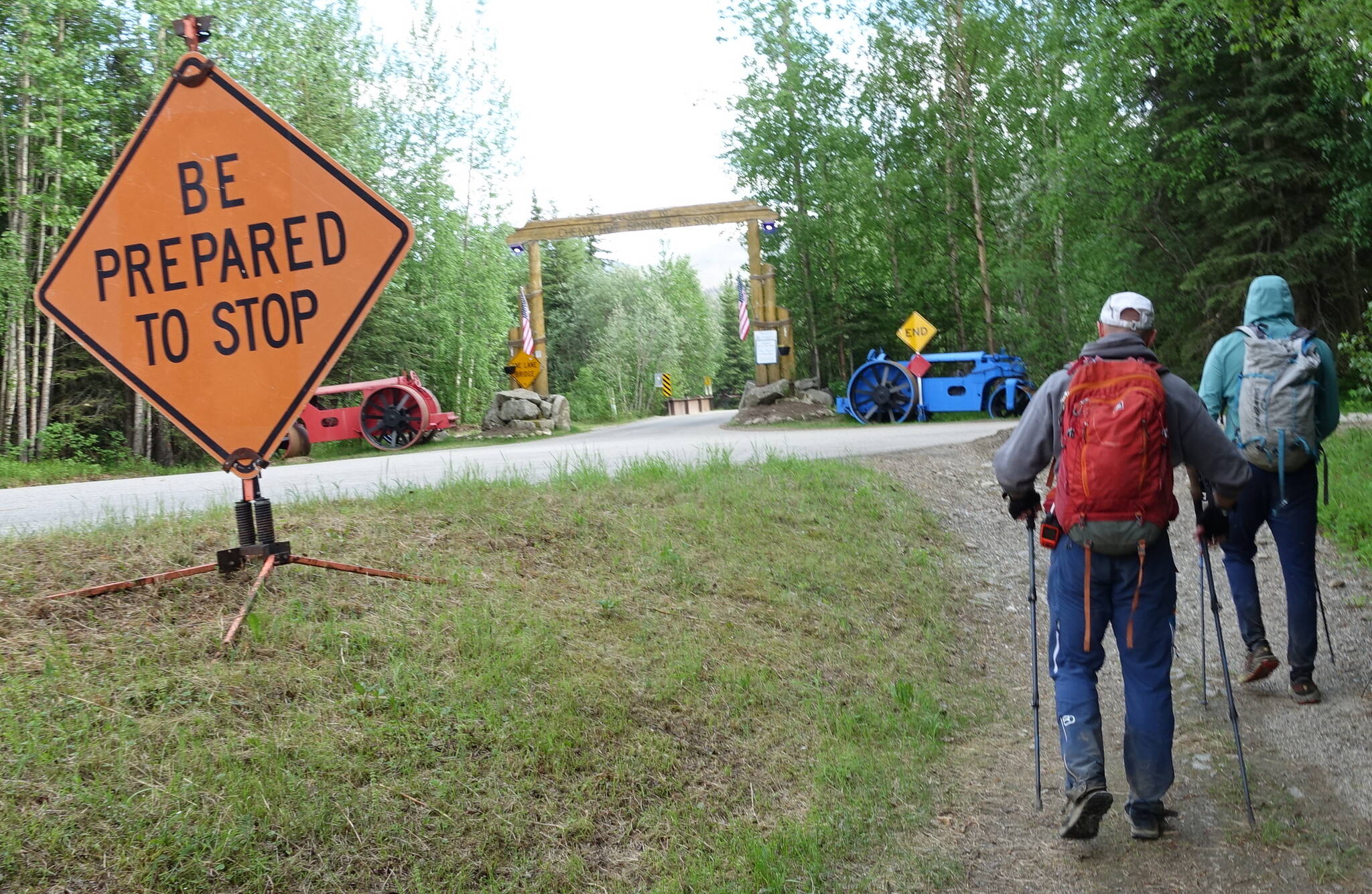
Bruno Grunau, left, and Forest Wagner approach the entryway to Chena Hot Springs Resort and the conclusion of their 50-mile, 33-hour foot journey from Eagle Summit. (Photo by Ned Rozell)
In June, the trail is good in spots but often degrades into pools of black water that want to suck your sneakers off. It is an earthy-smelling path, rich with yellow swallowtail butterflies landing on the moisture. And it offers the mental relief of not having to look at the map.
There, on broiled feet that looked forward to splashing through cold waterways that spilled over the trail, I decelerated to a creep that was uncomfortably slow for my companions. They marched ahead, making me glad for the alone time so my mind could wander.
I thought about doing this race the first time with two other friends 17 years ago and how lucky I was to be still doing it. Especially with these unusually good-natured companions.
As I plodded, I once again thought of Norwegian explorer Fridtjof Nansen, when he found himself surrounded by sea ice with no apparent way to get to a land mass he was seeking after a failed attempt at reaching the North Pole.
“Everything comes to an end, and so did this,” he wrote later.
The older I get, the faster the ends happen.
So, I tried to Be Here Now, observing what was in front of me: a clear creek running through white boulders, a ruby-crowned kinglet scolding a gray jay that had probably just robbed its nest, the tracks in mud of a bear cub who seemed to be traveling without his mother.
All good, as was the sight of my friends sitting and waiting for me at creek crossings.
Soon, just like Nansen said, at the terminus of a 60-mile road from Fairbanks, there was the entrance to Chena Hot Springs Resort. We tender-footed our way to a rock wall and found Mark Ross’ hidden clipboard.
Bruno signed us in 33 hours and two minutes since we had started walking from Eagle Summit. We had maintained our grip on last place.
Bruno informed us that we had not been a threat to Curtis Henry. Curtis had traveled alone wearing running shorts and a backpack the size of a grapefruit. He had covered 50 miles of mining trail and muck in 13 hours. That was 20 hours faster than us.
• Since the late 1970s, the University of Alaska Fairbanks’ Geophysical Institute has provided this column free in cooperation with the UAF research community. Ned Rozell ned.rozell@alaska.edu is a science writer for the Geophysical Institute.
Images:
1. Competitors in the AlaskAcross 2024 race prepare to depart from Eagle Summit at 10 a.m. on June 8, 2024. From left are Bruno Grunau, Mark Ross, Forest Wagner, Mike Fisher, Sarah Hurkett, Clinton Brown, Tracie Curry and Curtis Henry. Photo by Ned Rozell.
2. Bruno Grunau, Ned Rozell and Forest Wagner hike a ridgetop near Mastodon Dome in the AlaskAcross 2024, a 50-mile race. Photo by Bruno Grunau.
3. Bruno Grunau and Forest Wagner hike a trail through the alpine in Interior Alaska during the AlaskAcross 2024 50-mile race. Photo by Ned Rozell.
4. Bruno Grunau crosses the Ikheenjik River (formerly known as Birch Creek), the major water obstacle during the AlaskAcross 2024 race from Eagle Summit to Chena Hot Springs resort. Photo by Ned Rozell.
5. Bruno Grunau and Forest Wagner negotiate trail-less country during the AlaskAcross 2024 race from Eagle Summit to Chena Hot Springs resort. Photo by Ned Rozell.
6. Bruno Grunau, left, and Forest Wagner approach the entryway to Chena Hot Springs Resort and the conclusion of their 50-mile, 33-hour foot journey from Eagle Summit. Photo by Ned Rozell.
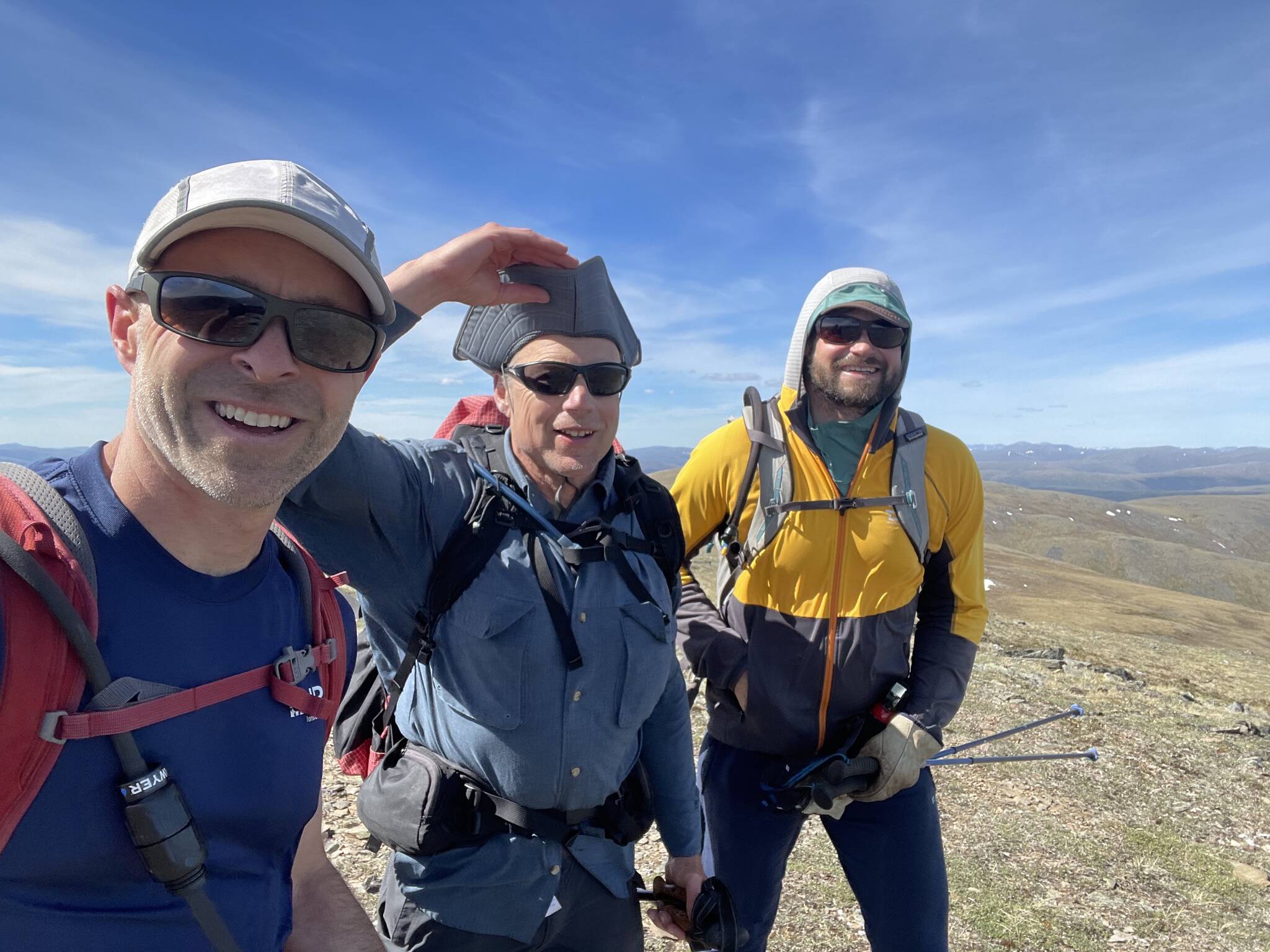
Bruno Grunau, Ned Rozell and Forest Wagner hike a ridgetop near Mastodon Dome in the AlaskAcross 2024, a 50-mile race. (Photo by Bruno Grunau)
