
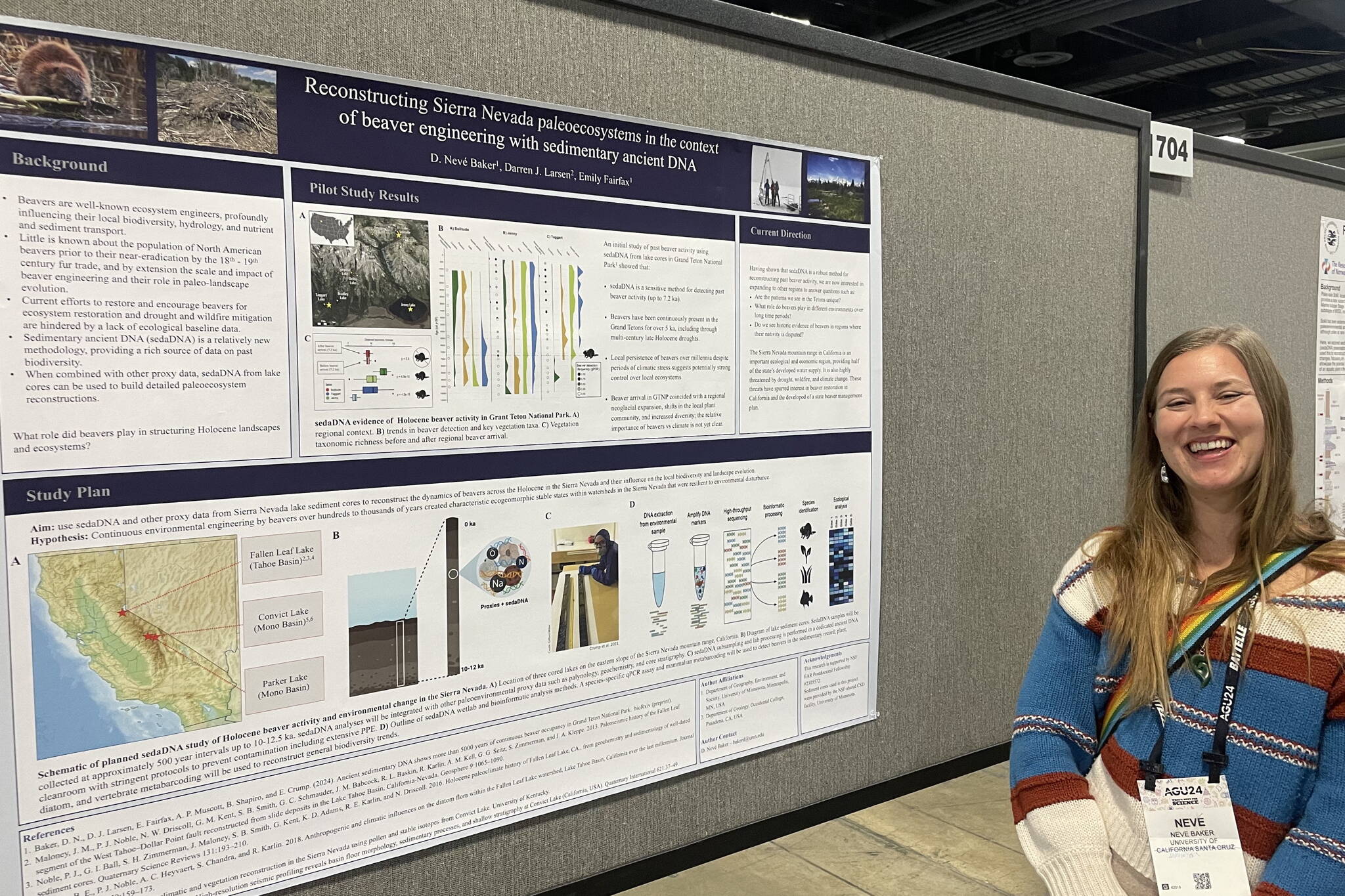
Neve Baker stands beside her poster on discovering ancient evidence of beavers in Grand Tetons National Park while she was at the Fall Meeting of the American Geophysical Union in Washington, D.C. in December 2024. (Photo by Ned Rozell)

Neve Baker stands beside her poster on discovering ancient evidence of beavers in Grand Tetons National Park while she was at the Fall Meeting of the American Geophysical Union in Washington, D.C. in December 2024. (Photo by Ned Rozell)

Alaska Science Forum: Ancient beavers, sea floor bumps, thick air

It’s time to start emptying the notebook following the Fall Meeting of the American Geophysical Union, which happened from Dec. 9-13, 2024 in Washington, D.C.

More than 25,000 scientists shared their work during those five days. Here is a sampling.

Where have beavers been? Neve Baker of the University of Minnesota uses ancient traces of DNA in pond sediments to determine if beavers have lived in a place. Last year, she found signs that beavers were present 7,500 years ago in a pond within Grand Teton National Park in Wyoming. Beavers don’t live there now.

California Department of Fish and Wildlife officials are interested in stocking some areas with beavers to help restore wetlands and provide more fire resiliency.

Baker hopes to visit Alaska in 2025 and sample northern lakes. Baker would like to try her technique to see when beavers may have been present in extreme northern wetlands thousands of years ago.
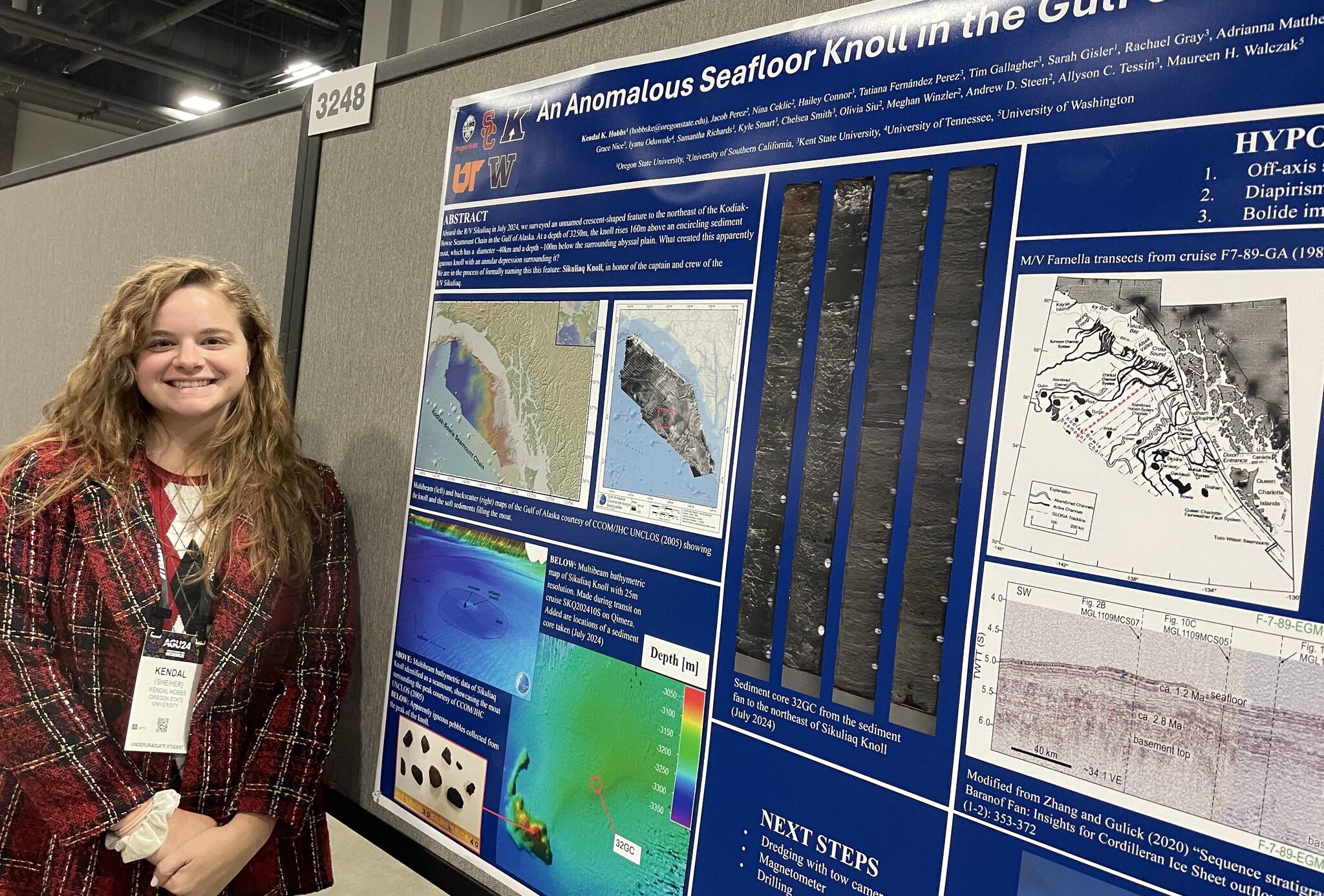
Kendal Hobbs tried to find the origin of an undersea mountain while she was at the Fall Meeting of the American Geophysical Union in Washington, D.C. in December 2024. (Photo by Ned Rozell)

Kendal Hobbs tried to find the origin of an undersea mountain while she was at the Fall Meeting of the American Geophysical Union in Washington, D.C. in December 2024. (Photo by Ned Rozell)

A mysterious bump on the Alaska sea floor. Kendal Hobbs of Oregon State University stood by her poster one afternoon with the hope that educated passers-by could help her identify a 400-foot lump she and others noticed on the sea floor beneath the Gulf of Alaska.

The bump might be a seamount (an underwater mountain often formed by a volcano), a mound caused by earthquake action, or maybe even debris kicked up by a meteorite strike. She and her colleagues imaged the underwater hill while aboard the University of Alaska Fairbanks research ship Sikuliaq in summer 2024.

Those who visited Hobbs’ poster were also a bit puzzled.

“We have no idea what it is — that’s what makes it a good story,” said Sean Gulick of the University of Texas at Austin.

By the end of several hours talking with passers-by in the massive poster hall at the Walter Washington Convention Center, Hobbs had not come up with an answer for what she calls “Sikuliaq Knoll.”

“Everyone I’ve talked to for the past four hours has a different idea,” she said. “I came away with a lot less clarity.”

Smoke ’em if you got ’em. Living in downtown Fairbanks, Alaska, is like smoking a cigarette a day during the town’s worst air-quality days in midwinter.
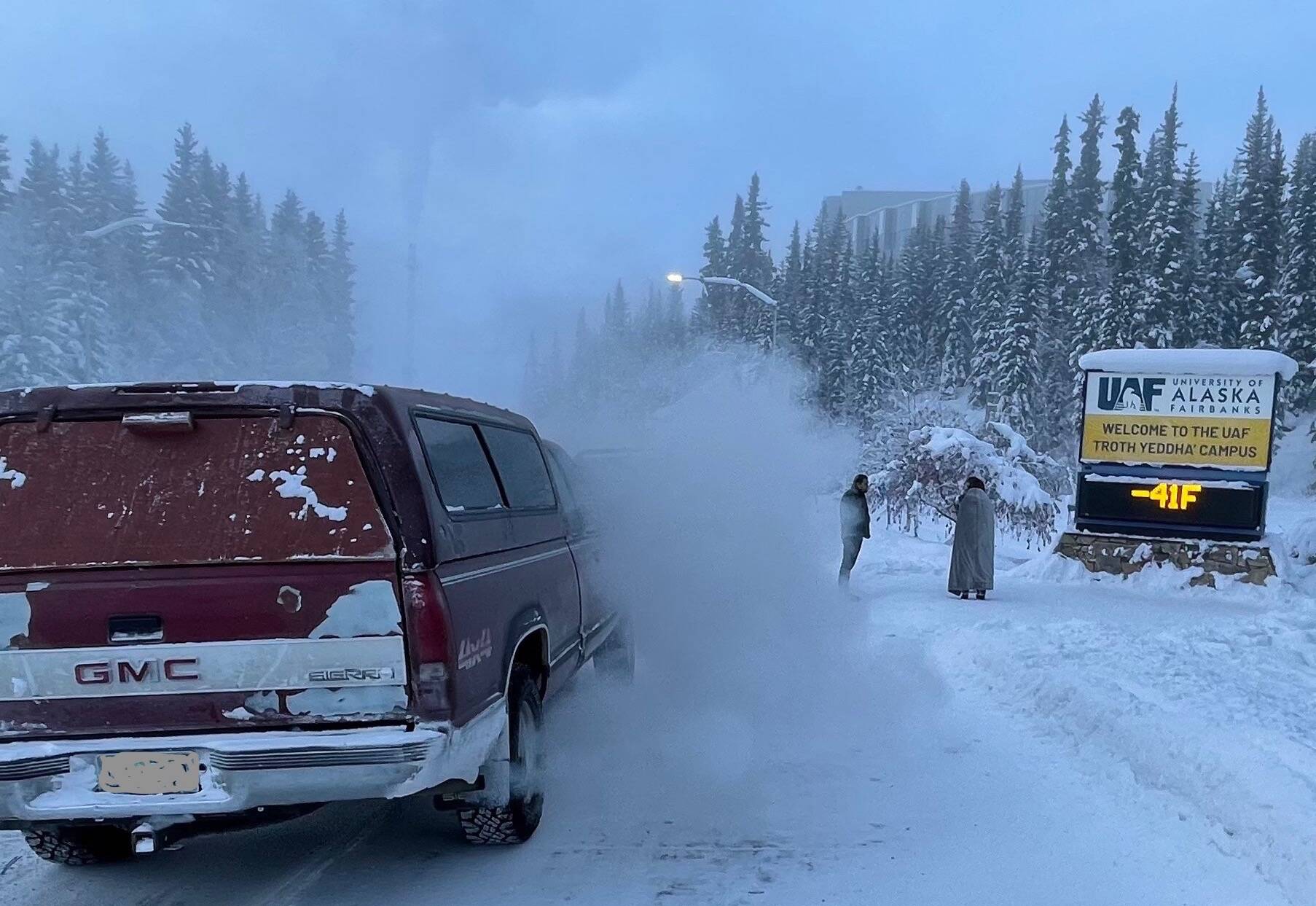
Fairbanks air quality is at its worst on still days like this one on January 27, 2024. (Photo by Ned Rozell)

Fairbanks air quality is at its worst on still days like this one on January 27, 2024. (Photo by Ned Rozell)

Winter temperature inversions — in which warmer air sits atop stagnant cold air — create conditions during which Fairbanks air is thick with tiny particles, reported Manabu Shiraiwa of the University of California, Irvine.

Shiraiwa visited Fairbanks in January and February of 2022 to sample the city’s air during a campaign with UAF researchers. Team members felt temperatures of minus 40 as they monitored air outside in downtown Fairbanks. They also measured air inside local homes.

Team members were able to detect when people fired up their woodstoves during extreme cold weather and how particulate matter from cars increased in overall percentage when the temperature warmed. Though not as bad as air quality in urban China, Fairbanks air was worse than most cities in the United States.

“Fairbanks people — even if they were not smoking — were breathing the equivalent of (up to) one cigarette daily,” Shiraiwa said of the worst days.

He also said that indoors often offered no escape due to particles that escaped wood and pellet stoves.

“Indoor air quality can be even worse than outdoors when people are burning wood,” Shiraiwa said.

• Since the late 1970s, the University of Alaska Fairbanks’ Geophysical Institute has provided this column free in cooperation with the UAF research community. Ned Rozell ned.rozell@alaska.edu is a science writer for the Geophysical Institute.

More in Sports

Senior Juneau-Douglas High School: Yadaa.at Kalé hockey players were recognized at the Treadwell Arena on Friday, Jan. 23, 2026 before the Crimson Bears faced the Homer High School Mariners. Head coach Matt Boline and assistant coaches Mike Bovitz, Luke Adams, Jason Kohlase and Dave Kovach honored 11 seniors. (Chloe Anderson / Juneau Empire)
JDHS celebrates hockey team’s senior night with sweeping victory over Homer

The Crimson Bears saw an 8-2 victory over the Mariners Friday night.

Photo by Ned Rozell
Golds and greens of aspens and birches adorn a hillside above the Angel Creek drainage east of Fairbanks.
Alaska Science Forum: The season of senescence is upon us

Trees and other plants are simply shedding what no longer suits them

Things you won’t find camping in Southeast Alaska. (Jeff Lund/Juneau Empire)
I Went to the Woods: Sodium and serenity

The terrain of interior Alaska is captivating in a way that Southeast isn’t

An albacore tuna is hooked on a bait pole on Oct. 9, 2012, in waters off Oregon. Tuna are normally found along the U.S. West Coast but occasionally stray into Alaska waters if temperatures are high enough. Sport anglers catch them with gear similar to that used to hook salmon. (Photo provided by the National Oceanic and Atmospheric Administration/West Coast Fisheries Management and Marine Life Protection)
Brief tuna bounty in Southeast Alaska spurs excitement about new fishing opportunity

Waters off Sitka were warm enough to lure fish from the south, and local anglers took advantage of conditions to harvest species that make rare appearances in Alaska

Isaac Updike breaks the tape at the Portland Track Festival. (Photo by Amanda Gehrich/pdxtrack)
Updike concludes historic season in steeplechase heats at World Championships

Representing Team USA, the 33-year-old from Ketchikan raced commendably in his second world championships

A whale breaches near Point Retreat on July 19. (Chloe Anderson/Juneau Empire)
Weekly Wonder: The whys of whale breaching

Why whales do the things they do remain largely a mystery to us land-bound mammals

Renee Boozer, Carlos Boozer Jr. and Carlos Boozer Sr. attend the enshrinement ceremony at the Naismith Basketball Hall of Fame in Sprinfield, Massachusetts, on Saturday, Sept. 6, 2025. As a member of the 2008 U.S. men's Olympic team, Boozer Jr. is a member of the 2025 class. (Photo provided by Carlos Boozer Sr.)
Boozer Jr. inducted into Naismith Hall of Fame with ‘Redeem Team’

Boozer Jr. is a 1999 graduate of Juneau-Douglas: Yadaa.at Kale

Photo by Martin Truffer
The 18,008-foot Mount St. Elias rises above Malaspina Glacier and Sitkagi Lagoon (water body center left) in 2021.
Alaska Science Forum: The long fade of Alaska’s largest glacier

SITKAGI BLUFFS — While paddling a glacial lake complete with icebergs and… Continue reading

Photo by Jeff Lund/Juneau Empire
The point of fishing is to catch fish, but there are other things to see and do while out on a trip.
I Went to the Woods: Fish of the summer

I was amped to be out on the polished ocean and was game for the necessary work of jigging

A female brown bear and her cub are pictured near Pack Creek on Admiralty Island on July 19, 2024. (Chloe Anderson for the Juneau Empire)
Bears: Beloved fuzzy Juneau residents — Part 2

Humor me for a moment and picture yourself next to a brown bear

Isaac Updike of Ketchikan finished 16th at the World Championships track and field meet in Budapest, Hungary, on Tuesday. (Alaska Sports Report)
Ketchikan steeplechaser makes Team USA for worlds

Worlds are from Sept. 13 to 21, with steeplechase prelims starting on the first day

Old growth habitat is as impressive as it is spectacular. (Photo by Jeff Lund/Juneau Empire)
I Went to the Woods: The right investments

Engaged participation in restoration and meaningful investment in recreation can make the future of Southeast special