
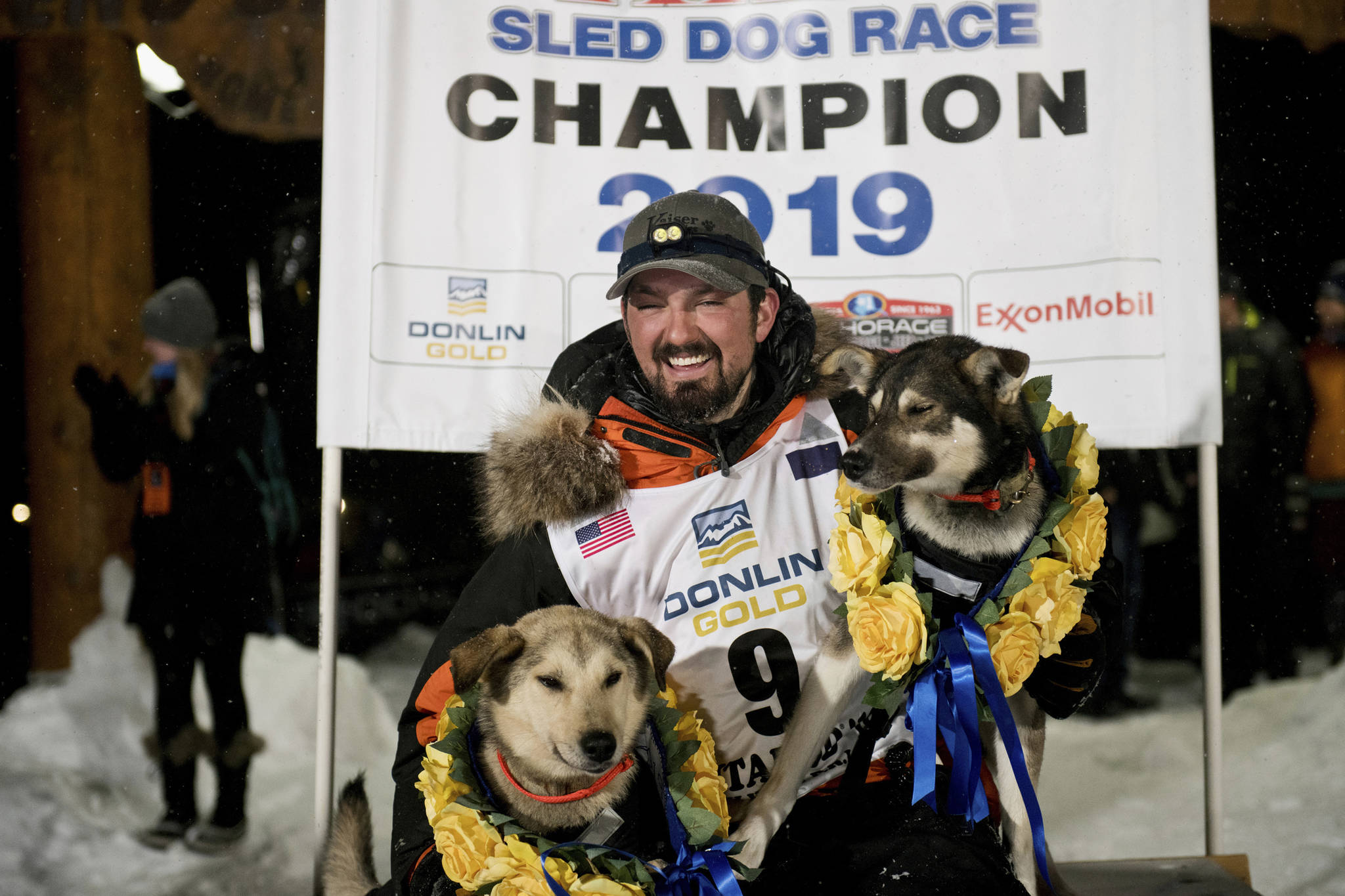
Peter Kaiser poses with his lead dogs, Morrow, left, and Lucy on Wednesday, March 13, 2019, in Nome, Alaska, after winning the Iditarod Trail Sled Dog Race. It’s the first Iditarod victory for Kaiser in his 10th attempt. (Marc Lester | Anchorage Daily News)

Peter Kaiser poses with his lead dogs, Morrow, left, and Lucy on Wednesday, March 13, 2019, in Nome, Alaska, after winning the Iditarod Trail Sled Dog Race. It’s the first Iditarod victory for Kaiser in his 10th attempt. (Marc Lester | Anchorage Daily News)

Alaska Native wins Iditarod sled dog race

Pete Kaiser crosses finish line in Nome after beating back a challenge from defending champion

  • By MARK THEISSEN ASSOCIATED PRESS
  • Wednesday, March 13, 2019 12:59pm
  • NewsSports

ANCHORAGE — A young Pete Kaiser had the drive to learn about racing sled dogs and the family and community to support his passion. Years later, he won his first Iditarod Trail Sled Dog Race.

Growing up, Kaiser had plenty of sled dogs to choose from at his parents’ kennel in Bethel, a rural community in southwest Alaska. He got his first taste of success as a senior in high school when he won a 65-mile race. From there, the competitions and prizes kept getting bigger.

On Wednesday, the 31-year-old captured the crowning glory in the sport, the Iditarod, a grueling test against the wildest terrain Alaska has to offer. Kaiser crossed the finish line in the Gold Rush town of Nome after beating back a challenge from the defending champion, Joar Ulsom of Norway.

[Multiple Crimson Bears make Region V all-academic and all-conference]

Ulsom finished the race just 12 minutes after Kaiser, who took 9 days, 12 hours, 39 minutes and 6 seconds to complete the 1,000-mile journey over two mountain ranges, along the frozen Yukon River and across the treacherous, wind-swept Bering Sea coast.

It’s Kaiser’s first Iditarod victory in his 10th try. He said he wasn’t sure what made everything come together for him this year.

“Just years of knowledge gained and trying to put it all together to have a better race, better dog team this year — every little detail coming into play,” he said in a post-victory interview televised from the finish line.

Kaiser became the fifth Alaska Native and first Yupik musher to win the world’s most famous sled dog race.

Veteran Iditarod musher Mike Williams Sr. has been friends with the Kaiser family and watched Pete’s career progress. His victory lifts up not only the Yupik people but all southwest Alaska, Williams said.

“It’s going to make 35,000 people proud,” Williams said. “I think he’s going to be a great representative for us.”

A large group of residents from Bethel, Kaiser’s hometown, flew in to see his victory. Alaska Native dancers and drummers performed near the finish line as they waited for Kaiser to arrive, even though it was past 3 a.m.

Kaiser called the support “extremely humbling, and it motivates me every day to perform to my best, and I just want to thank them for coming out here tonight.”

When he was young, Kaiser went to races like the Kuskokwim 300, an annual mid-distance race in Bethel, to learn everything he could from the mushers.

That includes Ed Iten, a veteran musher whose best Iditarod finish was second place in 2005.

“He was a young boy then and came over and helped me feed the dogs,” Iten said. “Then he went from helping out when I was in Bethel feeding my dogs to eventually whipping my butt in the Kusko 300, so he’s a quick study.”

Kaiser, who counts Iten as his mentor, went on to win four Kuskokwim 300 races.

“It just couldn’t be better,” Iten said of Kaiser’s Iditarod victory. “We’ve been waiting for this. There’s been no doubt in my mind that he was going to get it sooner or later.”

Dogs are in the Kaiser family’s blood. Pete’s father, Ron, raced dogs for a few years and then kept an active kennel. His mother, Janet, managed the Kuskokwim 300.

Kaiser, who is married with two children, mushes in the winter and gets seasonal summer jobs on top of managing the kennel.

Sled dog races don’t have lucrative jackpots — Kaiser picked up about $50,000 and a new truck for winning the world’s premier competition. The prize money is down about $20,000 from what the 2017 winner received.

This year’s race was marked by the stunning collapse of Frenchman Nicolas Petit, who was seemingly headed for victory as late as Monday. He had a five-hour lead until his dog team stopped running.

Petit said one dog was picking on another during a rest break, and he yelled at the dog to knock it off. At that point, the entire team refused to run. He had to withdraw.

Fifty-two mushers began this year’s race. Petit was among 10 who withdrew.

The 2019 race came during a bruising two-year stretch for the Iditarod that included a dog doping scandal and the loss of national sponsors amid protests by animal rights activists.

People for the Ethical Treatment of Animals is the biggest critic.

“Hundreds of dogs (including six from Pete Kaiser’s team) were so sick, exhausted, or injured that they were pulled from the race, forcing the ones remaining to work even harder, struggling on in what is a grueling test — not of human endurance but of a dog’s ability to survive extreme cruelty,” PETA Executive Vice President Tracy Reiman said in a statement after Kaiser’s victory.


• This is an Associated Press report by Mark Theissen.


More in Sports

Senior Juneau-Douglas High School: Yadaa.at Kalé hockey players were recognized at the Treadwell Arena on Friday, Jan. 23, 2026 before the Crimson Bears faced the Homer High School Mariners. Head coach Matt Boline and assistant coaches Mike Bovitz, Luke Adams, Jason Kohlase and Dave Kovach honored 11 seniors. (Chloe Anderson / Juneau Empire)
JDHS celebrates hockey team’s senior night with sweeping victory over Homer

The Crimson Bears saw an 8-2 victory over the Mariners Friday night.

Photo by Ned Rozell
Golds and greens of aspens and birches adorn a hillside above the Angel Creek drainage east of Fairbanks.
Alaska Science Forum: The season of senescence is upon us

Trees and other plants are simply shedding what no longer suits them

Things you won’t find camping in Southeast Alaska. (Jeff Lund/Juneau Empire)
I Went to the Woods: Sodium and serenity

The terrain of interior Alaska is captivating in a way that Southeast isn’t

An albacore tuna is hooked on a bait pole on Oct. 9, 2012, in waters off Oregon. Tuna are normally found along the U.S. West Coast but occasionally stray into Alaska waters if temperatures are high enough. Sport anglers catch them with gear similar to that used to hook salmon. (Photo provided by the National Oceanic and Atmospheric Administration/West Coast Fisheries Management and Marine Life Protection)
Brief tuna bounty in Southeast Alaska spurs excitement about new fishing opportunity

Waters off Sitka were warm enough to lure fish from the south, and local anglers took advantage of conditions to harvest species that make rare appearances in Alaska

Isaac Updike breaks the tape at the Portland Track Festival. (Photo by Amanda Gehrich/pdxtrack)
Updike concludes historic season in steeplechase heats at World Championships

Representing Team USA, the 33-year-old from Ketchikan raced commendably in his second world championships

A whale breaches near Point Retreat on July 19. (Chloe Anderson/Juneau Empire)
Weekly Wonder: The whys of whale breaching

Why whales do the things they do remain largely a mystery to us land-bound mammals

Renee Boozer, Carlos Boozer Jr. and Carlos Boozer Sr. attend the enshrinement ceremony at the Naismith Basketball Hall of Fame in Sprinfield, Massachusetts, on Saturday, Sept. 6, 2025. As a member of the 2008 U.S. men's Olympic team, Boozer Jr. is a member of the 2025 class. (Photo provided by Carlos Boozer Sr.)
Boozer Jr. inducted into Naismith Hall of Fame with ‘Redeem Team’

Boozer Jr. is a 1999 graduate of Juneau-Douglas: Yadaa.at Kale

Photo by Martin Truffer
The 18,008-foot Mount St. Elias rises above Malaspina Glacier and Sitkagi Lagoon (water body center left) in 2021.
Alaska Science Forum: The long fade of Alaska’s largest glacier

SITKAGI BLUFFS — While paddling a glacial lake complete with icebergs and… Continue reading

Photo by Jeff Lund/Juneau Empire
The point of fishing is to catch fish, but there are other things to see and do while out on a trip.
I Went to the Woods: Fish of the summer

I was amped to be out on the polished ocean and was game for the necessary work of jigging

A female brown bear and her cub are pictured near Pack Creek on Admiralty Island on July 19, 2024. (Chloe Anderson for the Juneau Empire)
Bears: Beloved fuzzy Juneau residents — Part 2

Humor me for a moment and picture yourself next to a brown bear

Isaac Updike of Ketchikan finished 16th at the World Championships track and field meet in Budapest, Hungary, on Tuesday. (Alaska Sports Report)
Ketchikan steeplechaser makes Team USA for worlds

Worlds are from Sept. 13 to 21, with steeplechase prelims starting on the first day

Old growth habitat is as impressive as it is spectacular. (Photo by Jeff Lund/Juneau Empire)
I Went to the Woods: The right investments

Engaged participation in restoration and meaningful investment in recreation can make the future of Southeast special