
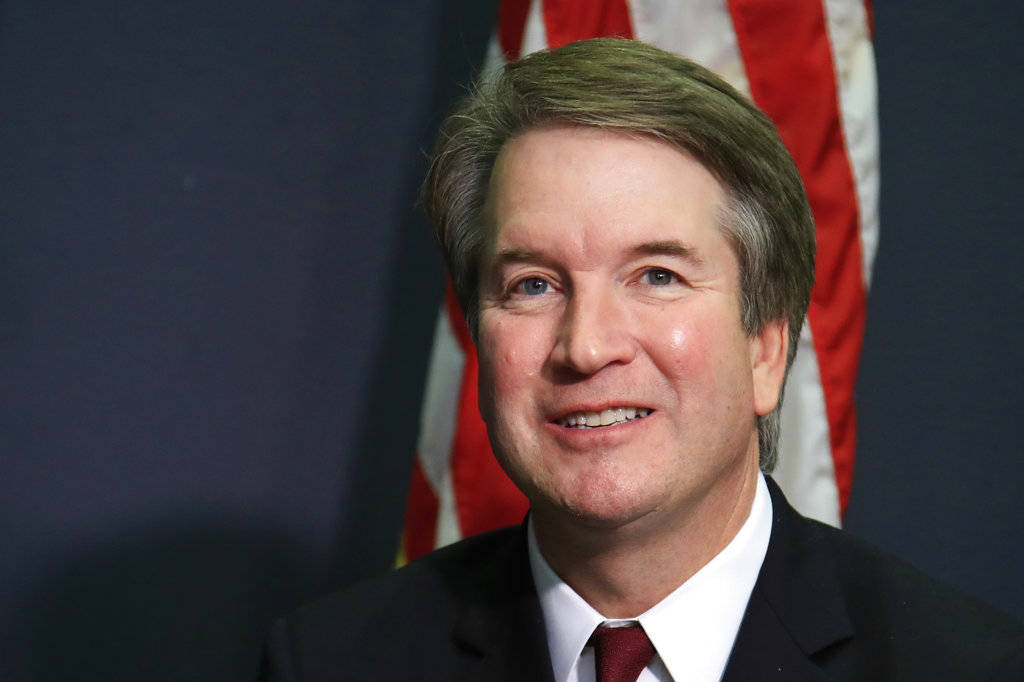
On the “Judicial Common Space” scale of the Supreme Court, President Donald Trump’s nominee Brett Kavanaugh is far right of Justices Samuel Alito and Neil Gorsuch and just left of Justice Clarence Thomas. Weighing the court so heavily could reverse environmental and consumer protections, eliminate special councils and immunize a sitting president from even investigation. As important as these issues are, one that affects half the nation’s population is most important, women’s rights. It alone is ample reason for Sen. Lisa Murkowski, R-Alaska, to vote no on the nomination of Brett Kavanaugh.
In a 2017 speech, Kavanaugh told the American Enterprise Institute that from his time in Yale Law School in 1987, he stood with Justice William Rehnquist, calling him “my first judicial hero.” He said he agreed with Rehnquist in five areas, “criminal procedure, religion, federalism, unenumerated rights and administrative law.” The area of foremost concern is “unenumerated rights” because within these Judge Kavanaugh counts Roe v. Wade, the bedrock of women’s reproductive rights.
The judge said he agreed with Rehnquist’s dissent against this 1972 landmark case. Easily found on the internet, this dissent reveals Rehnquist opining on how Roe probably didn’t even qualify as a plaintiff. But even if she did, he wrote, she had no exclusive privacy right because “a valid state objective” could trump it. And she did not have this right for another reason: the framers of the constitution had no concept of the idea of reproductive decision making. So since the state could outweigh this individual right and since the framers had no concept of it, women have no constitutional right to it.
Judge Kavanaugh recently demonstrated agreement with the Rehnquist dissent in an October 2017 case involving a 17-year-old immigrant. Seeking asylum, she crossed the U.S. border, found herself pregnant, and wanting to address it, applied for legal bypass. This requires a minor to show a judge that she is mature and sufficiently well informed to make a reproductive decision. She was granted permission under Texas law, but the U.S. government denied her Roe v. Wade right, which as a “person” she is granted by the U.S. Constitution. With legal aid, she appealed to the D.C. Court but was denied relief by a panel of two of three judges, one of whom was Kavanaugh. Appealing to the full court, the appellee prevailed in asserting her constitutional right to make a reproductive choice and have access to fulfilling it.
Kavanaugh composed a bitter dissent patterned on that of Rehnquist’s. He wrote that the court “badly erred” because it granted a new unenumerated right in the constitution. The judge wanted the minor to be transferred to the household of a government-approved sponsor so that she could have adult council about her decision.
The judge believed the stay appropriate because “the Government has permissible interests in favoring fetal life, protecting the best interests of a minor, and refraining from facilitating abortion.” The first two points are Kavanaugh’s personal opinions, not law, and the third was known by him not at all to be the case. Fortunately for the appellee, the full court found that locating a sponsor, going to live with that stranger, and being able to confide in him or her on such a personal matter would cause excessive delay and undue burdens.
Murkowski has said she will study Kavanaugh’s qualifications. She also said that she will give weight to what Alaskans have to say. The judicial subject addressed above is the prominent tip of an iceberg goliath beneath the surface. It deserves a flashing red light, and so do the many others surrounding it. They all pose dangers to the shipping lanes of American life. The judge favors the dissents of Justice Rehnquist, his “judicial hero” since 1987. Judge Kavanaugh poses many judicial dangers to the personal freedoms, rights, security and safety of Americans, but the one with the broadest impact is the threat to women’s rights. The judge has just reinforced his disregard and disrespect, if not animosity, for them. For this reason, but also many others, Murkowski should vote no on the nomination of Kavanaugh.
• Art Petersen is a 43-year resident of Juneau, retired from the University of Alaska Southeast. My Turns and Letters to the Editor represent the view of the author, not the view of the Juneau Empire.
