
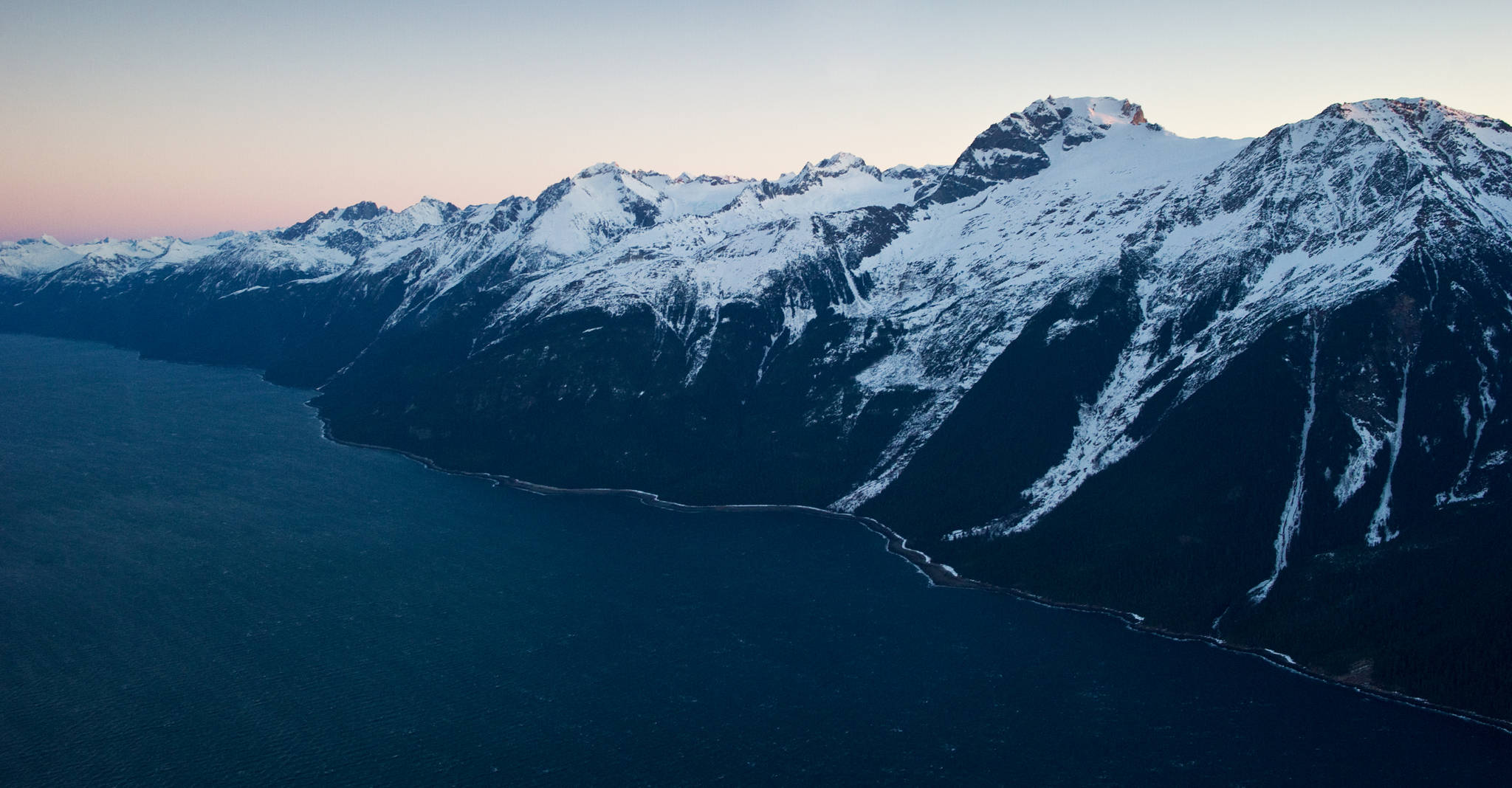
Last week the Federal Highway Administration endorsed Governor Bill Walker’s decision not to construct a road up Lynn Canal. The formal record of decision sent the project into a politically induced coma. Whenever it’s resurrected, and by all indications it will be, state officials need to come clean about the project’s long-term objectives. Because any decision to build the road will likely be followed by a lawsuit to stop it.
Just like it was a decade ago.
“The analysis reveals a clear bias toward road construction and a concerted effort to ignore public sentiment.” That was a joint statement made by the Southeast Alaska Conservation Society, the Alaska Transportation Priorities Project and the Auk Kwaan in March 2006. It was made in response to the final environmental impact statement published by the Department of Transportation. Like now, the preferred alternative was to build a road that would connect travelers to Haines and Skagway via shuttle ferries at Katzehin.
A highway extension that ended at Katzehin had not been ADOT’s preferred alternative until that time. They’ve wanted to build the road all the way to Skagway ever since the Klondike Highway was completed in 1979. But, as the Empire pointed out in a November 2014 editorial, the law prohibited spending federal funds to construct “a road into a national landmark if a viable alternative exists.”
That landmark is the portion of the Klondike National Historical Park on the east side of Lynn Canal.
The editorial board at the Empire didn’t support the project ending at Katzehin. They wanted “the whole road.” If it was built, they argued with good reason, “we suspect the state will return to the drawing board in a few years and try to gain support for the second half of the road — this time built with state money in order to avoid National Park Service objections.”
That’s exactly what advocates of the road believe. “The road will ultimately go to Skagway,” Denny DeWitt, the director of the First Things First Foundation, told the Empire last week while calling the FHWA decision “another slight delay in moving forward toward that end.” And it was the inevitability touted by Win Gruening a few months ago when he wrote about a transportation poll commissioned by DeWitt’s group.
If that is the ultimate goal, then ADOT began its 2014 environmental analysis knowing the road to Katzehin would be the preferred alternative. Even if they didn’t cook the books, so to speak, that bias still could have generated data and findings unjustly supportive of their predetermined conclusion. And because they weren’t compatible with that end objective, the benefits of other alternatives couldn’t have been taken seriously.
Most federally funded projects follow a similar trajectory. They begin with the intent to build what’s deemed the best solution to a problem. Other alternatives are only developed to comply with the National Environmental Protection Act.
That may sound like a bureaucratic process that results in unnecessary delays and a waste of taxpayer money. But it’s intended to ensure legitimate concerns about controversial projects aren’t ignored. Think of it as how NEPA makes the people the check and balance on its government’s actions.
That’s why the 2006 is so instructive. SEACC eventually sued the state and won. The courts agreed that ADOT failed to consider an improved marine highway alternative using existing ferries and terminals.
And as we’ve learned from the 2014 analysis, the complainants were also correct that ADOT had badly underestimated the cost of construction. The $273 million price tag then is now $680 million.
Another concern was ADOT had overestimated the benefits of the proposed road. Those are intrinsically related to the traffic demand which is more disputed now than in 2006. Which side is right doesn’t matter right now because the “no action” alternative was selected. But that and every other contentious issue will come alive again whenever the project is revived.
The “continued public controversy” that influenced this record of decision is here to stay. It’s why any decision to build the road won’t likely proceed without a lawsuit. And if ADOT hopes to convince the courts their analysis wasn’t biased, they’ll have to be able to prove they have no intention of ever constructing a highway between Katzehin and Skagway.
• Rich Moniak is a Juneau resident and retired civil engineer with more than 25 years of experience working in the public sector. He contributes a weekly “My Turn” to the Juneau Empire. My Turns and Letters to the Editor represent the view of the author, not the view of the Juneau Empire.
